


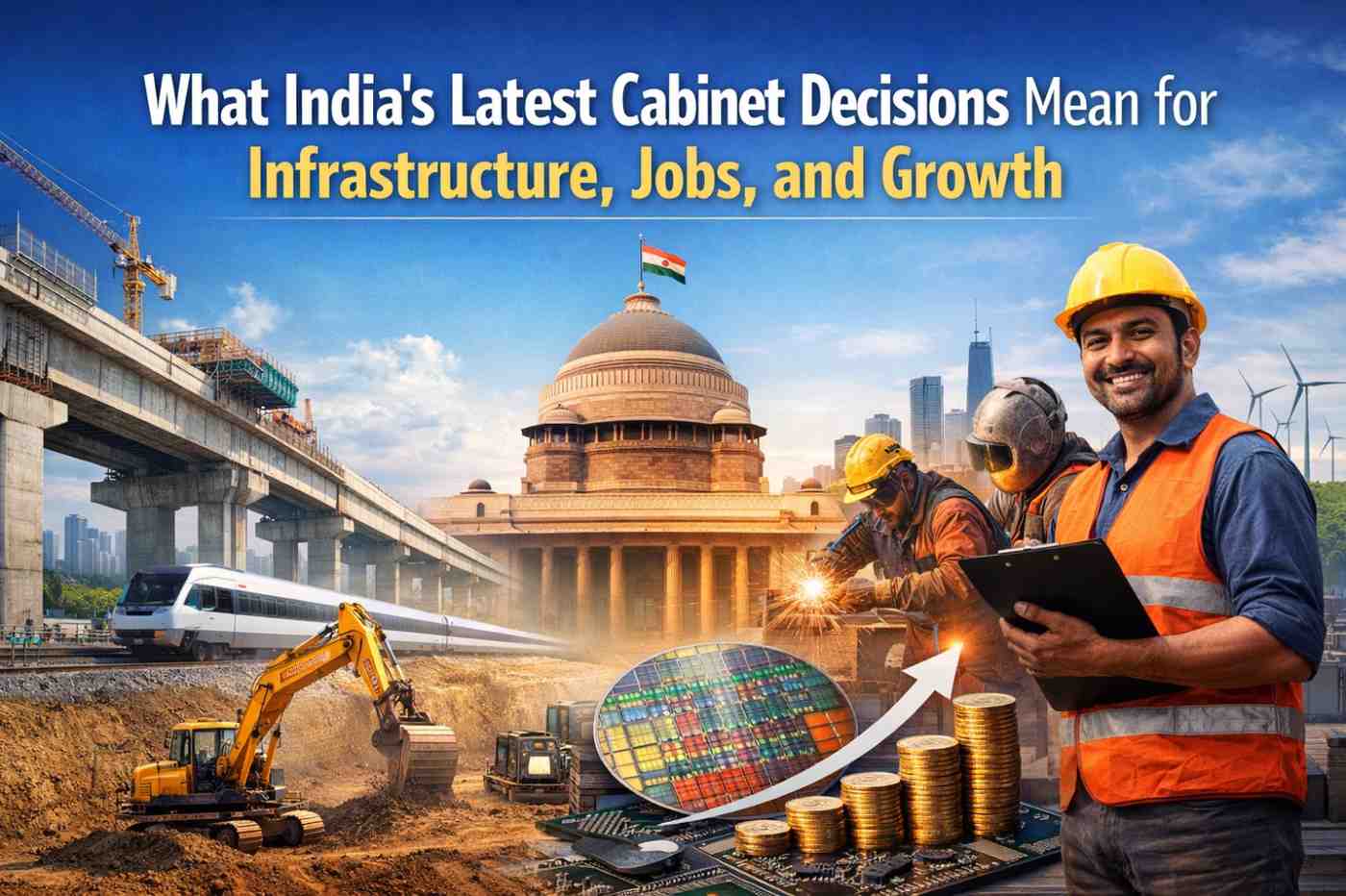
India’s economic direction over the next few years will be shaped not just by budget announcements, but by the steady stream of policy approvals coming from the Union Cabinet. In its latest round of decisions, the Cabinet has cleared a set of measures focused on infrastructure expansion, employment generation, and long-term economic growth—three pillars that remain central to India’s development strategy. While none of the decisions are sudden or disruptive, together they signal continuity in policy priorities and a calibrated push to sustain growth amid global uncertainty.
A Renewed Push on Infrastructure Development
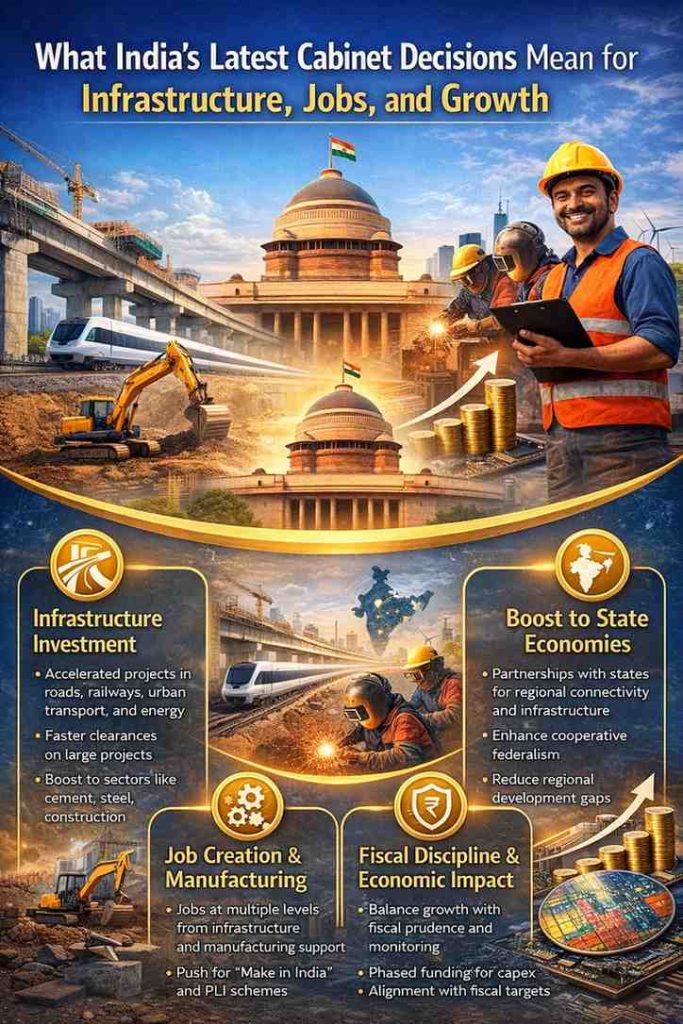
Infrastructure remains at the heart of the government’s economic agenda. Recent Cabinet approvals have focused on accelerating projects related to roads, railways, logistics, urban transport, and the energy sector. The emphasis has been on faster clearances for large-scale transport and connectivity projects, improved coordination between central ministries and state governments, and a sharper focus on time-bound execution to prevent delays and cost overruns.
The government views infrastructure spending as a strong economic multiplier. Large public works improve connectivity and productivity across regions while simultaneously stimulating demand in sectors such as cement, steel, construction, and engineering services. By prioritising execution and closer monitoring, policymakers aim to ensure that capital expenditure results in tangible outcomes on the ground rather than remaining tied up in stalled or delayed projects.
Job Creation Through Capex and Manufacturing
One of the most direct implications of infrastructure-focused Cabinet decisions is employment generation. Large public projects create jobs across skill levels, including opportunities for engineers, technicians, and construction workers, with a significant impact in rural and semi-urban areas where employment opportunities are often limited.
Beyond construction activity, Cabinet decisions continue to support manufacturing-linked incentives, the expansion of industrial corridors, and domestic production in strategic sectors. This approach aligns with the broader “Make in India” vision, where job creation is expected to emerge from a combination of public investment and private sector participation. In this framework, employment generation is not limited to short-term construction work but extends to more stable, long-term roles in manufacturing, logistics, and services.
Boost to State Economies and Regional Balance
Several recent Cabinet approvals involve projects implemented in close partnership with state governments. These include initiatives aimed at improving regional connectivity, upgrading urban infrastructure, and expanding energy capacity. Such measures play a crucial role in addressing long-standing regional development gaps.
States with improved infrastructure are better positioned to attract private investment, industries, and logistics hubs. Over time, this creates a virtuous cycle in which better connectivity and services lead to higher investment, stronger economic activity, and increased employment. These decisions also reinforce the principle of cooperative federalism, with the Centre and states working together to drive growth.
Fiscal Discipline Alongside Growth
A notable feature of the latest Cabinet decisions is the continued emphasis on fiscal prudence. Even as capital expenditure remains a priority, approvals have been structured to ensure phased funding, outcome-based monitoring, and alignment with medium-term fiscal targets.
This balance between growth and discipline is particularly important at a time when global interest rates remain elevated and external economic conditions are uncertain. The government’s approach suggests a focus on the quality and efficiency of spending rather than unchecked expansion, aimed at sustaining growth without undermining macroeconomic stability.
What It Means for the Economy
Taken together, the latest Cabinet decisions underline infrastructure as the primary driver of growth in the near to medium term. Employment generation is being addressed in a structural manner through investment-led development rather than through isolated short-term schemes. At the same time, policy continuity and predictability remain central to India’s economic strategy, offering reassurance to investors and industry.
For businesses, this signals a stable policy environment conducive to long-term planning and investment. For workers and jobseekers, it points to continued opportunities in construction, manufacturing, logistics, and allied sectors. For the broader economy, it suggests steady, if measured, growth driven largely by domestic investment.
The Road Ahead
While Cabinet approvals lay down the policy framework, the real test lies in implementation. Timely execution, effective coordination among agencies, and transparency in outcomes will determine how successfully these decisions translate into growth on the ground.
As India navigates a complex global environment, the latest Cabinet decisions highlight a familiar but deliberate strategy: strengthening infrastructure, supporting job creation, and sustaining economic momentum through consistent and predictable policy action. In that sense, these decisions are less about short-term headlines and more about shaping India’s development trajectory over the coming decade.
(ai generated image used)
Also read – Sundrex Oil Company Limited’s SME IPO Ends on a Positive Note
Add Newsestate.in as preferred source on google – click here