
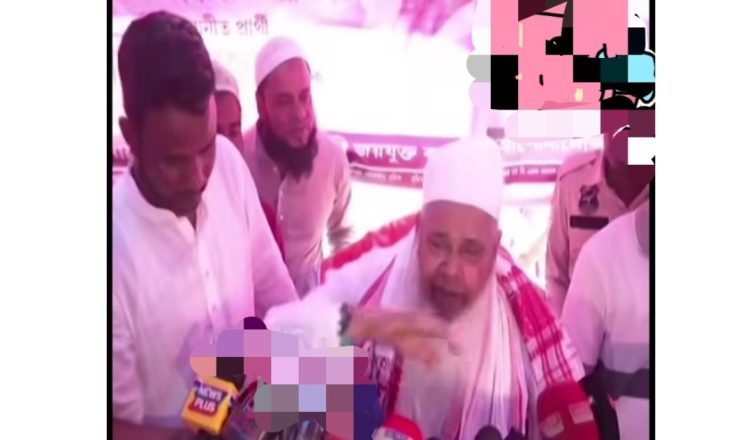
A fresh political controversy has unfolded in Assam after remarks attributed to Badruddin Ajmal, president of the All India United Democratic Front, drew sharp reactions from citizens and political observers alike. The comments, reportedly made during a recent public interaction, included a statement suggesting that “Miya will break the Chief Minister’s backbone,” which has since sparked widespread criticism across the state.
The incident comes at a politically sensitive time, with Assam gearing up for upcoming electoral contests. Public discourse has increasingly focused on the tone and language used by political leaders, with calls for restraint and responsible communication gaining traction.
Key Announcements / Highlights
- Controversial remarks attributed to Badruddin Ajmal have triggered backlash in Assam.
- Citizens and political commentators have termed the language provocative and potentially divisive.
- Concerns have been raised about the impact of such statements on communal harmony.
- References were made to the governance stance of Assam Chief Minister Himanta Biswa Sarma.
- The issue has reignited debate around political rhetoric ahead of elections.
Public Reaction and Political Fallout
The reaction to Ajmal’s alleged statement has been swift and critical. Residents in various parts of Assam expressed discomfort with the tone of the remarks, describing them as inflammatory and not conducive to maintaining social cohesion.
Several individuals voiced concerns that such rhetoric could deepen existing divisions within communities. Assam, known for its complex socio-cultural fabric, has historically witnessed sensitivities around identity and communal issues. As a result, statements perceived as targeting or mobilizing specific groups often attract heightened scrutiny.
Local voices emphasized that political discourse should prioritize unity and development rather than confrontation. “There is no place for threats or aggressive language in a democratic setup,” one resident noted, reflecting a broader sentiment seen across public discussions.
Official and Political Responses
While there has been no immediate detailed clarification from Ajmal in response to the controversy, the remarks have been interpreted by critics as part of a larger pattern of provocative political messaging.
Supporters of the state government pointed to the leadership of Chief Minister Himanta Biswa Sarma, reiterating his emphasis on governance driven by law and institutional authority rather than identity-based pressures.
Public reactions frequently referenced this governance model. Many residents stated that Assam’s administration operates under constitutional principles, and any attempt to assert dominance through rhetoric or threats contradicts democratic norms.
Political observers noted that such controversies often become focal points in election cycles, shaping narratives and influencing voter perception. In this case, the remarks have added to ongoing debates about political accountability and communication standards.
Criticism of Political Style
Critics of Ajmal have gone beyond the specific statement to question his broader political approach. Some have described him as a businessman-turned-politician whose strategies, they argue, rely significantly on identity-driven narratives.
These critics contend that such tactics may resonate with certain voter bases but risk alienating others and undermining social harmony. They argue that political leadership carries a responsibility to foster inclusive dialogue rather than deepen divides.
However, it is important to note that Ajmal remains a significant political figure in Assam, particularly among sections of minority communities. His party, the AIUDF, has maintained a presence in the state’s political landscape, often positioning itself as a voice for underrepresented groups.
Context: Political Climate in Assam
Assam’s political environment has evolved considerably over the past decade. Issues such as citizenship, migration, and identity have played a central role in shaping electoral debates.
The rise of the Bharatiya Janata Party (BJP) in the state, under leaders like Himanta Biswa Sarma, has been accompanied by a strong focus on governance, infrastructure development, and law enforcement.
At the same time, opposition parties, including the AIUDF, have sought to consolidate support among specific demographic groups. This dynamic has often led to sharp exchanges and heightened political rhetoric.
Experts note that such an environment increases the likelihood of controversies, particularly when statements are interpreted through the lens of communal or identity politics.
Why This Matters
The controversy surrounding Ajmal’s remarks is significant for several reasons:
1. Impact on Social Harmony
Assam is home to diverse communities with varying cultural, linguistic, and religious identities. Statements perceived as divisive can strain relationships and create tensions at the grassroots level.
2. Electoral Implications
With elections approaching, political messaging becomes more influential. Controversies can shape campaign narratives, influence voter sentiment, and shift public focus from policy issues to personality-driven debates.
3. Standards of Political Discourse
The incident highlights ongoing concerns about the quality of political communication in India. Analysts argue that inflammatory language undermines democratic values and detracts from substantive policy discussions.
4. Governance vs. Identity Politics
The reactions also underscore a broader debate about governance priorities. While some leaders emphasize development and administration, others focus on identity-based representation, leading to differing political approaches.
Public Impact
For ordinary citizens, the controversy raises questions about the direction of political discourse in the state. Many residents expressed a desire for leaders to focus on pressing issues such as employment, infrastructure, education, and healthcare rather than engaging in confrontational rhetoric.
There is also concern about how such statements might influence younger audiences and first-time voters. Political messaging plays a crucial role in shaping perceptions, and repeated exposure to aggressive language can normalize divisive narratives.
Community leaders and civil society groups have increasingly called for restraint, urging politicians across parties to adopt a more responsible tone. They emphasize that maintaining peace and mutual respect should remain a priority, especially in a state with a history of sensitive socio-political dynamics.
Expert Perspective
Political analysts suggest that controversies like this often serve as flashpoints rather than isolated incidents. They reflect deeper tensions within the political system, including competition for voter bases and differing ideological positions.
Some experts argue that such remarks may be strategically employed to mobilize support or draw attention. However, they caution that the long-term consequences can outweigh short-term political gains, particularly if they contribute to polarization.
Others highlight the role of media and public discourse in amplifying these issues. In an era of rapid information dissemination, statements can quickly gain traction, making it essential for political leaders to exercise caution.
Calls for Responsible Leadership
Across Assam, there has been a growing call for political leaders to adopt a more measured and constructive approach. Citizens and commentators alike stress the importance of dialogue that prioritizes development, inclusivity, and mutual respect.
The controversy has also prompted discussions about accountability. Many believe that leaders should be held responsible for their words, given their influence on public sentiment and social dynamics.
In this context, the role of institutions, including political parties and regulatory bodies, becomes crucial in ensuring that standards of conduct are maintained.
The backlash against remarks attributed to Badruddin Ajmal has once again brought the issue of political rhetoric into sharp focus in Assam. As the state moves closer to elections, the incident serves as a reminder of the power of language in shaping public discourse.
While controversies are not uncommon in political life, their handling often determines their broader impact. For Assam, the priority remains maintaining social harmony while fostering a political environment centered on constructive engagement.
In the coming weeks, attention will likely shift to how political parties respond to public sentiment and whether campaign narratives evolve toward more issue-based discussions. The incident underscores a larger question facing not just Assam but Indian politics as a whole: how to balance competitive electoral dynamics with the responsibility of preserving unity and democratic values.
Inputs and images : Hindusthan Samachar
Edited By E. Devanshi varma
Also Read: BJP Eyes Historic Assam Win with 126 Seats in Focus, Says CM Himanta Biswa Sarma
Follow us on Google News: Click Here
Last Updated on: Friday, March 27, 2026 2:41 pm by E. Devanshi Varma | Published by: E. Devanshi Varma on Friday, March 27, 2026 2:41 pm | News Categories: India
About The Author
