
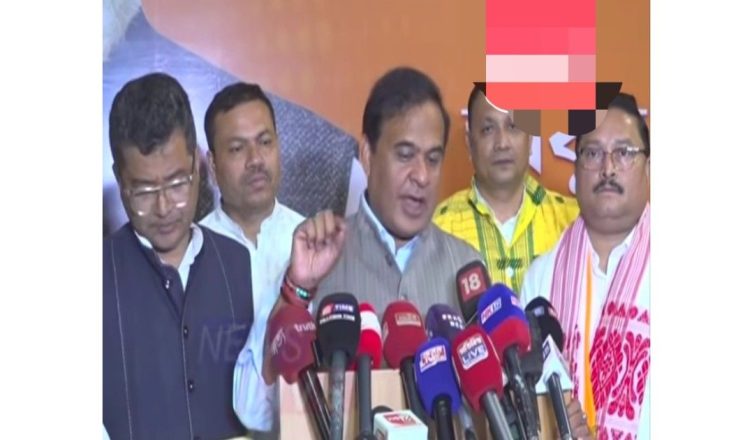
Guwahati, March 27: Assam Chief Minister Himanta Biswa Sarma on Friday projected strong confidence in a decisive electoral victory for the Bharatiya Janata Party (BJP) in the upcoming state assembly elections. Speaking during ongoing campaign activities, Sarma said that widespread public support and extensive grassroots mobilisation have placed the party in a strong position across the state’s 126 constituencies.
Polling for all seats is scheduled for April 9, according to the Election Commission of India, with vote counting set to take place on May 4.
Strong Campaign Response Boosts BJP Confidence
Addressing the media, Sarma highlighted what he described as an “overwhelming response” from voters during the BJP’s outreach initiatives, particularly the Vijay Sankalp Yatra. The campaign, which has covered multiple districts, was designed to connect directly with voters, communicate the party’s governance record, and outline its vision for the state’s future.
According to the Chief Minister, the turnout at campaign events and public meetings reflects a growing consolidation of support in favour of the ruling party. He noted that large crowds and positive feedback from residents across both urban and rural regions have reinforced the BJP’s belief that it is heading toward a significant electoral mandate.
Sarma also pointed to the party’s organisational readiness, emphasizing the role of booth-level workers and local leadership in strengthening voter engagement. He suggested that this combination of grassroots mobilisation and central leadership backing has helped the BJP maintain a competitive edge in the state’s political landscape.
Focus on Governance and Development Narrative
A key element of the BJP’s campaign in Assam has been its focus on governance, infrastructure development, and welfare initiatives. While Sarma did not detail specific schemes during his remarks, the party has consistently highlighted improvements in sectors such as road connectivity, healthcare access, education, and law enforcement.
Political observers note that the BJP’s electoral messaging in Assam has increasingly centered on continuity and stability, positioning the party as a reliable choice for sustained development. This narrative is aimed at appealing to both first-time voters and those who have supported the party in previous elections.
Sarma’s comments reflect this broader strategy, as he framed the upcoming election as a referendum on the government’s performance and future direction. By emphasizing achievements and ongoing initiatives, the BJP is seeking to consolidate its existing voter base while also attracting undecided voters.
Sharp Criticism of Political Opponents
Alongside projecting confidence in his party’s prospects, Sarma also directed criticism toward opposition leaders, particularly Badruddin Ajmal of the All India United Democratic Front (AIUDF). He accused certain opposition forces of acting against the broader interests of Assam, though he did not provide specific examples during his remarks.
The Chief Minister asserted that the BJP has already countered what he described as “negative influences” in the state’s political environment. He added that any remaining challenges would be addressed in the next phase of the campaign, suggesting a continued focus on countering opposition narratives.
Such statements indicate that the election is likely to witness intensified political rhetoric in the coming days, as parties attempt to differentiate themselves and appeal to voters across diverse demographics.
Electoral Timeline and Process
The Election Commission of India has announced that polling for all 126 assembly constituencies in Assam will take place on April 9. The single-phase voting process is expected to involve extensive logistical arrangements, given the state’s varied geography and population distribution.
Counting of votes is scheduled for May 4, when the results will determine the composition of the next state government. The outcome will be closely watched, not only for its impact on Assam’s political trajectory but also for its broader implications in national politics.
Election authorities have indicated that adequate security and administrative measures will be in place to ensure a smooth and fair voting process. Voter turnout, as in previous elections, is expected to play a crucial role in shaping the final outcome.
Political Context and Background
Assam has witnessed significant political shifts over the past decade, with the BJP emerging as a dominant force in the state. The party first came to power in 2016, marking a major departure from decades of Congress-led governance. Since then, it has sought to strengthen its position through alliances, policy initiatives, and organisational expansion.
The current election represents another critical test for the BJP, as it aims to retain power while expanding its influence further. For the opposition, including the AIUDF and other regional and national parties, the election presents an opportunity to challenge the ruling party’s dominance and regain political ground.
Issues such as identity, development, migration, and economic growth have historically played a central role in Assam’s electoral politics. These themes are expected to remain prominent in the current campaign as well.
Why This Election Matters
The upcoming Assam assembly election holds significance beyond the state’s borders. As one of the key states in Northeast India, Assam plays a strategic role in regional politics and governance. The election outcome will influence policy direction, administrative priorities, and political alignments in the region.
For the BJP, a strong performance would reinforce its position as a leading political force in the Northeast and validate its governance model in the state. For opposition parties, the election represents a chance to reassert relevance and reshape the political narrative.
From a governance perspective, the results will determine the continuity or change in policy implementation across sectors such as infrastructure, healthcare, education, and social welfare.
Public Impact and Voter Considerations
For voters in Assam, the election is an opportunity to assess the performance of the current government and decide on the state’s future direction. Key considerations are likely to include:
- Development outcomes: Infrastructure improvements, job creation, and economic growth
- Public services: Access to healthcare, education, and welfare schemes
- Law and order: Safety and security across the state
- Regional identity issues: Policies related to culture, language, and migration
The BJP’s campaign, as reflected in Sarma’s remarks, is focused on highlighting achievements and promising continued progress. Meanwhile, opposition parties are expected to emphasize gaps in governance and propose alternative approaches.
Campaign Intensifies Ahead of Polling Day
With less than two weeks remaining before voting, political activity in Assam is expected to intensify further. Campaign rallies, roadshows, and voter outreach programmes are likely to increase in frequency as parties make their final push to secure support.
Sarma’s confident tone suggests that the BJP is aiming to maintain momentum in the final phase of campaigning. However, electoral outcomes often depend on multiple factors, including voter turnout, last-minute shifts in public sentiment, and local-level dynamics.
Political analysts caution that while pre-election projections provide insight into party strategies, the final verdict ultimately rests with the electorate.
Conclusion
As Assam heads toward polling on April 9, the political landscape is marked by heightened activity and competing narratives. Chief Minister Himanta Biswa Sarma’s assertion of a “historic win” for the BJP reflects the party’s confidence, built on campaign response and organisational strength.
However, with opposition parties actively contesting and key issues at stake, the election remains a closely watched contest. The results on May 4 will not only determine the next government in Assam but also shape the broader political trajectory of the region.
Inputs and images : Hindusthan Samachar
Edited By E. Devanshi varma
Also Read: BJP Raises 3 Key Allegations Over Basanti Violence, Seeks Election Commission Action
Follow us on Google News: Click Here
Last Updated on: Friday, March 27, 2026 2:36 pm by E. Devanshi Varma | Published by: E. Devanshi Varma on Friday, March 27, 2026 2:36 pm | News Categories: India
About The Author
