

India’s journey toward inclusive growth has entered a decisive phase with the rollout of the Divyangjan Kaushal Yojana, a comprehensive skill training initiative designed exclusively for persons with disabilities. The scheme reflects a shift in policy thinking, moving away from welfare-centric approaches toward empowerment through employability, entrepreneurship, and self-reliance. At a time when skills are emerging as the real currency of the job market, the government’s renewed focus on Divyangjan skill development aims to bridge long-standing gaps in access to education, training, and dignified livelihoods.
Why the Divyangjan Kaushal Yojana Matters Now
Despite progress in disability rights and awareness, a large section of India’s Divyangjan population remains outside the formal workforce. Limited access to customized training, inaccessible infrastructure, social stigma, and lack of employer readiness have historically restricted opportunities. The Divyangjan Kaushal Yojana seeks to address these challenges holistically by aligning skill development with real market demand while ensuring that training environments are accessible, adaptive, and respectful of diverse abilities.
The timing of the scheme is significant. As industries increasingly adopt digital tools, automation, and flexible work models, new avenues have opened up for persons with disabilities to participate meaningfully in the economy. The scheme is positioned to leverage these shifts rather than letting them widen existing inequalities.
Key Objectives of the Scheme
At its core, the Divyangjan Kaushal Yojana aims to enhance employability and income-generation opportunities for persons with disabilities across urban and rural India. The focus is not merely on short-term training but on building sustainable career pathways. The scheme emphasizes skill certification, industry linkage, and post-training support to ensure that beneficiaries are not left to navigate the job market alone after completing their courses.
Another critical objective is social inclusion. By integrating Divyangjan candidates into mainstream skill ecosystems, the scheme challenges stereotypes and promotes the idea that disability is not an inability, but a different ability that can contribute productively to society.
Who Is Eligible Under the Divyangjan Kaushal Yojana
The scheme is open to persons with benchmark disabilities as defined under the Rights of Persons with Disabilities Act, 2016. This includes individuals with physical, sensory, intellectual, and multiple disabilities who meet the prescribed disability criteria. The age group typically targeted ranges from young adults entering the workforce to older individuals seeking reskilling or upskilling, ensuring that opportunities are not limited to first-time job seekers alone.
Special attention is given to women with disabilities, persons from economically weaker sections, and those residing in aspirational districts or remote areas where access to training has traditionally been limited.
Types of Skills Covered Under the Scheme
The Divyangjan Kaushal Yojana offers a wide spectrum of skill training programs tailored to different categories of disabilities. Courses span traditional trades as well as emerging sectors. Training modules include information technology and digital services, data entry and office automation, tailoring and garment making, handicrafts, food processing, beauty and wellness, electronics repair, and assistive technology services.
In line with evolving market trends, the scheme also promotes training in areas such as e-commerce operations, digital marketing support roles, customer relationship management, and remote service delivery. These sectors are particularly relevant as they allow flexible and work-from-home options, which can be crucial for many persons with disabilities.
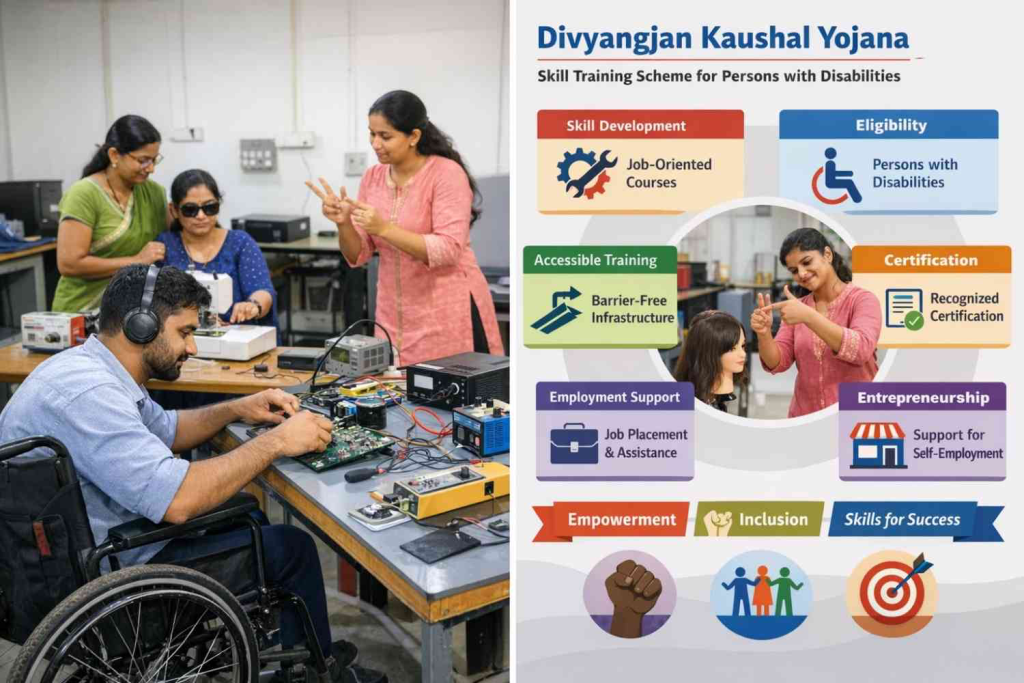
Accessible and Adaptive Training Infrastructure
One of the defining features of the Divyangjan Kaushal Yojana is its emphasis on accessibility. Training centers under the scheme are required to comply with accessibility norms, including barrier-free entry, accessible toilets, appropriate signage, and assistive devices. Course material is adapted into formats such as Braille, large print, audio, and sign language interpretation where required.
Trainers are sensitized and, in many cases, specially trained to work with Divyangjan learners. This focus on adaptive pedagogy ensures that the learning process is inclusive rather than exclusionary, allowing participants to progress at a pace that suits their individual needs.
Certification and Industry Recognition
Successful completion of training under the Divyangjan Kaushal Yojana leads to recognized certification, often aligned with national skill qualification frameworks. This certification plays a crucial role in enhancing credibility in the job market and reducing bias during recruitment.
The scheme actively encourages partnerships with industry bodies, private companies, and public sector undertakings. These collaborations help ensure that training curricula remain relevant and that employers are prepared to absorb trained candidates into suitable roles.
Employment, Placement, and Entrepreneurship Support
Beyond training, the scheme places strong emphasis on outcomes. Placement assistance is a key component, with training providers expected to facilitate job interviews, workplace adjustments, and onboarding support. In cases where wage employment may not be feasible or preferred, the scheme also promotes self-employment and entrepreneurship.
Beneficiaries interested in starting their own ventures receive guidance on business planning, access to credit, and linkage with government schemes that support micro and small enterprises. This approach recognizes that self-employment can often offer greater flexibility and autonomy for persons with disabilities.
Financial Support and Cost Coverage
Training under the Divyangjan Kaushal Yojana is largely subsidized or fully funded, reducing financial barriers for participants. In many cases, stipends are provided to cover basic expenses during the training period. Support for assistive devices, transportation, and accommodation may also be extended depending on the nature of the course and the needs of the trainee.
By addressing both direct and indirect costs, the scheme aims to ensure that financial constraints do not prevent eligible candidates from participating.
Implementation and Monitoring Mechanism
The scheme is implemented through a network of government institutions, recognized training partners, and non-governmental organizations with proven expertise in disability-focused education. Regular monitoring, audits, and feedback mechanisms are built into the framework to maintain quality and accountability.
Digital platforms are increasingly being used for enrollment, tracking progress, and grievance redressal, making the process more transparent and accessible for beneficiaries and their families.
Challenges and the Road Ahead
While the Divyangjan Kaushal Yojana represents a significant step forward, challenges remain. Awareness about the scheme is still uneven, particularly in rural and semi-urban areas. Employer sensitization and workplace accessibility continue to require sustained effort. Ensuring consistent quality across training centers is another ongoing concern.
However, the scheme’s comprehensive design and inclusive intent provide a strong foundation. With continued policy support, adequate funding, and active participation from industry and civil society, the Divyangjan Kaushal Yojana has the potential to transform the skill and employment landscape for persons with disabilities.
A Step Toward Dignity Through Skills
Ultimately, the Divyangjan Kaushal Yojana is more than a training program. It is a statement of intent that economic participation and dignity of work are fundamental rights for all citizens, regardless of physical or mental ability. By investing in the skills of persons with disabilities, India moves closer to an economy that values talent over limitations and inclusion over exclusion.
Add newsestate.in as a preferred source on google – click here
Last Updated on: Tuesday, February 3, 2026 10:27 am by News Estate Team | Published by: News Estate Team on Tuesday, February 3, 2026 10:27 am | News Categories: Trending
About The Author
