

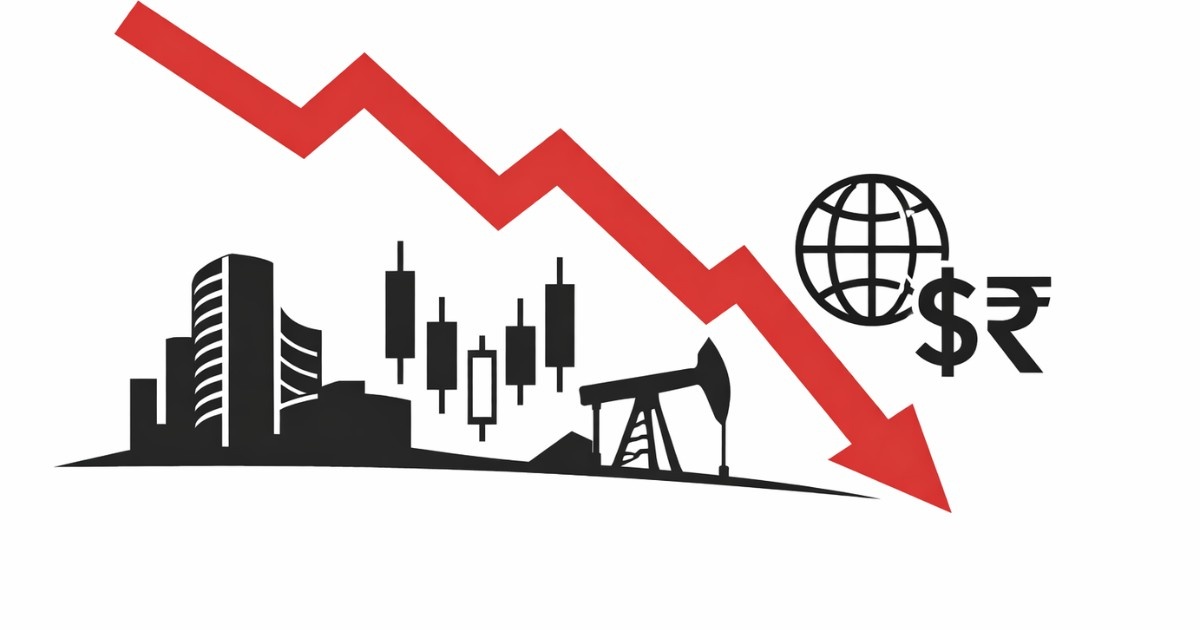
India’s benchmark indices, the Sensex and the Nifty 50, are trading with caution as global geopolitical tensions continue to shape investor mood. Market participants are closely watching developments in the Middle East, changes in global crude oil prices, foreign investor activity, and signals from major central banks.
The current situation matters because India’s stock market is deeply connected to global trade, oil imports, and foreign capital flows. When global uncertainty rises, investors tend to reduce risk. This often leads to sharp swings in equity markets.
In recent sessions, both the BSE Sensex and the NSE Nifty 50 have shown intraday volatility. While domestic fundamentals remain stable, global factors are influencing short-term sentiment.
Global Geopolitics Add Fresh Pressure on Equity Markets
Geopolitical tensions remain a key concern for global markets. Any rise in conflict risk can affect oil supply, currency movement, and global trade flows.
For India, this is important because:
- India imports a large share of its crude oil
- Higher oil prices can increase inflation
- Inflation can affect interest rate decisions
- Higher rates may impact corporate earnings
Even a small rise in crude oil prices can lead to nervousness in banking, auto, and consumer stocks.
Market experts say investors are reacting quickly to headlines related to international conflicts. This has increased short-term volatility in both large-cap and mid-cap stocks.
India’s Crude Oil Prices Remain a Key Trigger
Brent crude prices have seen fluctuations in recent days due to supply concerns and global uncertainty.
For Indian markets, crude oil is a critical factor because:
- Higher oil prices increase import bills
- The rupee may weaken against the US dollar
- Transport and logistics costs may rise
- Corporate margins may shrink
Sectors such as aviation, paints, oil marketing companies, and logistics are directly affected by oil price movements.
If oil sustains at elevated levels, inflation risks may increase. This could reduce hopes of interest rate cuts in the near term.
Foreign Institutional Investors Turn Cautious
Foreign Institutional Investors (FIIs) play a major role in Indian equity markets. When global risk rises, FIIs often pull out funds from emerging markets, including India.
Recent trading sessions have seen mixed FII activity. Even modest selling can create downward pressure because foreign investors hold significant stakes in large-cap companies.
At the same time, Domestic Institutional Investors (DIIs) have continued to provide support by buying quality stocks on dips. This has helped limit deeper corrections.
The tug of war between FIIs and DIIs is keeping the indices range-bound.
Sensex and Nifty: Key Technical Levels to Watch
Technical analysts are closely monitoring important support and resistance zones.
For the Sensex:
- Strong support is seen near recent swing lows
- Resistance remains near previous peak levels
For the Nifty 50:
- Psychological levels are acting as support
- Upside is capped near short-term moving averages
If global conditions improve, markets may attempt a rebound. However, a decisive breakout will depend on sustained buying interest.
Traders are also watching:
- Volatility Index (VIX) movement
- Banking index performance
- IT sector strength
A rise in volatility often signals uncertainty in the near term.
India’s Banking and IT Stocks in Focus
Banking stocks carry heavy weight in both the Sensex and Nifty. Any pressure on banking shares can quickly pull indices lower.
Banks are sensitive to:
- Interest rate outlook
- Bond yields
- Liquidity conditions
Meanwhile, IT stocks are reacting to global demand signals. Since many Indian IT firms earn revenue from the US and Europe, global economic concerns can impact their outlook.
If the US economy slows, IT spending could be affected. This keeps investors cautious in the technology sector.
Rupee Movement Adds Another Layer of Concern
The Indian rupee’s movement against the US dollar is closely linked to global risk sentiment.
When global uncertainty rises:
- Investors shift toward safe-haven assets
- The US dollar strengthens
- Emerging market currencies may weaken
A weaker rupee can increase import costs. This may lead to inflation pressure in the domestic economy.
Currency stability is therefore critical for investor confidence.
Global Central Banks and Interest Rate Signals
Another important factor influencing Indian markets is the policy stance of global central banks.
Investors are watching:
- US Federal Reserve commentary
- Inflation data from major economies
- Bond yield movements
If global central banks signal tighter monetary policy, equity markets may react negatively. Higher global interest rates make risk assets less attractive.
On the other hand, any indication of easing could support equities worldwide, including India.
Domestic Fundamentals Remain Stable
Despite global uncertainty, India’s domestic fundamentals remain relatively stable.
Key supportive factors include:
- Steady corporate earnings in select sectors
- Strong domestic consumption trends
- Infrastructure spending momentum
- Continued retail investor participation
India remains one of the fastest-growing major economies. This provides long-term support to equities.
However, short-term volatility may continue as external risks dominate headlines.
Mid-Cap and Small-Cap Stocks Show Mixed Trends
Mid-cap and small-cap indices have seen sharper swings compared to large caps.
These segments often react strongly to:
- FII selling
- Global headlines
- Profit-booking after rallies
Retail investors should be cautious during volatile periods. Sharp corrections can occur when global sentiment weakens.
Market experts advise focusing on fundamentally strong companies rather than chasing short-term momentum.
What Should Investors Watch Next?
Several key triggers could decide the near-term direction of the market:
- Movement in crude oil prices
- FII inflow or outflow data
- Global geopolitical developments
- US bond yields and dollar index
- Domestic inflation and macroeconomic data
If tensions ease and oil stabilizes, markets may recover gradually.
However, if uncertainty increases, investors may prefer safer assets.
Long-Term Outlook vs Short-Term Volatility
It is important to separate short-term volatility from long-term fundamentals.
Short-term:
- News-driven swings
- Global risk sentiment
- Quick FII reactions
Long-term:
- India’s growth story
- Demographic advantage
- Digital and infrastructure expansion
- Corporate earnings growth
Many analysts believe that while volatility may continue, long-term investors should focus on disciplined allocation rather than reacting to daily fluctuations.
Sectoral View: Defensive vs Cyclical Stocks
During uncertain periods, investors often rotate toward defensive sectors such as:
- FMCG
- Pharmaceuticals
- Utilities
Cyclical sectors like metals, real estate, and capital goods may see more volatility.
Portfolio diversification remains important in such phases.
Market Sentiment Remains Fragile but Not Weak
Current market conditions suggest caution rather than panic.
There is no sign of structural weakness in the Indian economy. However, global developments are influencing short-term trading patterns.
The Sensex and Nifty continue to trade within broader ranges. Breakouts may depend on clarity in global geopolitics and stability in commodity markets.
Conclusion: Cautious Optimism Amid Global Uncertainty
Indian stock markets remain on edge as global geopolitical tensions influence trading patterns. The Sensex and Nifty are reacting to oil prices, foreign investor flows, currency movement, and global central bank signals.
While volatility may persist in the short term, domestic fundamentals offer stability.
Investors are advised to:
- Avoid panic selling
- Focus on quality stocks
- Maintain diversification
- Monitor global developments closely
As global risks evolve, markets will likely continue to adjust quickly to fresh headlines. For now, caution and selective buying appear to define the broader sentiment in Dalal Street.
Edited By: E.Devanshi Varma
Also Read: US Election 2026: 7 Big Poll Changes and Campaign Updates
Follow us on google news: Click Here