

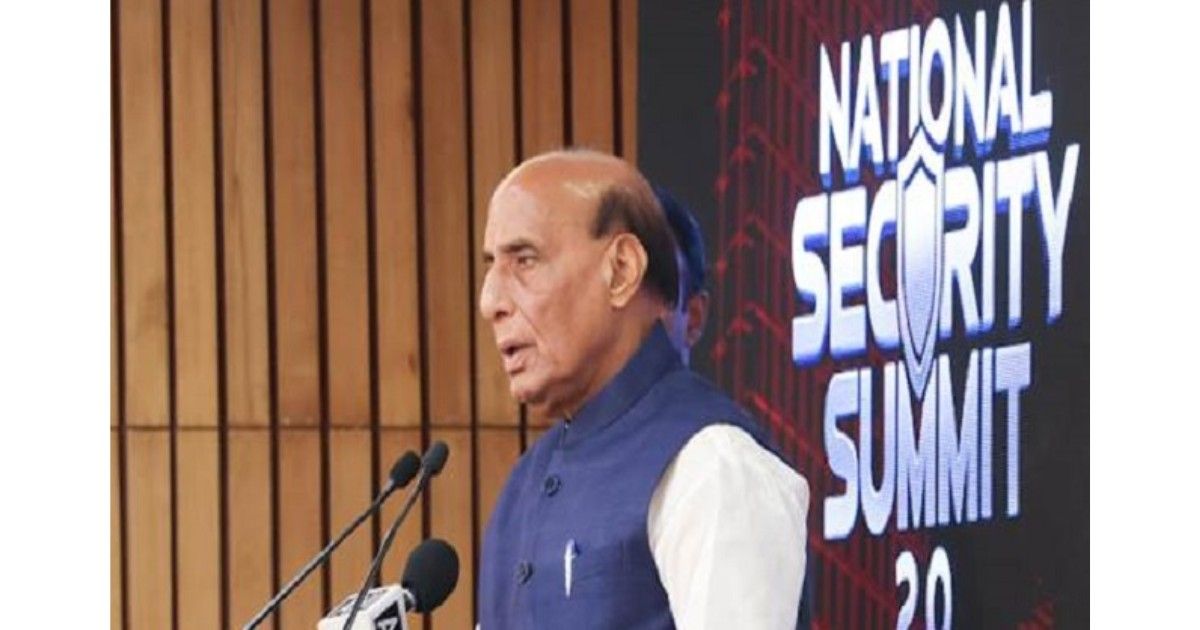
New Delhi, April 30: India’s Defence Minister Rajnath Singh on Thursday used a national security summit in the capital to underline the country’s uncompromising stance on terrorism, asserting that recent military actions—including what he described as Operation Sindoor—demonstrate India’s ability to respond firmly while retaining control over escalation.
Addressing policymakers, security experts and officials, Singh said India has sent a “clear and unambiguous message” to the global community that acts of terror will not be tolerated under any circumstances. He linked this posture to a broader security doctrine that combines military capability with political resolve and strategic restraint.
India’s Assertive Approach to Terrorism
Singh framed terrorism as a threat that goes beyond national borders and security frameworks. According to him, it represents a deeper ideological challenge rooted in distorted thinking that undermines basic human values.
He argued that terrorism should not be viewed narrowly as isolated incidents of violence but as a multidimensional problem with operational, ideological and political layers. Addressing it, therefore, requires coordinated responses across intelligence, diplomacy, internal security and military action.
India, he said, has consistently advocated this comprehensive view at both domestic and international platforms. By doing so, the country seeks to build global consensus against terror networks and their support systems.
The Defence Minister stressed that as long as terrorism persists, it will continue to obstruct global peace, economic development and social stability. He warned that attempts to justify violent acts through religion or ideological movements create dangerous narratives that embolden extremist groups.
Warning Against Linking Terror to Religion or Ideology
A significant portion of Singh’s remarks focused on what he described as the risks of associating terrorism with religion or political ideologies such as Naxalism.
He cautioned that such framing not only distorts the nature of the threat but also provides indirect legitimacy to violent actors. According to him, when terror is given a religious or ideological cover, it becomes harder to isolate perpetrators and dismantle their networks.
Singh described terrorism as a “stain on humanity,” arguing that it violates all norms of civilised society. He added that combating it is not merely a matter of protecting national security but also of defending universal human values.
The minister’s comments reflect a broader policy position that seeks to separate faith and legitimate political expression from extremist violence, thereby preventing radical narratives from gaining wider acceptance.
Operation Sindoor and Military Coordination
Highlighting recent military efforts, Singh referred to Operation Sindoor as an example of India’s operational readiness and strategic clarity. While details of the operation were not elaborated upon in the address, he described it as a demonstration of the country’s ability to act decisively against threats.
He said the operation showcased seamless coordination among the Indian armed forces, including the Army, Navy and Air Force. According to Singh, this level of integration reflects a shift from traditional siloed functioning to a unified military structure capable of executing complex missions.
The Defence Minister noted that India achieved its objectives during the operation without being deterred by provocations or threats, including those involving nuclear rhetoric. This, he suggested, indicates a calibrated approach where strength is combined with restraint.
Singh added that India no longer distinguishes between terrorists and those who support or sponsor them, signalling a tougher stance on cross-border terrorism and its enablers.
Reference to Pakistan and Regional Security Dynamics
Without deviating into detailed geopolitical commentary, Singh made a pointed comparison involving Pakistan, stating that while both India and Pakistan gained independence at the same time, their trajectories have diverged significantly.
He said India has emerged as a global leader in sectors such as information technology, while Pakistan continues to face allegations of being a hub for international terrorism.
The remarks align with India’s long-standing position on cross-border terrorism, particularly concerns over support systems that allow extremist groups to operate.
Singh’s comments also reflect ongoing tensions in the region, where security concerns remain closely tied to diplomatic relations and international perceptions.
Evolution of India’s Counter-Terror Strategy
India’s approach to counter-terrorism has evolved over the past decade, marked by a willingness to undertake targeted military actions when deemed necessary. References to surgical strikes and air strikes in Singh’s speech highlight this shift.
These actions, often framed as precise and limited in scope, are intended to neutralise threats while avoiding broader conflict escalation. Analysts view this as part of a doctrine that combines deterrence with strategic messaging.
At the same time, India has increased its focus on intelligence-sharing, border management and counter-radicalisation efforts. The emphasis on integrated responses reflects lessons learned from past incidents and changing security dynamics.
Singh’s remarks suggest that Operation Sindoor fits within this broader framework, representing continuity rather than a departure in policy.
Why This Matters
The Defence Minister’s statements come at a time when global concerns about terrorism remain high, with evolving threats ranging from lone-wolf attacks to organised networks operating across borders.
India’s emphasis on a zero-tolerance policy and its willingness to act militarily sends a signal not only to adversaries but also to international partners. It reinforces the country’s position as an active participant in global security efforts.
The warning against linking terrorism to religion or ideology also carries domestic implications. In a diverse society like India, maintaining social cohesion while addressing security challenges is a critical balancing act.
By framing terrorism as an ideological aberration rather than a religious or political expression, the government aims to prevent polarisation and ensure that counter-terror measures do not inadvertently deepen divisions.
Public Impact and Security Outlook
For the public, the government’s stance translates into a stronger emphasis on national security preparedness. Increased coordination among armed forces and security agencies is expected to enhance response capabilities in the event of threats.
At the same time, the focus on dismantling ideological support systems may lead to expanded efforts in monitoring online radicalisation, strengthening community engagement and improving intelligence networks.
Singh’s remarks also indicate that India will continue to pursue both domestic and international avenues to counter terrorism. This includes diplomatic engagement, participation in global forums and collaboration with other nations on intelligence and security matters.
The broader message is one of preparedness combined with restraint—asserting that while India is capable of decisive action, it remains committed to stability and controlled escalation.
Looking Ahead
As security challenges evolve, India’s approach is likely to remain anchored in a combination of military readiness, strategic communication and international cooperation. The emphasis on integrated operations suggests continued reforms within the armed forces to improve coordination and efficiency.
Singh’s address at the summit reinforces the idea that counter-terrorism is not a one-dimensional effort but an ongoing process requiring vigilance across multiple fronts.
With references to past operations and current strategies, the speech positions India as a nation determined to protect its interests while contributing to broader global stability.
Inputs and images : Hindusthan Samachar
Edited By E. Devanshi varma
Also Read: Assam Assembly Polls See 7 Major Highlights as Turnout Peaks, Counting Set for May 4
Follow us on Google News: Click Here