
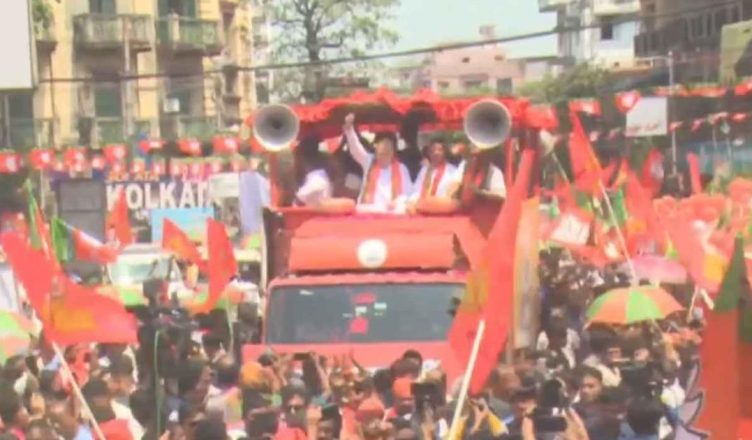
Kolkata, April 2: Union Home Minister Amit Shah on Thursday led a high-profile roadshow in Kolkata, marking a significant political moment ahead of the nomination filing of Bharatiya Janata Party (BJP) leader Suvendu Adhikari from the Bhabanipur Assembly constituency. The event, held in one of West Bengal’s most politically sensitive constituencies, was positioned by the BJP as a demonstration of its organisational strength and electoral intent.
The roadshow began at Hazra crossing, a key junction in south Kolkata, and drew a considerable number of party workers and supporters. It comes at a time when the BJP is intensifying its campaign efforts in the state, aiming to challenge the dominance of Chief Minister Mamata Banerjee and the ruling Trinamool Congress (TMC).
Key Announcements and Highlights
The roadshow was not merely a symbolic show of strength but carried clear political messaging from the BJP leadership. Sharing the stage, Shah and Adhikari greeted supporters and emphasized the importance of Bhabanipur in the broader political landscape of West Bengal.
Several BJP candidates, who were also scheduled to file their nominations on the same day, joined the event. Their presence underscored the party’s strategy of consolidating its campaign momentum through coordinated public outreach efforts.
Shah, addressing the gathering, reiterated that political change in West Bengal was “inevitable” and suggested that constituencies like Bhabanipur could play a decisive role in shaping that outcome. He urged voters to support BJP candidates, framing the election as an opportunity to alter the state’s political trajectory.
Strategic Importance of Bhabanipur
Bhabanipur holds particular significance in West Bengal politics. It is widely regarded as a stronghold of Mamata Banerjee, who has previously represented the constituency. The BJP’s decision to field Suvendu Adhikari from this seat is seen as a calculated political move aimed at challenging the chief minister on her home turf.
Adhikari, once a prominent leader within the TMC before joining the BJP, has emerged as a key figure in the party’s West Bengal strategy. His candidacy from Bhabanipur adds a layer of political contestation, especially given his earlier electoral victory against Banerjee in the high-stakes Nandigram contest during the 2021 Assembly elections.
During his address, Shah referred to that electoral outcome, highlighting Adhikari’s previous win against Banerjee as a demonstration of the BJP’s potential to disrupt established political strongholds. He suggested that contesting from both Nandigram and Bhabanipur reflects a broader strategy to expand the party’s influence across the state.
Campaign Messaging and Political Positioning
The messaging from the BJP during the roadshow was focused on the theme of political transformation. Shah emphasized that the party aims to secure a majority by winning constituencies incrementally, while also identifying symbolic victories that could influence voter sentiment across the state.
He described Bhabanipur as one such constituency where a BJP victory could carry significant political weight. According to Shah, a win in this seat would not only impact the immediate electoral outcome but also send a broader message about shifting political dynamics in West Bengal.
The roadshow itself served as a platform to reinforce these themes, with party leaders and workers projecting confidence and unity. The presence of multiple candidates further highlighted the BJP’s attempt to present a coordinated and comprehensive campaign strategy.
Religious Visits and Nomination Process
Earlier in the day, Suvendu Adhikari visited a gurdwara and the Lakshminarayan temple in Bhabanipur, offering prayers before proceeding with his nomination filing. Such visits are a common feature in Indian electoral politics, often seen as a way for candidates to connect with local communities and seek blessings before entering the electoral fray.
Following the roadshow, BJP candidates, including Adhikari, were scheduled to head to the Survey Building to complete the formal nomination process. This administrative step marks a critical milestone in the electoral timeline, officially confirming candidates’ participation in the contest.
Organisational Show of Strength
Amit Shah’s visit to Kolkata, which began late Wednesday night, is being viewed by political observers as part of the BJP’s broader effort to consolidate its presence in West Bengal. The roadshow was designed not only to energise party workers but also to signal the party’s commitment to competing aggressively in key constituencies.
Large-scale public events such as roadshows play a significant role in Indian elections, serving both as campaign tools and as indicators of a party’s grassroots mobilisation capabilities. In this context, the Kolkata roadshow can be seen as an attempt by the BJP to demonstrate its organisational depth and voter outreach in an urban setting.
Context and Background
West Bengal has been a politically competitive state, with the TMC maintaining a strong hold under Mamata Banerjee’s leadership. The BJP, however, has made significant electoral gains in recent years, emerging as the principal opposition party in the state.
The 2021 Assembly elections marked a turning point, with the BJP increasing its seat share substantially, even though it fell short of forming the government. The contest between the TMC and BJP has since intensified, with both parties focusing on strategic constituencies and high-profile candidates.
Bhabanipur, in particular, has remained in the political spotlight due to its association with the chief minister. Any contest in this constituency is likely to attract significant attention, both within the state and nationally.
Public Impact and Voter Considerations
For voters in Bhabanipur and across West Bengal, the upcoming election represents a critical decision point. Issues such as governance, development, infrastructure, and public services are expected to influence voter preferences.
The BJP’s campaign, as reflected in the roadshow, is centered on the promise of political change and an alternative governance model. On the other hand, the TMC is likely to highlight its track record and continuity in leadership.
The presence of high-profile leaders like Amit Shah in the campaign indicates the national importance being attached to the state’s electoral outcomes. Such involvement often shapes voter perception and can influence turnout and engagement levels.
At the same time, local dynamics, including candidate credibility, community outreach, and constituency-specific issues, will play a crucial role in determining the final outcome.
Electoral Momentum and What Lies Ahead
As the nomination process progresses, campaign activities are expected to intensify across West Bengal. Political parties will likely increase their outreach efforts, including rallies, door-to-door campaigns, and digital engagement.
The BJP’s focus on Bhabanipur suggests that the constituency will remain a key battleground in the coming weeks. The outcome here could have implications beyond a single seat, potentially influencing the narrative of the broader election.
With multiple candidates entering the fray and high-stakes political messaging shaping the campaign, the electoral contest in West Bengal continues to evolve. The roadshow led by Amit Shah marks an early but significant moment in what is expected to be a closely watched political contest.
Inputs and images : Hindusthan Samachar
Edited By E. Devanshi varma
Also Read: Supreme Court Orders Central Forces After 7 Judicial Officers Held Hostage in Bengal
Follow us on Google News: Click Here
Last Updated on: Thursday, April 2, 2026 2:39 pm by E. Devanshi Varma | Published by: E. Devanshi Varma on Thursday, April 2, 2026 2:39 pm | News Categories: Politics
About The Author
