
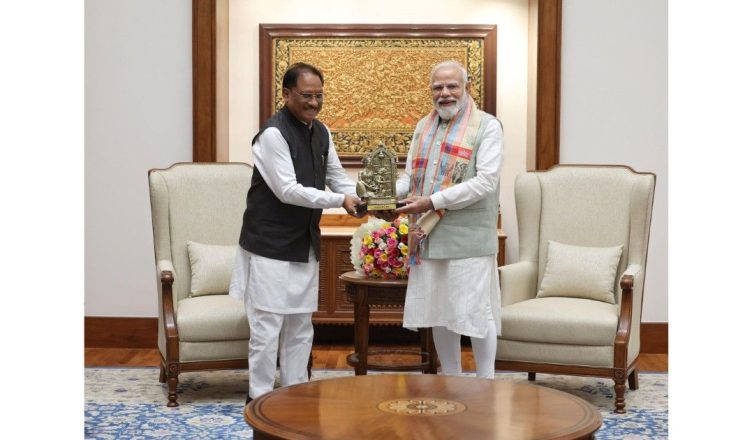
In a significant push toward regional development, Chhattisgarh Chief Minister Vishnu Deo Sai met Prime Minister Narendra Modi in New Delhi on April 7 to present a comprehensive blueprint for the transformation of the Bastar region. The proposal, titled “Bastar 2.0,” focuses on improving infrastructure, boosting tourism, supporting startups, and enhancing public services in one of the state’s historically underdeveloped areas.
The meeting comes at a time when the state government is emphasizing improved security conditions in Bastar, a region that has long faced challenges related to left-wing extremism. With stability gradually improving, the government is now shifting its focus toward long-term economic and social development.
Key Announcements and Highlights
The Bastar 2.0 plan outlines a multi-pronged strategy aimed at accelerating growth and improving quality of life for residents. A central component of the proposal is infrastructure development, particularly in road connectivity.
Under the Pradhan Mantri Gram Sadak Yojana (PMGSY), the state aims to complete all pending rural road projects by 2027. In addition, the blueprint includes the construction of 228 new roads and 267 bridges to improve connectivity in remote and tribal areas. These projects are expected to reduce travel time, improve access to markets, and enhance delivery of essential services.
The Chief Minister also proposed additional infrastructure projects requiring central assistance, signaling the state’s intent to collaborate closely with the Union government to accelerate implementation.
In the healthcare and education sectors, the plan includes upgrading residential schools, expanding primary health centres, and establishing advanced medical facilities. These measures are designed to address long-standing gaps in access to quality education and healthcare in the region.
Official Statement
During the meeting, the Chief Minister highlighted the changing landscape of Bastar, pointing to improvements in security and governance. He emphasized that these developments have created a conducive environment for investment and growth.
He also extended an invitation to the Prime Minister to visit Bastar after the monsoon season to lay foundation stones and inaugurate key projects. The proposed visit is expected to include announcements related to railway expansion, airport development, and the establishment of a super-speciality hospital and medical college.
Officials indicated that such a visit would not only accelerate project timelines but also bring national attention to the region’s transformation efforts.
Focus on Irrigation and Agriculture
Agriculture remains a key livelihood source in Bastar, and the Bastar 2.0 plan places strong emphasis on improving irrigation infrastructure. Projects centered around the Indravati River are expected to expand irrigation coverage significantly.
Improved irrigation facilities could help farmers move beyond rain-dependent agriculture, enabling multiple cropping cycles and higher yields. This, in turn, is expected to strengthen food security and increase rural incomes.
The irrigation push is aligned with the broader goal of enhancing agricultural productivity while ensuring sustainable water management in the region.
Livelihood and Economic Development
A three-year livelihood plan forms a crucial part of the Bastar 2.0 blueprint. The initiative aims to increase household incomes and provide economic stability to local communities, particularly tribal populations.
The plan focuses on skill development, access to markets, and promotion of local industries such as handicrafts and forest-based products. By strengthening value chains and improving market linkages, the government aims to create sustainable income opportunities.
In addition, the expansion of the Niyad Nellanar 2.0 initiative to more districts is expected to improve delivery of welfare schemes and ensure that development benefits reach underserved populations.
Push for Startups and Innovation
Recognizing the importance of entrepreneurship in driving economic growth, the state government has introduced a startup policy with an ambitious target of supporting 5,000 startups by 2030.
The policy aims to foster innovation, create employment opportunities, and encourage youth participation in emerging sectors. By providing financial support, mentorship, and infrastructure, the government hopes to build a startup ecosystem even in traditionally underdeveloped regions like Bastar.
This move reflects a broader shift in policy thinking, where rural and tribal areas are increasingly being integrated into the country’s innovation economy.
Tourism Development Plans
Bastar is known for its natural beauty, including waterfalls, forests, and national parks. The Bastar 2.0 plan seeks to tap into this potential by investing in tourism infrastructure.
Proposals include the development of facilities at major tourist sites, improvement of connectivity, and promotion of adventure tourism. These initiatives are expected to attract both domestic and international visitors, generating employment and boosting local economies.
Tourism development is also seen as a way to change perceptions about Bastar, showcasing it as a destination of cultural and ecological significance rather than conflict.
Strengthening Governance and Service Delivery
To improve access to government services, the Bastar Munne initiative will organize camps at the gram panchayat level. These camps aim to facilitate delivery of welfare schemes, address grievances, and ensure that citizens can access services without traveling long distances.
Such localized governance models are particularly important in remote areas, where administrative access has historically been limited. By bringing services closer to the people, the government aims to improve transparency and efficiency.
Context and Background
The Bastar region has long been considered one of the most challenging areas for governance and development in India. Issues related to security, infrastructure gaps, and limited economic opportunities have hindered progress.
However, recent improvements in the security situation have opened new possibilities for development. The Bastar 2.0 plan builds on this momentum, aiming to transition the region from a security-focused approach to a development-driven model.
The emphasis on infrastructure, livelihoods, and innovation reflects lessons learned from previous initiatives, which often struggled due to lack of coordination and inadequate implementation.
Public Impact
If implemented effectively, the Bastar 2.0 plan could have far-reaching impacts on the region’s population. Improved roads and connectivity would make it easier for residents to access healthcare, education, and markets.
Enhanced irrigation and agricultural support could lead to higher incomes for farmers, while the startup policy and tourism initiatives could create new employment opportunities for youth.
Better healthcare and education infrastructure would improve overall quality of life, while initiatives like Bastar Munne would strengthen trust between citizens and the government.
The plan also has the potential to reduce regional disparities by bringing Bastar closer to mainstream economic growth.
Future Outlook
The success of the Bastar 2.0 blueprint will depend on effective coordination between the state and central governments, timely allocation of resources, and robust monitoring mechanisms.
The proposed visit by the Prime Minister after the monsoon season is expected to be a key milestone, potentially unlocking further investments and accelerating project execution.
With a comprehensive approach that combines infrastructure, social development, and economic initiatives, the Bastar 2.0 plan represents a significant step toward transforming one of India’s most complex regions into a hub of growth and opportunity.
Inputs and images : Hindusthan Samachar
Edited By E. Devanshi varma
Also Read: US-Israel Strike on Iran Nuclear Facility Escalates 38-Day Conflict, Trump Issues Strait Ultimatum
Follow us on Google News: Click Here
Last Updated on: Tuesday, April 7, 2026 3:45 pm by E. Devanshi Varma | Published by: E. Devanshi Varma on Tuesday, April 7, 2026 3:45 pm | News Categories: Politics
About The Author
