
India stands at a decisive moment in its economic journey as the Economic Survey 2026 presents an optimistic yet grounded outlook for the coming years. According to the Survey, the Indian economy is projected to grow at a robust rate of around 7.4 percent in FY26–27, setting the stage for the country to cross the long-anticipated $5 trillion GDP milestone in FY27. This projection places India firmly among the fastest-growing major economies in the world, reinforcing its rising stature in global economic affairs.
The Survey underscores that this growth is not a short-term rebound but the result of sustained structural reforms, improved macroeconomic stability, and increasing domestic demand. Despite global uncertainties, India’s economic fundamentals remain strong, providing confidence to policymakers, investors, and citizens alike.
Growth Drivers Powering the $5 Trillion Vision
At the heart of the Economic Survey’s projections lies a combination of consumption-led growth and investment momentum. Strong domestic consumption, particularly in urban centers, continues to drive demand across sectors such as manufacturing, services, and construction. At the same time, rural demand is showing signs of steady recovery, supported by improved agricultural output and targeted welfare measures.
Public capital expenditure remains a key engine of growth. The Survey highlights sustained government investment in infrastructure, including roads, railways, ports, and digital connectivity, as a critical factor crowding in private investment. With capacity utilization levels improving across industries, private sector capital expenditure is expected to gain further traction, reinforcing the growth cycle.
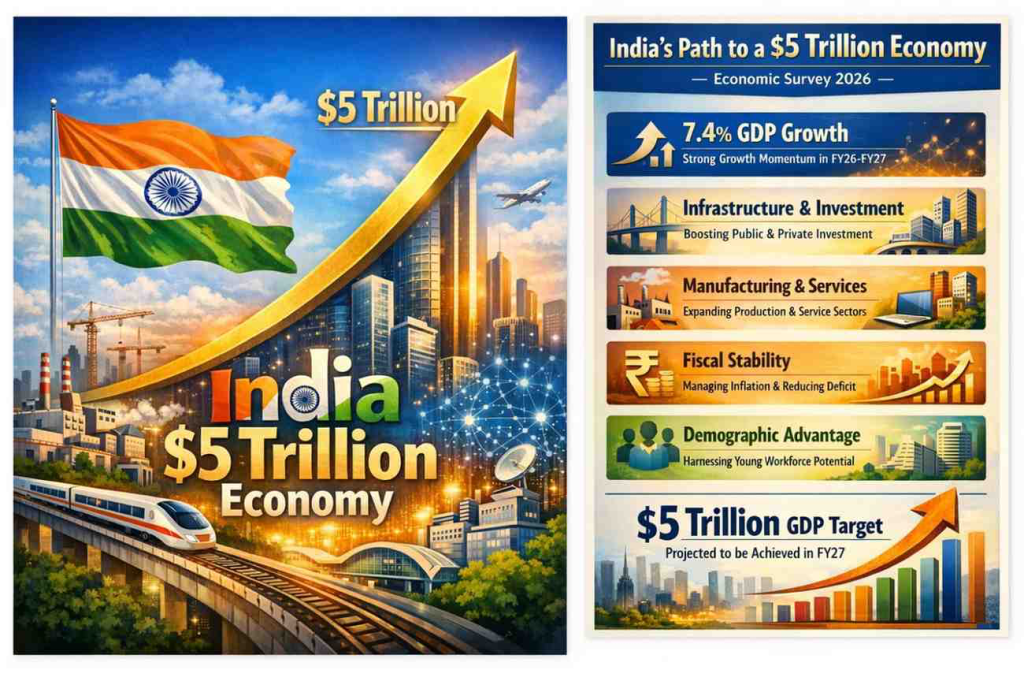
Manufacturing and Services as Twin Pillars
The Economic Survey places special emphasis on the role of manufacturing and services in achieving the $5 trillion milestone. Initiatives such as the Production-Linked Incentive schemes have strengthened India’s manufacturing base, encouraging domestic production and reducing import dependence in key sectors like electronics, pharmaceuticals, and renewable energy equipment.
The services sector, long a backbone of India’s economy, continues to expand with resilience. IT and digital services remain strong contributors, while tourism, financial services, logistics, and professional services are witnessing renewed growth. Together, manufacturing and services are expected to generate employment and enhance India’s export competitiveness.
Inflation, Fiscal Discipline, and Macroeconomic Stability
A notable feature of the Economic Survey 2026 is its focus on maintaining macroeconomic stability amid growth. Inflation management remains a priority, with coordinated monetary and fiscal measures helping to keep price pressures within manageable limits. The Survey acknowledges global commodity price volatility but notes that India’s diversified supply chains and policy buffers have reduced vulnerability.
Fiscal consolidation is also highlighted as a key achievement. Gradual reduction in the fiscal deficit, improved tax compliance through digital systems, and rationalization of subsidies have strengthened public finances. This fiscal discipline, the Survey notes, is essential to sustaining high growth without compromising economic stability.
Employment, Demographics, and Human Capital
India’s demographic advantage features prominently in the Survey’s narrative. With a young and expanding workforce, the country has the potential to convert growth into broad-based employment generation. The Survey points to increased job creation in manufacturing, construction, services, and the startup ecosystem as signs of positive momentum.
Investments in education, skilling, and healthcare are seen as critical to maximizing this demographic dividend. The Economic Survey stresses that improving workforce productivity and aligning skills with industry needs will be central to sustaining high growth and achieving long-term development goals.
Global Risks and India’s Resilience
While the outlook is optimistic, the Economic Survey does not overlook global risks. Geopolitical tensions, slowing growth in advanced economies, and financial market volatility remain challenges on the horizon. However, the Survey emphasizes India’s resilience, supported by strong foreign exchange reserves, a stable banking system, and diversified trade partnerships.
India’s growing role in global supply chains and its emphasis on self-reliance, without turning inward, are presented as strategic advantages. These factors, combined with consistent policy direction, are expected to help the economy navigate external shocks.
The Road Ahead to a $5 Trillion Economy
As per the Economic Survey 2026, surpassing the $5 trillion GDP mark in FY27 is not merely a symbolic achievement but a reflection of deeper structural transformation. The Survey concludes that sustained reforms, inclusive growth, and continued investment in infrastructure and human capital will be crucial to maintaining momentum beyond this milestone.
With projected growth of 7.4 percent and a stable macroeconomic framework, India appears well-positioned to enter the next phase of its economic evolution. The coming years, as outlined in the Survey, will determine how effectively the nation converts this growth into prosperity, opportunity, and improved living standards for its citizens.
Add newsestate.in as a preferred source on google – click here
Last Updated on: Friday, January 30, 2026 11:36 am by News Estate Team | Published by: News Estate Team on Friday, January 30, 2026 11:36 am | News Categories: News
About The Author
