
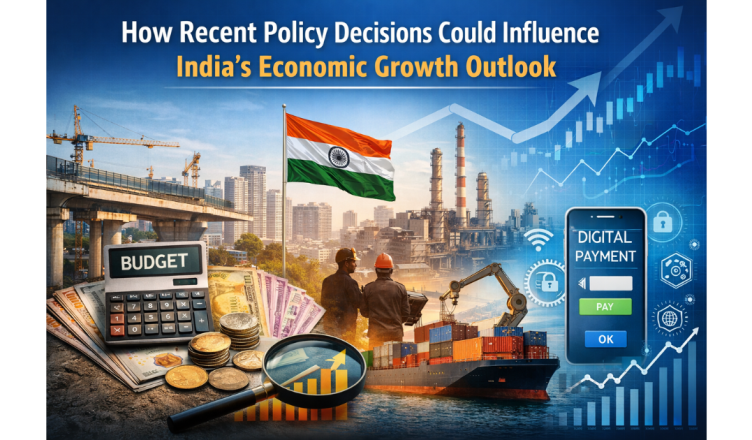
India’s economic growth trajectory is closely tied to policy choices made by the government and the central bank. Over the past year, a series of fiscal, monetary, and structural policy decisions have signalled how authorities intend to balance growth, inflation control, employment generation, and long-term stability. While the full impact of these measures will unfold over time, their direction offers important clues about India’s medium-term economic outlook.
Focus on Fiscal Discipline With Growth Support
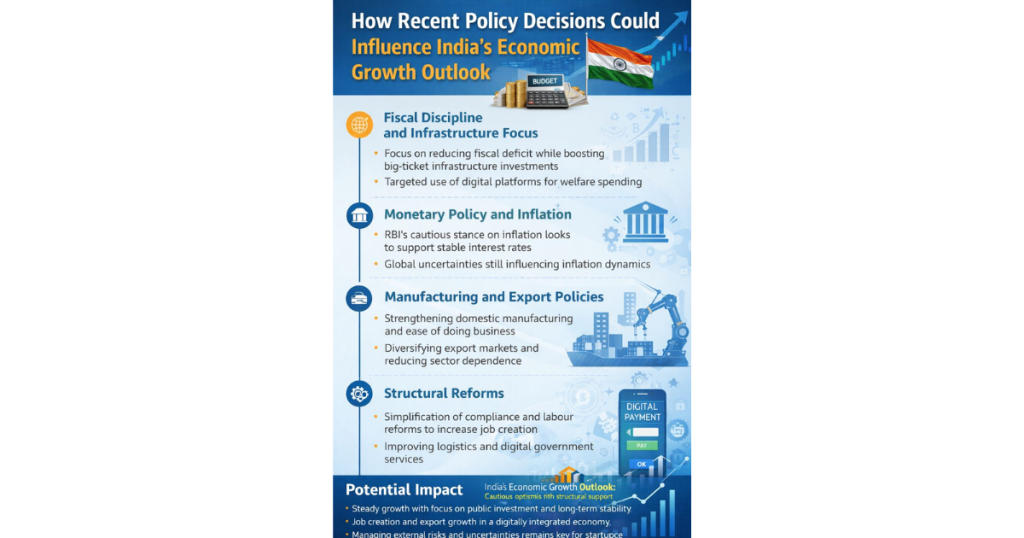
One of the key policy themes has been the continued emphasis on fiscal discipline alongside targeted spending. The government has reiterated its commitment to gradually reducing the fiscal deficit while protecting expenditure that supports economic expansion. Capital expenditure on infrastructure—such as roads, railways, ports, and urban development—has remained a central priority.
Economists widely view public capital expenditure as a growth multiplier for the economy. Infrastructure investment not only creates immediate employment but also lowers logistics costs, improves productivity, and attracts private investment. If execution remains steady, this approach is expected to support GDP growth without placing excessive pressure on public finances.
At the same time, rationalisation of subsidies and a greater focus on targeted welfare delivery through digital platforms aim to improve spending efficiency. These measures are designed to ensure that fiscal resources are directed where they have the greatest economic and social impact.
Monetary Policy and Inflation Management
Monetary policy decisions by the Reserve Bank of India (RBI) play a critical role in shaping growth conditions. Over recent months, the central bank has maintained a cautious stance, prioritising inflation control while remaining attentive to growth risks.
Stable interest rates, combined with clear forward guidance, help businesses plan investments and households manage borrowing decisions. If inflation remains within the RBI’s comfort range, the scope for policy support to growth could widen. However, global uncertainties—such as commodity price volatility and geopolitical tensions—continue to influence inflation dynamics, requiring a careful balancing act.
A predictable monetary policy environment is particularly important for sectors like housing, manufacturing, and small businesses, which are sensitive to borrowing costs.
Manufacturing, Exports, and Supply Chains
Policy measures aimed at strengthening domestic manufacturing are expected to have a longer-term impact on growth. Initiatives that encourage local production, improve ease of doing business, and integrate Indian firms into global supply chains are designed to boost industrial output and exports.
In addition, trade-related policies that focus on diversifying export markets and reducing dependency on a narrow set of sectors could make growth more resilient. While global demand conditions remain uncertain, supportive domestic policies can help Indian exporters stay competitive.
Reforms in Labour, Logistics, and Compliance
Structural reforms continue to influence India’s growth potential beyond short-term cycles. Simplification of compliance requirements, digitalisation of government services, and efforts to improve logistics efficiency reduce the cost of doing business.
Labour-related reforms, aimed at increasing formalisation and flexibility while ensuring worker protection, could support job creation if implemented effectively at the state level. Over time, these changes may help India absorb a growing workforce into productive employment, which is critical for sustaining high growth rates.
Role of the Services and Digital Economy
The services sector remains a major driver of India’s economy, and recent policy decisions have reinforced support for digital infrastructure, financial inclusion, and technology-led growth. Expansion of digital public infrastructure has enabled faster service delivery, improved transparency, and created opportunities for innovation across sectors.
Policies that promote startups, skill development, and adoption of emerging technologies such as artificial intelligence and data analytics can strengthen productivity and create new growth engines. The challenge lies in ensuring that digital growth translates into broad-based employment and income gains.
Risks and External Factors
While domestic policy decisions provide a framework for growth, external factors continue to pose risks. Global economic slowdowns, shifts in capital flows, and changes in trade policies can influence India’s growth outlook regardless of domestic measures.
Policymakers have sought to build buffers—such as strong foreign exchange reserves and diversified growth drivers—to manage these uncertainties. The effectiveness of recent policy decisions will partly depend on how well India navigates these external challenges.
Outlook: Cautious Optimism With Structural Support
Taken together, recent policy decisions suggest a strategy focused on sustaining growth while maintaining macroeconomic stability. Continued public investment, prudent monetary management, and incremental structural reforms form the backbone of this approach.
If implementation remains consistent and global conditions do not deteriorate sharply, these policies could support steady economic expansion over the coming quarters. For businesses, investors, and households, the emphasis on stability and long-term capacity building signals cautious optimism about India’s economic growth outlook.
Last Updated on: Thursday, January 22, 2026 10:13 am by News Estate Team | Published by: News Estate Team on Thursday, January 22, 2026 10:13 am | News Categories: News
About The Author
