
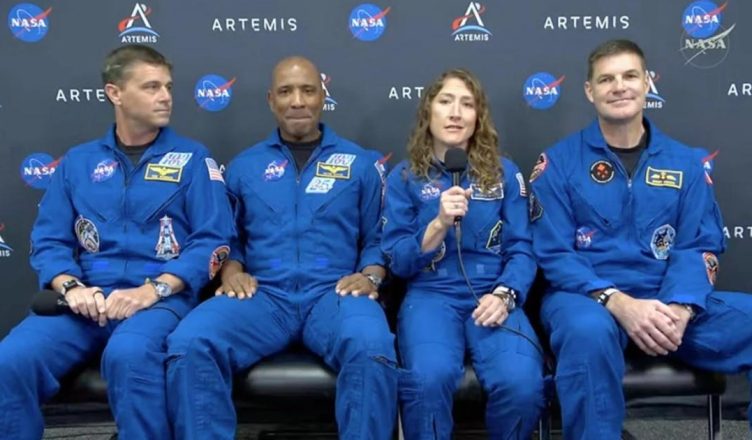
NASA is preparing for a major milestone in human spaceflight as the Artemis II mission, its first crewed lunar mission in more than 50 years, approaches launch. Scheduled for April 1 from the Kennedy Space Center in Florida, the mission will carry four astronauts aboard the Space Launch System (SLS) rocket and Orion spacecraft on a journey around the Moon and back.
The crew—Commander Reid Wiseman, Pilot Victor Glover, and Mission Specialists Christina Koch and Jeremy Hansen—has confirmed readiness ahead of the highly anticipated launch. Their mission represents a critical step in NASA’s broader Artemis program, which aims to establish a sustained human presence on the Moon.
Key Announcements / Highlights
- Artemis II is NASA’s first crewed mission beyond low Earth orbit since 1972
- Launch is scheduled for April 1 with a two-hour window
- The mission will last approximately 10 days
- Astronauts will conduct a lunar flyby, not a landing
- The Orion spacecraft will undergo critical deep-space system tests
- The mission could set a new record for the farthest distance traveled by humans from Earth
Countdown and Launch Timeline
NASA has outlined a detailed countdown schedule leading up to liftoff. The official countdown is expected to begin late on March 31 (Eastern Time), initiating a 49-hour and 40-minute sequence of checks and preparations.
If conditions remain favorable, the SLS rocket is set to launch at 6:24 p.m. EDT on April 1. However, the agency has built flexibility into the schedule with a two-hour launch window extending until 8:24 p.m. EDT. This allows engineers and mission controllers to address any minor technical or weather-related concerns without delaying the mission entirely.
Weather conditions currently appear promising, with meteorologists estimating an 80% chance of favorable conditions at the launch site. Weather remains a critical factor in launch decisions, particularly for missions of this scale.
Mission Profile: Testing the Path to the Moon
Unlike the Apollo missions that aimed for lunar landings, Artemis II is designed as a test flight. The mission will send astronauts on a lunar flyby, allowing NASA to evaluate the Orion spacecraft’s performance in deep space.
After launch, Orion will spend about 24 hours in high Earth orbit. During this time, astronauts will conduct system checks, ensuring that propulsion, navigation, communication, and life-support systems are functioning as expected.
Roughly 25 hours into the mission, the spacecraft will begin its journey toward the Moon. It will follow what is known as a “free-return trajectory,” using the Moon’s gravitational pull to loop around its far side and return to Earth without requiring major propulsion adjustments.
The spacecraft is expected to pass within approximately 6,500 kilometers of the lunar surface before heading back. This trajectory minimizes risk while still allowing NASA to gather critical data needed for future missions.
Official Statement
Speaking ahead of the launch, Commander Reid Wiseman emphasized the crew’s readiness and the significance of the mission. He described the experience of preparing for the first crewed flight aboard the SLS rocket as both surreal and exciting.
According to NASA officials, the mission is not only a technical test but also a demonstration of confidence in the systems developed over the past decade. Ground systems manager Shaun Quinn highlighted that Artemis II represents a return to deep space exploration, marking the first human journey toward the Moon since Apollo 17 in 1972.
Reaching Beyond Previous Limits
One of the mission’s notable objectives is to push the boundaries of human space travel. If launched within the early part of the window, Artemis II is expected to travel approximately 406,000 kilometers from Earth.
This would surpass the record set by the Apollo 13 mission in 1970, making Artemis II the farthest distance humans have ever traveled from Earth. The milestone underscores the mission’s role in expanding the limits of human exploration.
NASA officials view this achievement not merely as a record but as a necessary step toward long-duration missions in deep space, including future journeys to Mars.
Context and Background
The Artemis program represents NASA’s long-term strategy for lunar exploration. Named after the twin sister of Apollo in Greek mythology, Artemis builds on the legacy of the Apollo missions while incorporating modern technology and international collaboration.
The program began with Artemis I, an uncrewed test flight that successfully orbited the Moon and returned to Earth. Artemis II is the next phase, introducing astronauts into the system and validating its readiness for human missions.
Future missions are expected to increase in complexity. Artemis III, currently targeted for later in the decade, aims to land astronauts on the Moon’s surface, with a focus on the lunar south pole. This region is of particular interest due to the presence of water ice, which could support long-term habitation.
Public Impact: Why This Mission Matters
Artemis II is more than a technological demonstration; it represents a shift in the direction of human space exploration.
For the public, the mission signals the beginning of a new era in which humans are once again venturing beyond Earth orbit. It also lays the groundwork for scientific research, technological innovation, and potential economic opportunities tied to space exploration.
The mission is expected to inspire a new generation of scientists, engineers, and explorers. Educational institutions and space agencies worldwide are closely watching the developments, as Artemis II could influence future international collaborations.
Additionally, the technologies tested during the mission—such as advanced life-support systems and deep-space navigation—have potential applications beyond space exploration, including in extreme environments on Earth.
Splashdown and Mission Completion
After completing its journey around the Moon, the Orion spacecraft will return to Earth for a high-speed re-entry into the atmosphere. This phase is one of the most technically challenging parts of the mission, as the spacecraft must withstand extreme temperatures and forces.
The capsule is expected to splash down in the Pacific Ocean near the coast of California, close to San Diego, around April 10. Recovery teams will retrieve the crew and spacecraft, marking the successful completion of the mission.
In total, Artemis II is expected to travel approximately 1.1 million kilometers over its 10-day duration, much of it in deep space beyond low Earth orbit.
As the launch date approaches, Artemis II stands as a pivotal moment in space exploration. The mission is designed to validate systems, build confidence, and prepare for more ambitious objectives in the coming years.
NASA’s broader vision includes not only returning humans to the Moon but establishing a sustainable presence that can support ongoing research and exploration. Artemis II is a crucial step in achieving that goal.
With astronauts ready and systems in place, the mission reflects decades of planning and technological advancement. If successful, it will mark the beginning of a new chapter—one that extends human presence deeper into space and sets the stage for future exploration beyond the Moon.
Inputs and images : Hindusthan Samachar
Edited By E. Devanshi varma
Also Read: Praggnanandhaa’s Opening Win Headlines Round 1 Action at FIDE Candidates 2026
Follow us on Google News: Click Here
Last Updated on: Monday, March 30, 2026 1:59 pm by E. Devanshi Varma | Published by: E. Devanshi Varma on Monday, March 30, 2026 1:59 pm | News Categories: Trending
About The Author
