
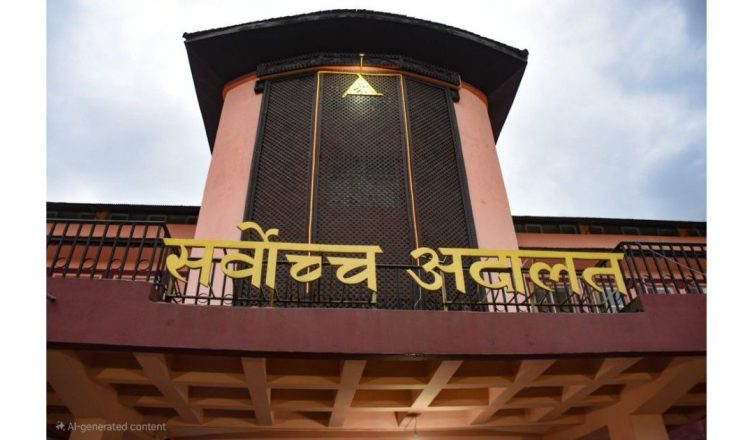
Kathmandu, April 7: Nepal’s recent decision to restrict government advertisements exclusively to state-owned media outlets has come under judicial scrutiny, with a writ petition filed in the Supreme Court challenging the legality and constitutional validity of the move. The case has triggered a wider debate about press freedom, media sustainability, and the role of the state in regulating information dissemination.
The petition, filed by advocate Anant Raj Luintel on behalf of the Nepal Media Society, an association representing publishers of daily newspapers, argues that the government’s directive violates fundamental rights and undermines the independence of private media.
Government Directive and Its Scope
The controversy stems from a circular issued on April 1 by Nepal’s Prime Minister’s Office and the Cabinet Secretariat. The directive instructs all government bodies—including federal ministries, provincial authorities, and local governments—to publish advertisements solely through state-run media outlets.
Government advertisements are a significant source of revenue for media organizations in Nepal, particularly for print publications and smaller regional outlets. These advertisements include public notices, tenders, awareness campaigns, and policy announcements.
By limiting such advertisements to government-owned platforms, the directive effectively excludes private media organizations from accessing a critical income stream.
Key Issues Raised in the Petition
The writ petition challenges the directive on multiple legal and constitutional grounds. It raises three primary concerns:
1. Violation of Freedom of Expression
The petitioner argues that restricting government advertisements to state-owned media indirectly curtails freedom of expression. In Nepal, the constitution guarantees press freedom and prohibits censorship or undue restrictions on the dissemination of information.
While the directive does not explicitly ban private media from publishing content, critics say it creates economic pressure that could weaken independent journalism.
2. Contravention of Advertisement Laws
The petition also claims that the directive conflicts with existing provisions under Nepal’s Advertisement Act. The law is intended to regulate fair distribution of public advertisements and ensure transparency in government communication.
By mandating exclusive use of state media, the government is accused of bypassing legal mechanisms designed to maintain a level playing field.
3. Threat to Media Sustainability
A major concern highlighted in the petition is the potential financial impact on private media organizations. Many outlets rely heavily on government advertising revenue to sustain operations, particularly in a market already facing declining print circulation and digital disruption.
The petition warns that enforcing the directive could result in “irreparable harm” to the media sector, potentially leading to layoffs, closures, or reduced journalistic output.
Request for Interim Relief
In addition to challenging the directive, the petitioner has sought an interim order from the Supreme Court to suspend its implementation until a final verdict is reached.
Such interim relief is typically granted in cases where immediate enforcement of a policy could cause lasting damage. If the court accepts this request, it could temporarily restore access to government advertisements for private media outlets.
Legal experts note that the court’s initial response will be closely watched, as it may signal how seriously the judiciary views the constitutional concerns raised.
Government’s Position and Possible Rationale
While the government has not publicly detailed its reasoning in the directive, analysts suggest several possible motivations behind the policy.
One argument could be cost efficiency. By centralizing advertisements in state-run media, the government may aim to streamline communication and reduce expenditure.
Another possible rationale is ensuring wider reach through national broadcasters and publications, particularly in rural areas where state media may have stronger penetration.
However, critics argue that such justifications do not outweigh the broader implications for media plurality and independence.
Broader Context: Media Landscape in Nepal
Nepal has a diverse media ecosystem, with a mix of state-owned and privately operated outlets across print, television, radio, and digital platforms. Over the past two decades, the country has seen significant growth in independent journalism following political reforms.
However, the sector continues to face challenges, including financial instability, political pressure, and competition from digital platforms.
Government advertising has historically played a stabilizing role, especially for smaller and regional publications that lack access to large commercial advertisers.
Any disruption to this revenue model could disproportionately affect these outlets, potentially narrowing the diversity of voices in the media landscape.
Why This Matters
The case goes beyond a financial dispute and touches on fundamental questions about democracy and governance.
Impact on Press Freedom
Economic independence is widely considered a cornerstone of editorial independence. When media organizations face financial constraints, they may be more vulnerable to external influence or self-censorship.
By restricting access to government advertising, the directive could indirectly shape the editorial environment, even without direct interference.
Implications for Public Information
Private media outlets play a key role in disseminating government information to the public. Limiting their access to official advertisements may reduce the reach and effectiveness of public communication.
This could have practical consequences, particularly in areas such as public health campaigns, disaster alerts, and civic awareness initiatives.
Legal Precedent
The Supreme Court’s decision in this case could set an important precedent for how government policies affecting media are evaluated under constitutional law.
A ruling against the directive may reinforce protections for press freedom and fair competition, while a decision in favor of the government could redefine the boundaries of state control over public communication.
Reactions from Media and Civil Society
Although formal responses are still emerging, early reactions from media organizations and press freedom advocates suggest widespread concern.
Many view the directive as a step backward for media independence in Nepal, warning that it could create an uneven playing field favoring state-run outlets.
Civil society groups are also likely to monitor the case closely, given its implications for transparency and democratic accountability.
What Happens Next
The immediate focus is on whether the Supreme Court will issue an interim order to halt the directive. This decision could come in the coming days, depending on the court’s schedule and initial hearings.
If the case proceeds to a full hearing, it may involve detailed examination of constitutional provisions, statutory laws, and the practical impact of the directive on the media sector.
The final verdict could take weeks or months, but its implications are expected to be long-lasting.
As the legal process unfolds, the case is likely to remain a focal point in discussions about media freedom, government accountability, and the balance between regulation and independence in Nepal’s democratic framework.
Inputs and images : Hindusthan Samachar
Edited By E. Devanshi varma
Also Read: Modi Congratulates Vietnam’s New President To Lam in 5-Year Leadership Transition
Follow us on Google News: Click Here
Last Updated on: Tuesday, April 7, 2026 3:56 pm by E. Devanshi Varma | Published by: E. Devanshi Varma on Tuesday, April 7, 2026 3:56 pm | News Categories: News
About The Author
