
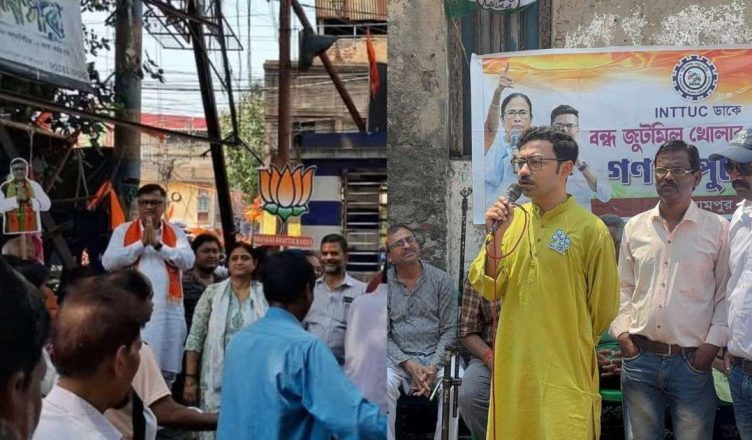
Hooghly district in West Bengal is witnessing heightened political activity as the 2026 Assembly elections approach, with the Serampore constituency emerging as a closely watched battleground. At the heart of this contest are jute mill workers, a large and influential segment of the electorate whose concerns are now shaping campaign strategies.
Both the Bharatiya Janata Party (BJP) and the Trinamool Congress (TMC) have stepped up efforts to engage with workers and their families. Their outreach reflects not only electoral calculations but also the economic significance of the jute industry in this region.
Jute Workers Become a Political Priority
Serampore and its surrounding areas have long been associated with the jute industry, which once formed the backbone of eastern India’s industrial economy. Even today, several operational and non-operational mills dot the landscape, employing or having previously employed thousands of workers.
In recent days, political engagement with this workforce has intensified. BJP candidate Bhaskar Bhattacharya visited Sandhya Bazar in Rishra, where he interacted directly with workers, urging them to support his party in the upcoming polls. The outreach was focused on building personal connections and understanding worker grievances at the ground level.
Soon after, TMC candidate Tanmay Ghosh held a rally involving jute workers, raising demands for the reopening of closed mills. The campaign also included submitting a memorandum to the relevant government department, highlighting the urgency of industrial revival.
This back-to-back engagement from both parties underlines how critical jute workers are in influencing the electoral outcome in Serampore.
Key Election Issues: Employment, Wages, and Mill Closures
The concerns of jute workers are neither new nor limited to election cycles. However, the current political climate has brought these issues into sharper focus.
One of the most pressing demands is the reopening of closed jute mills. Over the years, several mills have either shut down or significantly reduced operations due to financial distress, labor disputes, or declining profitability. This has left many workers either unemployed or dependent on irregular, low-paying work.
Irregular employment remains another major issue. Even in operational mills, workers often face uncertainty regarding shifts, wages, and job continuity. Many workers rely on daily or contractual arrangements, making their income unstable.
Low wages also continue to be a persistent grievance. Despite the physically demanding nature of their work, many workers report that their earnings are insufficient to meet rising living costs. This has led to growing dissatisfaction, making economic issues central to voting decisions.
Industrial Legacy and Electoral Influence
Serampore’s identity is deeply tied to the jute industry. Mills such as Hastings, Wellington, and Serampore Jute Mills have historically provided employment to large sections of the local population.
The presence of these mills has shaped not only the economy but also the social fabric of the region. Entire neighborhoods have developed around mill operations, with generations of families dependent on the industry for livelihood.
This concentration of workers and their families creates a significant voting bloc. Political observers note that a consolidated voting pattern among jute workers could play a decisive role in determining the election result in the constituency.
Given the close electoral contests typically seen in the region, even small shifts in voter sentiment among this group could alter outcomes.
Political Strategies: Outreach vs. Policy Promises
The BJP and TMC appear to be adopting different strategies to appeal to jute workers.
The BJP’s approach has focused on direct engagement. Candidate visits, worker interactions, and localized campaigning aim to build trust and demonstrate responsiveness to immediate concerns. This grassroots outreach is designed to connect with workers on a personal level.
On the other hand, the TMC is emphasizing broader policy commitments. By organizing rallies and raising demands for reopening mills, the party is positioning itself as a proponent of industrial revival and employment generation.
While both approaches address worker concerns, they differ in execution—one prioritizing direct voter connection, the other highlighting administrative and policy-level solutions.
Official Messaging Reflects Competing Narratives
Though formal statements have been limited in detail, the messaging from both parties reflects their broader political narratives.
The BJP has stressed the need for change and accountability, pointing to ongoing issues in the jute sector as evidence of governance gaps. Its outreach efforts suggest a focus on immediate engagement and responsiveness.
The TMC, which currently holds power in the state, has emphasized continuity and development. Its campaign around reopening mills aligns with its narrative of economic revival and job creation.
These competing narratives are likely to shape voter perception in the coming weeks, especially among workers directly affected by industrial challenges.
Broader Context: Decline of the Jute Industry
The prominence of jute workers in this election also highlights the broader challenges facing the industry.
Once a thriving sector, the jute industry in West Bengal has struggled in recent decades due to multiple factors. These include competition from synthetic alternatives, outdated machinery, fluctuating demand, and financial constraints faced by mill owners.
Government interventions, including minimum support prices for raw jute and policies promoting eco-friendly packaging, have attempted to support the sector. However, implementation gaps and structural challenges have limited their impact.
The situation in Serampore reflects these wider trends. While some mills continue operations, others remain closed or operate intermittently, affecting worker livelihoods.
Why This Election Matters Beyond Politics
The focus on jute workers in the Serampore constituency underscores a larger question about the future of traditional industries in India.
For many families, employment in jute mills is not just a job but a generational livelihood. The uncertainty surrounding the industry affects education, healthcare, and overall quality of life for these communities.
This election, therefore, is not just about political representation. It is also about addressing long-standing economic issues that have persisted despite policy interventions.
The outcome could influence how seriously industrial revival and worker welfare are prioritized in future governance.
Impact on Local Communities
The issues raised during this election have direct implications for thousands of families in Serampore.
If closed mills are reopened, it could lead to job creation and economic stability in the region. Improved wages and consistent employment would also enhance living standards.
Conversely, if these issues remain unresolved, workers may continue to face financial insecurity. This could lead to migration, reduced spending, and broader economic slowdown in local markets.
The stakes are therefore high, not just for workers but for the entire local economy.
The Road Ahead
As campaigning intensifies, both major parties are expected to continue their outreach efforts among jute workers. Further rallies, meetings, and policy announcements are likely in the coming days.
Voters, particularly those connected to the jute industry, will be closely evaluating which party offers more credible solutions to their concerns.
The Serampore Assembly constituency thus stands at a critical juncture, where electoral choices are closely intertwined with economic realities. The prominence of jute workers in this contest serves as a reminder that local industries and livelihoods remain central to democratic decision-making.
Inputs and images : Hindusthan Samachar
Edited By E. Devanshi varma
Also Read: Amit Shah Roadshow Signals 3 Key Political Messages Ahead of Bhabanipur Nomination
Follow us on Google News: Click Here
Last Updated on: Thursday, April 2, 2026 2:43 pm by E. Devanshi Varma | Published by: E. Devanshi Varma on Thursday, April 2, 2026 2:43 pm | News Categories: Politics
About The Author
