
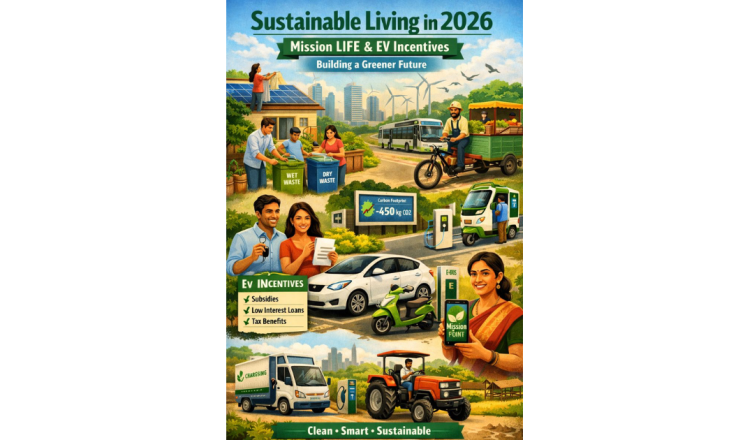
Sustainable living has moved decisively from the margins to the mainstream in 2026, driven by climate stress, rising energy costs, and worsening urban pollution. What was once framed as an ethical choice is now widely understood as a practical necessity. Across India, households, businesses, and local governments are converging around a shared understanding that sustainability is no longer optional—it is foundational to economic resilience and quality of life. At the heart of this transition lies Mission LiFE—Lifestyle for Environment—working in tandem with a new generation of incentives accelerating electric vehicle adoption.
Mission LiFE’s Evolution Into a Mass Behavioural Movement
Mission LiFE has matured into one of the most influential citizen-led sustainability frameworks in the country. Rather than functioning as a conventional government scheme, it operates as a behavioural blueprint, encouraging millions of small, everyday actions that collectively deliver large environmental outcomes. In 2026, the initiative’s strength lies in how seamlessly it has been woven into daily routines. Energy efficiency, water conservation, waste reduction, and responsible consumption are increasingly viewed not as acts of sacrifice, but as markers of responsible citizenship.
Local governments and community institutions have played a critical role in this normalization. Housing societies monitor electricity savings, schools treat climate awareness as a core life skill, and urban local bodies deploy digital tools that translate abstract environmental goals into tangible household-level outcomes. This shift has made sustainability visible, measurable, and socially reinforced.
Incentives That Reward Conscious Choices
A defining feature of Mission LiFE’s current phase is the alignment of behavioural nudges with economic incentives. Households that reduce peak electricity usage or adopt renewable energy solutions are rewarded through rebates and preferential tariffs. Waste segregation compliance is increasingly linked to municipal benefits, while water conservation measures influence local fee structures. The intent is clear: sustainable behaviour is no longer only morally encouraged, it is materially supported.
Retail and digital platforms have also joined this ecosystem, highlighting low-impact products and transparent sourcing. As a result, sustainability has begun to influence purchasing decisions at scale, reshaping markets rather than merely individual habits.
Electric Mobility Becomes Central to Sustainable Living
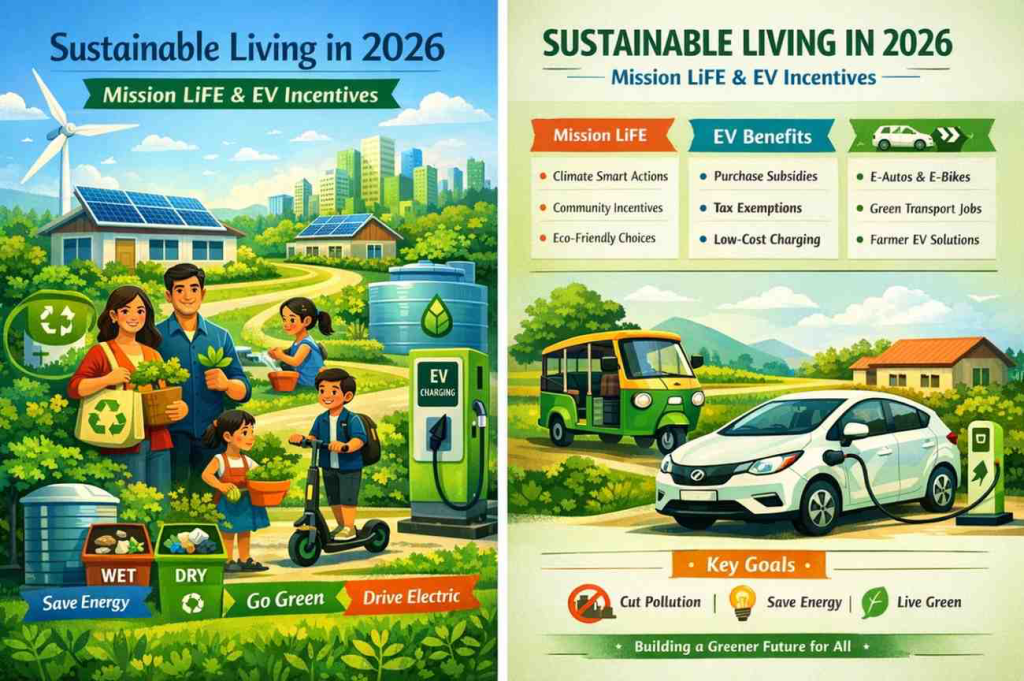
Transportation remains one of India’s most complex environmental challenges, making electric mobility a central pillar of sustainable living in 2026. Electric vehicles are no longer positioned as futuristic alternatives but as practical, cost-effective solutions for everyday mobility. Policy focus has shifted from blanket subsidies to targeted incentives that prioritize urban pollution reduction, high-usage vehicles, and domestic manufacturing.
For individual buyers, the economics of EV ownership have improved markedly. Purchase incentives are now complemented by lower registration costs, road tax exemptions in several states, and increasingly competitive financing options. Maintenance costs remain significantly lower than internal combustion vehicles, while insurance premiums have stabilized as performance data improves. For many urban commuters, particularly two-wheeler users, electric mobility is now the financially rational choice.
Charging Infrastructure and the Confidence Factor
One of the most significant developments in 2026 is the rapid expansion of charging infrastructure. Highways feature fast-charging corridors, cities mandate EV-ready parking in new developments, and workplaces increasingly offer charging facilities as part of employee benefits. This infrastructure push has reduced range anxiety, replacing it with confidence and convenience. Electric mobility is no longer a logistical challenge but a normalized component of urban planning.
Aligning Electric Vehicles With the Mission LiFE Mindset
What sets the current phase apart is how electric vehicle adoption is being framed as an extension of Mission LiFE rather than a standalone technological shift. EV buyers are encouraged to see their choice as part of a broader lifestyle commitment to cleaner air, quieter cities, and reduced dependence on imported fuel. Digital dashboards allow owners to track emissions avoided and fuel savings, transforming personal data into a sense of collective environmental contribution.
This feedback loop—choice, impact, and recognition—has proven crucial in sustaining long-term behaviour change and preventing policy fatigue.
Rural and Semi-Urban India Joins the Transition
Sustainable living in 2026 is no longer an urban-centric narrative. Electric three-wheelers, small commercial EVs, and agricultural mobility solutions are gaining traction in rural and semi-urban areas. Incentives are increasingly tied to livelihood generation, positioning clean mobility as an economic enabler rather than an abstract climate solution. For small entrepreneurs and farmers, the appeal lies in predictable operating costs and insulation from fuel price volatility.
Trust, Transparency, and Long-Term Commitment
The success of this sustainability push rests heavily on policy credibility. Clear eligibility criteria, predictable incentive timelines, and responsive grievance mechanisms have become central to maintaining public trust. Citizens are more willing to invest in sustainable choices when policies signal continuity rather than experimentation. In 2026, sustainable living is framed not as a temporary campaign but as a long-term national direction.
A New Definition of Responsible Citizenship
As Mission LiFE and electric mobility incentives converge, a broader cultural shift is taking shape. Sustainable living is no longer defined by isolated gestures but by systems that make responsible choices easy, affordable, and socially valued. The Indian citizen of 2026 is not expected to be perfect—only conscious. Increasingly, the ecosystem rewards that consciousness, embedding sustainability into daily life from the household meter to the vehicle driveway. The result is a future where environmental responsibility and economic logic are no longer in conflict, but fundamentally aligned.
Also read :https://newspixel.in/the-vertical-saas-2-0-revolution-indias-blueprint-for-global-niche-dominance/
Add newsestate.in as a preferred source on google – click here
Last Updated on: Wednesday, January 28, 2026 12:13 pm by News Estate Team | Published by: News Estate Team on Wednesday, January 28, 2026 12:13 pm | News Categories: News
About The Author
