


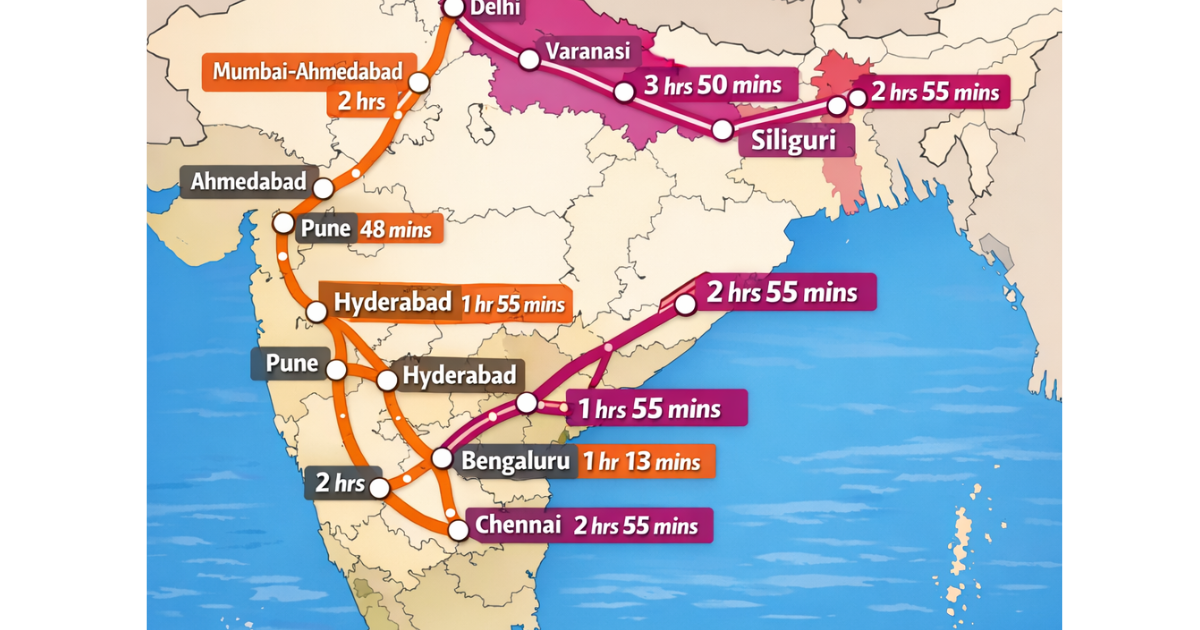
India is aggressively expanding its vision for high-speed rail infrastructure, aiming to transform the way people travel across the country. The government’s bold plans, outlined most recently in the Union Budget 2026–27, propose an interconnected network of high-speed corridors that will link key economic, cultural, educational, and tourist destinations. These projects are seen as pivotal to India’s future transport ecosystem, promising dramatic cuts in travel time, greater regional integration, sustainable mobility, and enhanced economic activities.
Emergence of a National High-Speed Rail Network
The high-speed rail initiative in India traces its roots to the Mumbai–Ahmedabad High-Speed Rail Corridor—the country’s first bullet train project. This flagship route, built with advanced technology and designed to operate at speeds above 300 km/h, symbolized India’s entry into true high-speed rail travel. Encouraged by the progress on this corridor, the government has expanded the ambitions to include multiple new corridors covering different regions of the country.
Building on this foundation, seven new high-speed rail corridors were announced in the 2026 budget as part of a comprehensive plan to introduce faster and cleaner passenger systems between major urban, industrial, and cultural centres. These corridors, expected to attract an estimated ₹16 lakh crore in investments, are intended to serve as “growth connectors” that will drive regional development, cut travel times significantly compared to existing rail and road options, and reduce carbon emissions from intercity travel.
List of High-Speed Rail Routes and Travel Times
The seven high-speed rail corridors outlined in the budget cover routes across the north, south, east, and west of India. Although most of these projects remain in early planning or preparatory stages such as DPR (Detailed Project Report) formulation, the projected travel times offer a glimpse of the transformational impact of these services once operational:
- Mumbai–Pune High-Speed Rail Corridor: Traditionally a journey of 2.5 to 4 hours on conventional rail or road, this corridor aims to reduce the travel time to about 48 minutes, making it possible to connect two of Maharashtra’s largest economic hubs within an hour.
- Pune–Hyderabad High-Speed Rail Corridor: Expected to link the financial and IT centres of Pune and Hyderabad in roughly 1 hour 55 minutes, dramatically shortening what is now an 8–10 hour journey by conventional means.
- Hyderabad–Bengaluru High-Speed Rail Corridor: A strategic southern corridor anticipated to cut travel time between Hyderabad and Bengaluru to about 2 hours, vastly improving connectivity in the burgeoning tech triangle of South India.
- Hyderabad–Chennai and Chennai–Bengaluru High-Speed Corridors: These corridors will knit together three of South India’s largest cities. The Chennai–Bengaluru link alone aims to complete the trip in 1 hour 13 minutes, while Hyderabad–Chennai is projected at around 2 hours 55 minutes—both major improvements on the current 8–14 hour conventional journeys.
- Delhi–Varanasi High-Speed Rail Corridor: This northern corridor is envisioned to bridge the national capital with the historic city of Varanasi in approximately 3 hours 50 minutes, compared to 8–12 hours by conventional trains.
- Varanasi–Siliguri High-Speed Rail Corridor: Spanning Uttar Pradesh, Bihar, and West Bengal, this eastern corridor will reduce the long journey between Varanasi and Siliguri to around 2 hours 55 minutes, opening up improved access to the northeastern gateway and boosting religious, educational, and tourism linkages.
In total, these corridors are expected to extend over roughly 4,000 kilometres of high-speed lines once fully developed, and form an integrated grid that connects major urban clusters across the country.
Connectivity Benefits and Economic Impact
The strategic deployment of high-speed rail corridors is poised to deliver profound benefits beyond mere reductions in travel time. For passengers, these routes will offer fast, reliable, and comfortable alternatives to conventional trains and short-haul flights. Shorter journey durations could reshape commuting patterns and promote daily intercity travel for workers, students, and tourists alike.
Economically, the corridors are expected to stimulate growth in sectors such as manufacturing, services, and tourism by linking business districts with production hubs and markets. Regions that previously faced long, arduous journeys will gain easier access to wider opportunities, leading to balanced regional development and increased investments in infrastructure, hospitality, and related industries.
Moreover, high-speed rail will contribute to environmental sustainability by shifting travellers from road and air to electric rail transport, thereby reducing congestion and lowering greenhouse gas emissions. Enhanced connectivity also tends to support urban expansion in tier-2 and tier-3 cities, alleviating pressure on megacities and fostering more equitable growth.
For the thousands of Indians who regularly undertake long-distance travel for business, education, or personal reasons, the actualisation of these high-speed corridors would mark a historic leap. What once took half a day could soon take half a morning, stimulating cross-regional links and reinvigorating India’s mobility landscape in ways that resonate far beyond simple transportation—ushering in a truly modern era of travel.
Add newsestate.in as a preferred source on google – click here