

• Privacy Policy
  • About
  • Advertise with us
  • Contact us
News Estate
Advertisement
  • India
  • Politics
  • Tech
  • Business
  • Trending
  • Entertainment
  • Sports
No Result
View All Result
  • India
  • Politics
  • Tech
  • Business
  • Trending
  • Entertainment
  • Sports
No Result
View All Result
News Estate
No Result
View All Result
Home News

High-Speed Rail Corridors in India: Full List of Routes, Travel Times, and Connectivity Benefits

News Estate Team by News Estate Team
Wednesday, February 4, 2026 11:22 am
in News
0
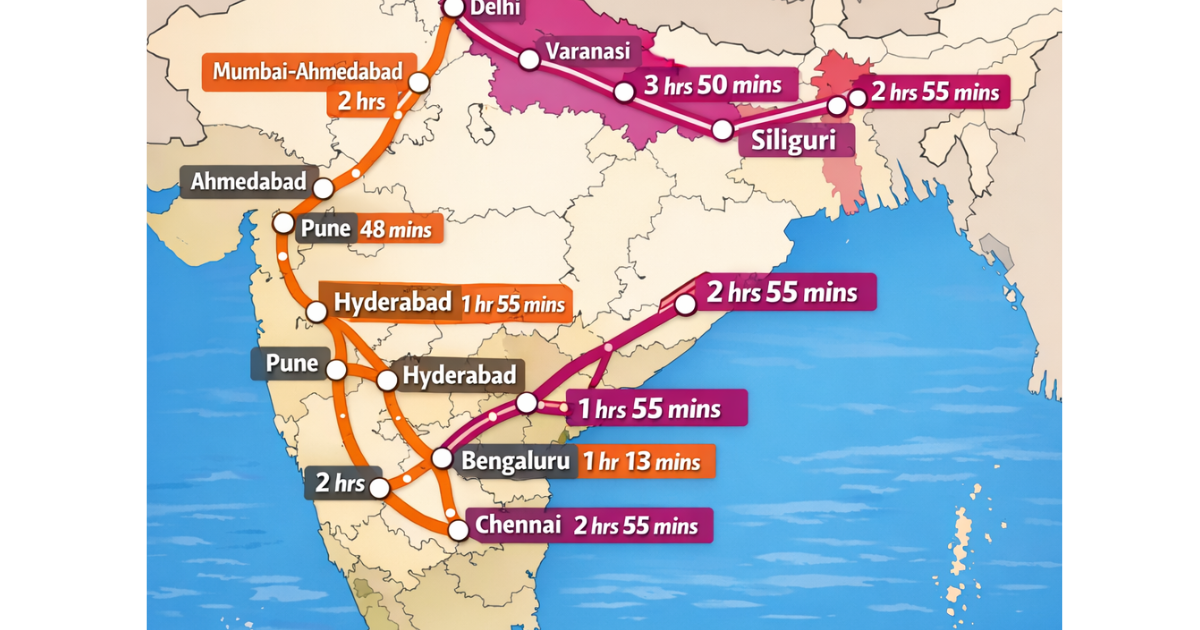
A map of India highlighting proposed and under-construction high-speed rail corridors, including Mumbai–Ahmedabad, Mumbai–Pune, Delhi–Varanasi, Chennai–Bengaluru, Hyderabad–Bengaluru, and eastern routes, with major cities marked and travel times indicated.

India’s expanding high-speed rail network aims to connect major economic and cultural hubs, cutting intercity travel times and reshaping long-distance mobility across the country.

0
SHARES
0
VIEWS
Share on Facebook
Share on Twitter

Home » News » High-Speed Rail Corridors in India: Full List of Routes, Travel Times, and Connectivity Benefits

India is aggressively expanding its vision for high-speed rail infrastructure, aiming to transform the way people travel across the country. The government’s bold plans, outlined most recently in the Union Budget 2026–27, propose an interconnected network of high-speed corridors that will link key economic, cultural, educational, and tourist destinations. These projects are seen as pivotal to India’s future transport ecosystem, promising dramatic cuts in travel time, greater regional integration, sustainable mobility, and enhanced economic activities. 

Emergence of a National High-Speed Rail Network

The high-speed rail initiative in India traces its roots to the Mumbai–Ahmedabad High-Speed Rail Corridor—the country’s first bullet train project. This flagship route, built with advanced technology and designed to operate at speeds above 300 km/h, symbolized India’s entry into true high-speed rail travel. Encouraged by the progress on this corridor, the government has expanded the ambitions to include multiple new corridors covering different regions of the country. 

Building on this foundation, seven new high-speed rail corridors were announced in the 2026 budget as part of a comprehensive plan to introduce faster and cleaner passenger systems between major urban, industrial, and cultural centres. These corridors, expected to attract an estimated ₹16 lakh crore in investments, are intended to serve as “growth connectors” that will drive regional development, cut travel times significantly compared to existing rail and road options, and reduce carbon emissions from intercity travel. 

List of High-Speed Rail Routes and Travel Times

The seven high-speed rail corridors outlined in the budget cover routes across the north, south, east, and west of India. Although most of these projects remain in early planning or preparatory stages such as DPR (Detailed Project Report) formulation, the projected travel times offer a glimpse of the transformational impact of these services once operational:

  • Mumbai–Pune High-Speed Rail Corridor: Traditionally a journey of 2.5 to 4 hours on conventional rail or road, this corridor aims to reduce the travel time to about 48 minutes, making it possible to connect two of Maharashtra’s largest economic hubs within an hour. 
  • Pune–Hyderabad High-Speed Rail Corridor: Expected to link the financial and IT centres of Pune and Hyderabad in roughly 1 hour 55 minutes, dramatically shortening what is now an 8–10 hour journey by conventional means. 
  • Hyderabad–Bengaluru High-Speed Rail Corridor: A strategic southern corridor anticipated to cut travel time between Hyderabad and Bengaluru to about 2 hours, vastly improving connectivity in the burgeoning tech triangle of South India. 
  • Hyderabad–Chennai and Chennai–Bengaluru High-Speed Corridors: These corridors will knit together three of South India’s largest cities. The Chennai–Bengaluru link alone aims to complete the trip in 1 hour 13 minutes, while Hyderabad–Chennai is projected at around 2 hours 55 minutes—both major improvements on the current 8–14 hour conventional journeys. 
  • Delhi–Varanasi High-Speed Rail Corridor: This northern corridor is envisioned to bridge the national capital with the historic city of Varanasi in approximately 3 hours 50 minutes, compared to 8–12 hours by conventional trains. 
  • Varanasi–Siliguri High-Speed Rail Corridor: Spanning Uttar Pradesh, Bihar, and West Bengal, this eastern corridor will reduce the long journey between Varanasi and Siliguri to around 2 hours 55 minutes, opening up improved access to the northeastern gateway and boosting religious, educational, and tourism linkages. 

In total, these corridors are expected to extend over roughly 4,000 kilometres of high-speed lines once fully developed, and form an integrated grid that connects major urban clusters across the country. 

Connectivity Benefits and Economic Impact

The strategic deployment of high-speed rail corridors is poised to deliver profound benefits beyond mere reductions in travel time. For passengers, these routes will offer fast, reliable, and comfortable alternatives to conventional trains and short-haul flights. Shorter journey durations could reshape commuting patterns and promote daily intercity travel for workers, students, and tourists alike.

Economically, the corridors are expected to stimulate growth in sectors such as manufacturing, services, and tourism by linking business districts with production hubs and markets. Regions that previously faced long, arduous journeys will gain easier access to wider opportunities, leading to balanced regional development and increased investments in infrastructure, hospitality, and related industries.

Moreover, high-speed rail will contribute to environmental sustainability by shifting travellers from road and air to electric rail transport, thereby reducing congestion and lowering greenhouse gas emissions. Enhanced connectivity also tends to support urban expansion in tier-2 and tier-3 cities, alleviating pressure on megacities and fostering more equitable growth. 

For the thousands of Indians who regularly undertake long-distance travel for business, education, or personal reasons, the actualisation of these high-speed corridors would mark a historic leap. What once took half a day could soon take half a morning, stimulating cross-regional links and reinvigorating India’s mobility landscape in ways that resonate far beyond simple transportation—ushering in a truly modern era of travel. 

Also read :https://newsestate.in/divyangjan-kaushal-yojana-complete-guide-to-the-new-skill-training-scheme-for-persons-with-disabilities/

Add newsestate.in as a preferred source on google – click here

Previous Post

Union Budget 2026-27: Industry Leaders Hail Push for Self-Reliance, Innovation, and Global Competitiveness

Next Post

Explained: The Bharat-VISTAAR AI Platform and How It Aims to Increase Farmer Incomes in 2026

News Estate Team

News Estate Team

The News Estate Team is a dedicated group of experienced journalists and content creators focused on delivering the latest updates and in-depth coverage across a wide range of topics, including current affairs, technology, entertainment, viral trends, and automobiles. With a strong commitment to accuracy, reliability, and engaging storytelling, the team ensures that readers stay informed with timely and comprehensive content. Whether it’s breaking news or emerging trends, the News Estate Team provides fresh perspectives and insightful reports to keep audiences up-to-date in today’s fast-paced world. For inquiries or collaborations, contact us at anishsrivastava025@gmail.com.

Related Posts

KARAM-Safety-Backs-PHDCCI’s-National-Model-School-Safety-Toolkit-for-Safer,-Future-Ready-Schools
Brand Post

KARAM Safety Backs PHDCCI’s National Push for Safer, More Resilient Schools

Tuesday, August 11, 2026 12:04 pm
The Gera School Encourages Student Wellness with Special International Yoga Day Sessions
Brand Post

The Gera School Encourages Student Wellness with Special International Yoga Day Sessions

Thursday, July 2, 2026 10:58 am
Central Government Raises Passport Fees After 14 Years, Prompting Debate on Cost, Accessibility and India’s Digital Travel Infrastructure
News

Central Government Raises Passport Fees After 14 Years, Prompting Debate on Cost, Accessibility and India’s Digital Travel Infrastructure

Saturday, June 27, 2026 9:42 pm
Why Manufacturing Companies Need Transparent Communication During Workforce and Compliance Changes
Business

Why Manufacturing Companies Need Transparent Communication During Workforce and Compliance Changes

Thursday, June 25, 2026 12:45 pm
Professionals taking a break from smartphones and laptops during a digital detox challenge to improve focus, productivity, and mental well-being.
Lifestyle

Digital Detox Trends Grow as 7 Workplace Habits Face Scrutiny

Thursday, June 11, 2026 2:39 pm
Young Gen Z users interacting with AI chatbot platforms on smartphones and laptops as artificial intelligence increasingly competes with traditional search engines.
Tech

Gen Z’s Digital Future Takes a 360-Degree Turn Toward AI

Thursday, June 11, 2026 2:38 pm
Next Post
A digital illustration showing Indian farmers in a field using smartphones and tablets, with AI data overlays such as weather forecasts, crop health indicators, market prices, and satellite imagery connected through a central Bharat-VISTAAR platform interface.

Explained: The Bharat-VISTAAR AI Platform and How It Aims to Increase Farmer Incomes in 2026

Leave a Reply Cancel reply

Your email address will not be published. Required fields are marked *

Stay Connected test

  • 23.9k Followers
  • 99 Subscribers
  • Trending
  • Comments
  • Latest
Startup founder reviewing visa documents after reported US visa denial despite building a business valued at approximately $12 million.

Founder Faces 3 Major Challenges After US Visa Denial Despite Building a $12 Million Brand

Wednesday, June 10, 2026 2:55 pm

Kedarnath Helicopter Tragedy: A Wake-Up Call for Safer Skies

Sunday, June 15, 2025 9:58 pm

India Named ‘Country of the Year’ at BIOFACH 2026: What It Means for Organic Exports

Friday, February 13, 2026 1:22 pm

HAKS Celebrates 50 Years of Culinary Engineering at IHE 2025 

Thursday, August 14, 2025 10:08 pm

Vishy Anand’s Masterclass: Mentoring India’s Chess Revolution

1

Crucial Faceoff India-Australia’s First T20 – Eying Opportunities for Ishan-Yashasvi and Sundar-Axar Duo

0

IIM Indore Breaks Barriers Launches Leadership Development Programme in Hindi

0

BBC 100 Women 2023 Trailblazing Women Making Their Mark on the Global Stage

0
KARAM-Safety-Backs-PHDCCI’s-National-Model-School-Safety-Toolkit-for-Safer,-Future-Ready-Schools

KARAM Safety Backs PHDCCI’s National Push for Safer, More Resilient Schools

Tuesday, August 11, 2026 12:04 pm

Famous Friendships That Changed History

Saturday, August 1, 2026 10:03 am
The Gera School Encourages Student Wellness with Special International Yoga Day Sessions

The Gera School Encourages Student Wellness with Special International Yoga Day Sessions

Thursday, July 2, 2026 10:58 am
Central Government Raises Passport Fees After 14 Years, Prompting Debate on Cost, Accessibility and India’s Digital Travel Infrastructure

Central Government Raises Passport Fees After 14 Years, Prompting Debate on Cost, Accessibility and India’s Digital Travel Infrastructure

Saturday, June 27, 2026 9:42 pm

Recent News

KARAM-Safety-Backs-PHDCCI’s-National-Model-School-Safety-Toolkit-for-Safer,-Future-Ready-Schools

KARAM Safety Backs PHDCCI’s National Push for Safer, More Resilient Schools

Tuesday, August 11, 2026 12:04 pm

Famous Friendships That Changed History

Saturday, August 1, 2026 10:03 am
The Gera School Encourages Student Wellness with Special International Yoga Day Sessions

The Gera School Encourages Student Wellness with Special International Yoga Day Sessions

Thursday, July 2, 2026 10:58 am
Central Government Raises Passport Fees After 14 Years, Prompting Debate on Cost, Accessibility and India’s Digital Travel Infrastructure

Central Government Raises Passport Fees After 14 Years, Prompting Debate on Cost, Accessibility and India’s Digital Travel Infrastructure

Saturday, June 27, 2026 9:42 pm
news estate logo header 400 by 100

News Estate is an independent digital news platform delivering timely, accurate, and insightful coverage across Business, Real Estate, Technology, Politics, Startups, Markets, and more. Our editorial team is committed to factual reporting, transparency, and ethical journalism, ensuring readers receive reliable news and in-depth analysis that matters. News Estate is part of Qi Media Network, owned and operated by QITA IT Services Private Limited, and is headquartered in Hyderabad, India.

Follow Us

Browse by Category

  • Astroguide
  • Automobile
  • Brand Post
  • Business
  • Education
  • Entertainment
  • India
  • Interview
  • Lifestyle
  • News
  • Opinion
  • Politics
  • Press Release
  • Sports
  • Startup
  • Tech
  • Trending
  • Trending

Recent News

KARAM-Safety-Backs-PHDCCI’s-National-Model-School-Safety-Toolkit-for-Safer,-Future-Ready-Schools

KARAM Safety Backs PHDCCI’s National Push for Safer, More Resilient Schools

Tuesday, August 11, 2026 12:04 pm

Famous Friendships That Changed History

Saturday, August 1, 2026 10:03 am
  • About
  • Advertise with us
  • Advertising & Sponsored Content Policy
  • Authors
  • Careers
  • Contact us
  • Cookie Policy
  • Corrections and Updates
  • Disclaimer Policy
  • DMCA Policy
  • Editorial Policy
  • Editorial Team
  • Ethics Policy
  • Fact-Checking Policy
  • Get Featured
  • Grievance Redressal
  • Join  Our Community
  • Ownership and Funding Info
  • Refund Policy
  • RSS FEED
  • Submit Press Release
  • Terms and Condition
  • Work With Us

© 2026 NewsEstate.in. Published by Qi Media Network. All Rights Reserved.

No Result
View All Result
  • India
  • Politics
  • Tech
  • Business
  • Trending
  • Entertainment
  • Sports

© 2026 NewsEstate.in. Published by Qi Media Network. All Rights Reserved.