
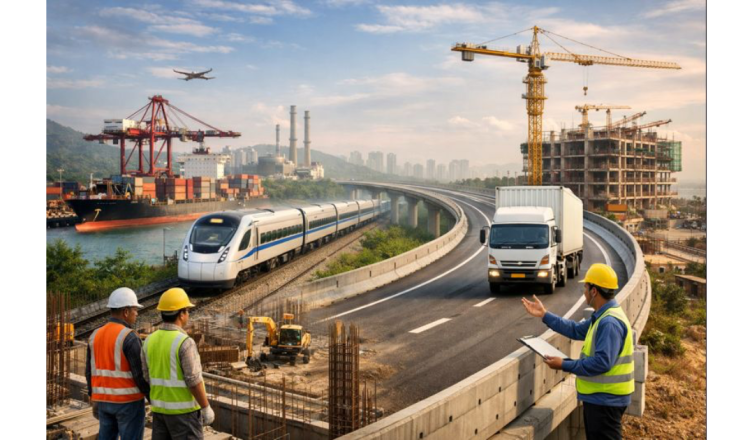
New Delhi: India’s renewed focus on infrastructure development is beginning to show tangible effects across logistics networks, employment generation, and regional economic balance. With sustained public investment in roads, railways, ports, airports, and digital infrastructure, the government is positioning infrastructure as a long-term growth engine rather than a short-term stimulus. The impact is increasingly visible not only in major urban centres but also in Tier-II, Tier-III, and rural regions.
A Strategic Shift in Infrastructure Planning
Over the past few years, India’s infrastructure strategy has moved towards integrated planning and outcome-based execution. Instead of treating highways, rail corridors, industrial parks, and logistics hubs as isolated projects, policymakers are increasingly focusing on connectivity and efficiency. National logistics corridors, multimodal transport hubs, and coordinated project timelines are aimed at reducing delays and improving asset utilisation.
This approach reflects a broader objective: lowering logistics costs, improving ease of doing business, and strengthening India’s competitiveness in global supply chains. Infrastructure is now closely aligned with industrial policy, export goals, and regional development plans.
Transforming India’s Logistics Landscape
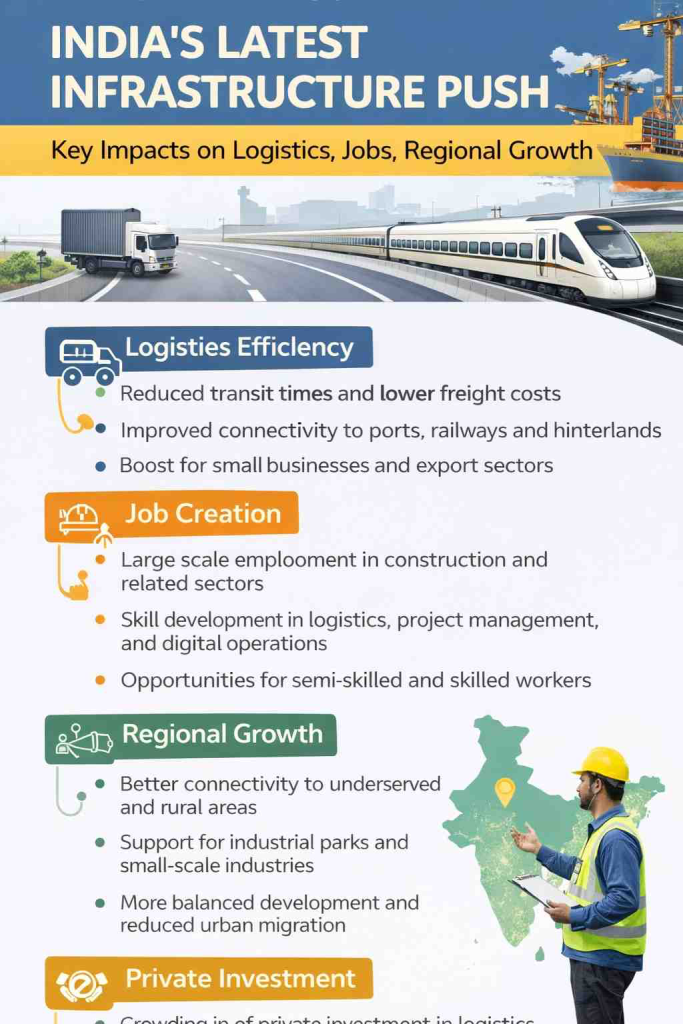
One of the most immediate effects of the infrastructure push is visible in logistics and freight movement. Expanded highway networks, dedicated freight corridors, upgraded ports, and improved last-mile connectivity are reducing transit times and operational bottlenecks. Faster movement of goods is helping manufacturers, retailers, and agricultural producers cut costs and improve delivery reliability.
For small and medium enterprises, improved logistics access is particularly significant. Better roads and transport links are allowing businesses in non-metro regions to reach national markets more easily. Warehousing, cold storage, and logistics services are also expanding along new corridors, creating an ecosystem that supports trade and distribution beyond traditional industrial clusters.
Employment Generation Across Skill Levels
Infrastructure development continues to be one of the largest sources of job creation in the Indian economy. Construction activity generates direct employment for engineers, technicians, and skilled workers, while also providing large-scale opportunities for semi-skilled and unskilled labour. Beyond construction, infrastructure projects stimulate indirect employment in cement, steel, machinery, transport, and services.
What is changing is the nature of jobs being created. Alongside traditional roles, demand is growing for project management professionals, logistics planners, digital mapping specialists, and maintenance experts. The expansion of infrastructure-linked industries is also encouraging skill development initiatives, particularly in regions that previously had limited access to formal employment opportunities.
Boost to Regional and Balanced Growth
A key objective of India’s infrastructure strategy is to reduce regional disparities. By improving connectivity to remote and underdeveloped areas, infrastructure investment is helping unlock local economic potential. Industrial parks, logistics hubs, and manufacturing units are increasingly being planned outside major metropolitan regions, supported by better transport and utilities.
This shift is contributing to more balanced regional growth. States with strong infrastructure execution are attracting private investment, while improved access to markets is supporting agriculture, tourism, and small-scale industries. For local populations, this translates into better income opportunities, improved access to services, and reduced migration pressure on big cities.
Strengthening Private Investment and Confidence
Public infrastructure spending is also playing a catalytic role in crowding in private investment. Clearer project pipelines, improved transparency, and faster execution are boosting investor confidence. Sectors such as logistics, renewable energy, urban development, and industrial infrastructure are seeing increased private participation as risks become more manageable.
For businesses, reliable infrastructure reduces operational uncertainty and long-term costs. This is particularly important for export-oriented industries and companies looking to diversify supply chains. As infrastructure quality improves, India’s appeal as a manufacturing and investment destination strengthens.
Challenges and the Road Ahead
Despite progress, challenges remain. Land acquisition, environmental clearances, financing constraints, and coordination between multiple agencies continue to affect project timelines. Ensuring quality execution and long-term maintenance is also critical to sustaining the benefits of infrastructure investment.
Going forward, the emphasis is expected to remain on integrated planning, digital monitoring, and public-private collaboration. As projects move from planning to operation, their real impact will be measured by how effectively they improve productivity, create jobs, and support inclusive growth.
Why This Matters
India’s infrastructure push is no longer just about building assets; it is about reshaping the economic geography of the country. By improving logistics efficiency, generating employment, and enabling regional development, infrastructure investment is laying the foundation for sustained and more inclusive growth. For businesses, workers, and local economies alike, the outcomes of this strategy are set to influence India’s growth trajectory well beyond the immediate future.
Also read :https://newsvent.in/how-data-security-and-privacy-concerns-are-reshaping-indias-tech-ecosystem/
Add newsestate.in as a preferred source on google – click here
Last Updated on: Friday, January 23, 2026 12:13 pm by News Estate Team | Published by: News Estate Team on Friday, January 23, 2026 12:13 pm | News Categories: News, Trending
About The Author
