

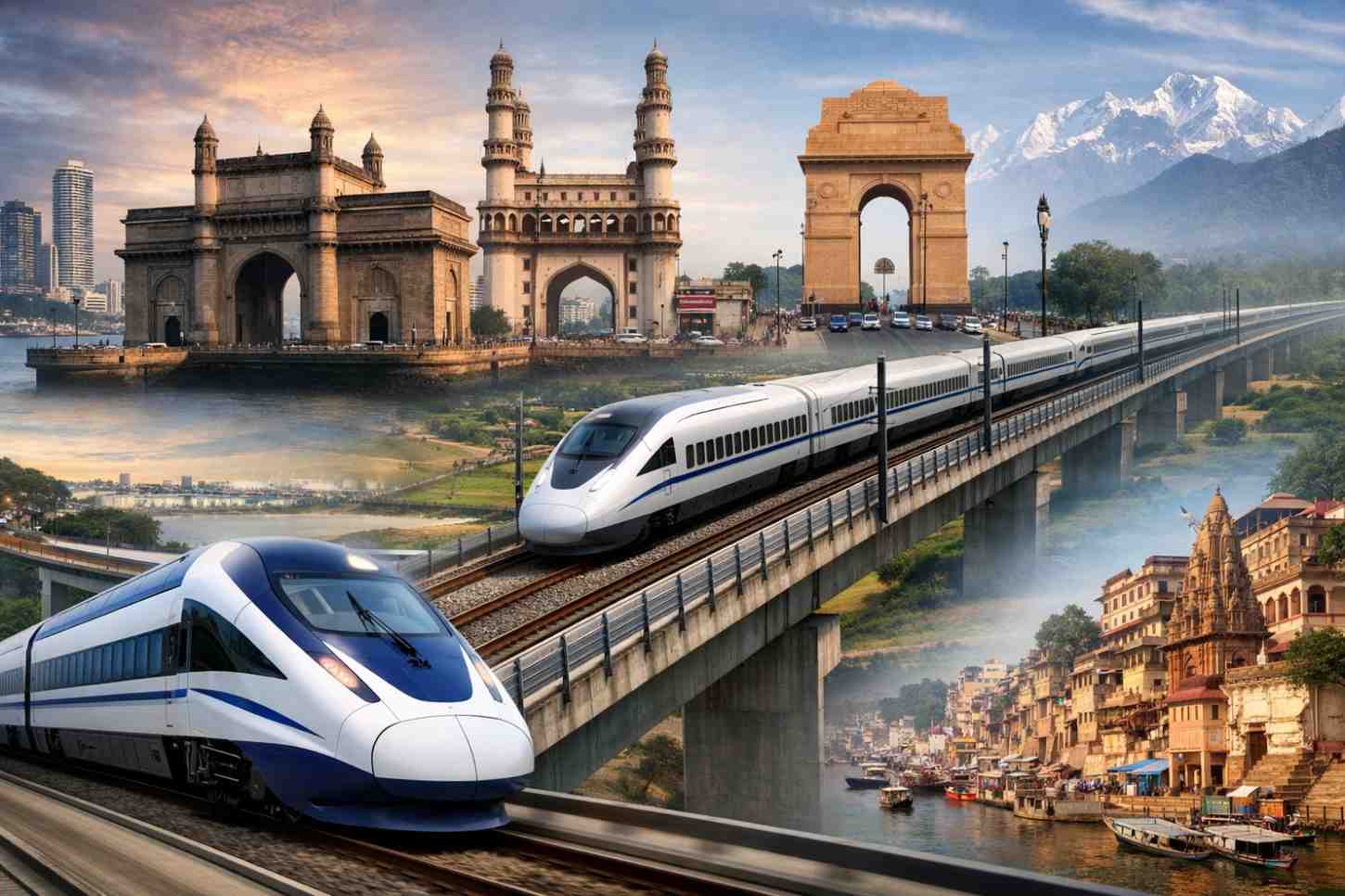
The Union Budget 2026–27 formally announced seven new high-speed rail corridors intended to expand India’s bullet-train network beyond the Mumbai–Ahmedabad project and compress intercity travel times across multiple regions. The corridors — linking economic and cultural hubs from Mumbai to Siliguri via the Deccan and Gangetic plains — were presented as part of a broader rail modernisation push by the Ministry of Railways to reconfigure passenger mobility and catalyse regional development. The government’s initial statements set out target travel times for several routes and signalled an emphasis on domestic manufacture and system integration, while existing project experience with the Mumbai–Ahmedabad corridor is being cited as the operational precedent for future lines.
Background: past, present and policy context
India’s first under-construction bullet-train project, the Mumbai–Ahmedabad high-speed corridor, has been implemented by the National High Speed Rail Corporation Limited as a joint effort involving Japanese technical and financial cooperation. That project — a roughly 508-kilometre corridor designed for 320–350 km/h operations — has supplied the country with its first statutory and institutional experience of high-speed rail procurement, right-of-way acquisition, design standards and contractual management. The institutional structures and technical standards developed there are now being referenced by planners as a template for scaling the programme.
The Budget announcement and the seven corridors
In her Budget speech, the Finance Minister included a line item announcing development of seven high-speed rail corridors. Those corridors, as itemised in official statements and subsequent government press material, are: Mumbai–Pune, Pune–Hyderabad, Hyderabad–Bengaluru, Hyderabad–Chennai, Chennai–Bengaluru, Delhi–Varanasi, and Varanasi–Siliguri. The Government released estimated intercity travel times for several of these corridors. The Ministry described the corridors as growth connectors in official communications.
What exactly was announced — and what was not
The Budget declaration is a strategic policy signal rather than a full project approval package. The announcement names corridors, offers indicative travel times, and indicates an intent to develop associated manufacturing capacity. It does not supply comprehensive project reports, final alignment maps, detailed ridership studies, full cost estimates or firm construction timetables. Those are typically developed in project-level feasibility studies, Detailed Project Reports, environment-clearance submissions, and procurement documents that follow an initial policy decision.
Developments so far: implementation experience and early signals
The National High Speed Rail Corporation Limited has been the nodal agency for the Mumbai–Ahmedabad corridor and remains the institutional actor most closely associated with India’s first full-scale high-speed rail implementation. Its published material documents alignment decisions, tunnelling progress, station design briefs and land acquisition milestones for the Mumbai–Ahmedabad corridor. The experience of working with international suppliers on rolling stock, signalling and civil contracts has built administrative capability within the agency and among state partners — a capability the government says will be leveraged for the newly announced corridors.
In parallel, the Union government has framed an industrial objective for the programme: to expand domestic manufacturing and local supply-chain capability for high-speed trains and their components. Senior officials have presented the plan as an opportunity to develop indigenous capacity for train manufacturing, signalling systems and specialised components. Project-level procurement decisions, including possible localisation requirements, remain to be formalised.
Corridor-by-corridor snapshot and likely trajectories
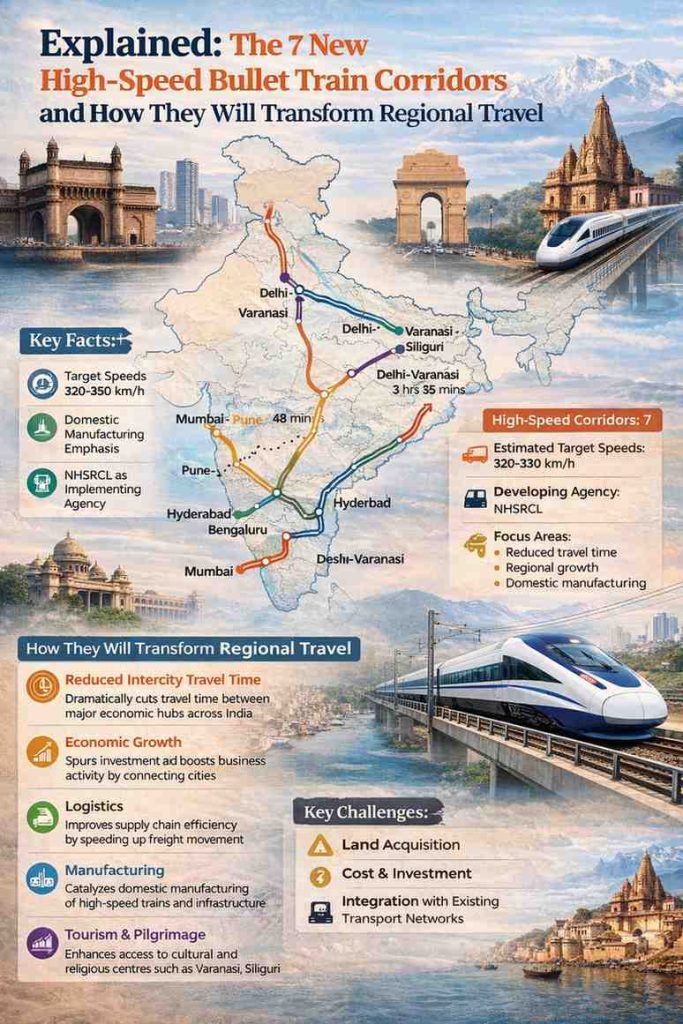
Mumbai–Pune
The short, dense intercity link between India’s financial capital and the Pune metropolitan region has been identified as a priority for a high-frequency corridor. The government indicated a reduction in travel time to under an hour. The route would require complex engineering through the Western Ghats and dense urban zones.
Pune–Hyderabad
This corridor would connect Maharashtra’s industrial belt with Telangana’s capital, linking financial, IT and manufacturing centres across the Deccan plateau. Detailed alignments and operational parameters are yet to be finalised.
Hyderabad–Bengaluru and Hyderabad–Chennai
The Budget listed both corridors, positioning Hyderabad as a nodal point connecting three southern metropolitan regions. The rationale cited in policy statements is strong existing passenger demand and business travel between these cities.
Chennai–Bengaluru
Announced separately, this corridor is projected as one of the shortest high-speed routes in the network, with a sharply reduced travel time. Achieving this will require near-continuous grade separation and high-speed design standards.
Delhi–Varanasi and Varanasi–Siliguri
The northern and eastern corridors aim to connect the national capital region with the Gangetic plain and onward to the northeast gateway at Siliguri. Government material indicates that the Varanasi–Siliguri route would pass through Patna, integrating major urban centres in eastern India.
Financing, timelines and limits of current information
The Budget announcement establishes intent but does not substitute for project approvals. Each corridor will require feasibility studies, land acquisition, environmental clearances, financing arrangements and procurement processes. While rail modernisation funding has been outlined at a macro level, corridor-specific cost estimates and construction timelines will emerge only through Detailed Project Reports and tender documentation.
Technical and institutional challenges
High-speed rail systems require extensive grade separation, gentle curves and specialised civil works, resulting in high capital costs and complex land requirements. Environmental clearances, resettlement issues, cost escalation risks and coordination between the Centre and states are expected challenges. Workforce readiness and domestic supply-chain capacity will also influence delivery timelines.
How the corridors could reshape regional travel
Reduced travel times can compress economic distances between cities, enabling deeper labour markets and business integration. High-speed rail has the potential to draw passengers away from short-haul aviation and road travel, particularly where city-centre stations reduce overall journey time. Station-area development could influence land values and urban growth patterns, while faster access may increase tourism and pilgrimage travel along select corridors.
Manufacturing and skills development
The government has articulated a goal of using the high-speed rail programme to strengthen domestic manufacturing and technical capability. Achieving this will depend on procurement policy, technology transfer mechanisms and investment in skills training. Construction and operation will require a specialised workforce, including engineers, technicians and operations staff.
Integration with existing transport systems
For high-speed corridors to deliver full benefits, stations must be integrated with metro, suburban rail and bus networks. Planning for last-mile connectivity will be critical to ensure that on-track speed translates into meaningful door-to-door time savings.
Steps ahead
The next phase for each corridor will involve feasibility studies, alignment selection, environmental assessments, financing decisions and tendering. Progress will vary by corridor depending on state cooperation, land availability and funding arrangements. Official documentation from the Ministry of Railways and the National High Speed Rail Corporation Limited will provide primary updates as projects advance.
The announcement of seven new high-speed rail corridors represents a significant expansion of India’s long-term transport vision. While the projected travel times illustrate the scale of ambition, realisation will depend on sustained institutional coordination, technical execution and financial discipline. The corridors have the potential to transform regional mobility, but their impact will ultimately be determined by how effectively policy intent is translated into deliverable projects over the coming years.
Also read :High-Speed Rail Corridors in India: Full List of Routes, Travel Times, and Connectivity Benefits
add newsestate.in as a preferred source on google – click here