

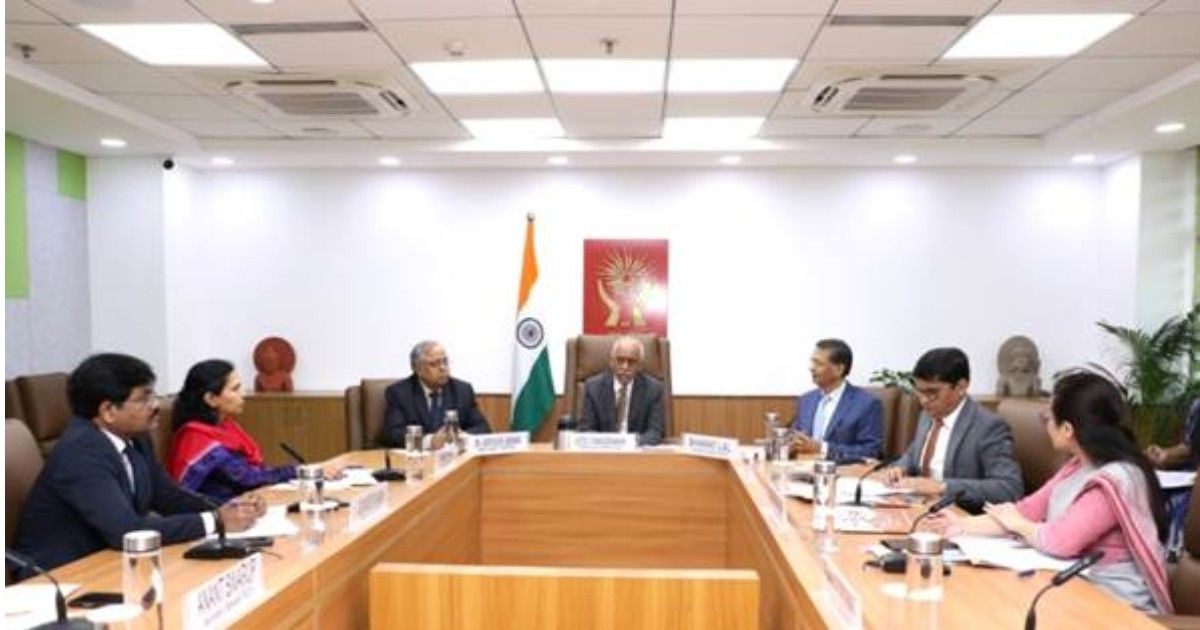
At a high-level discussion in New Delhi, members of the National Human Rights Commission called for stronger protections, better welfare access, and a shift toward a rights-based approach for migrant workers across India.
India must move beyond a “compliance-based” system and build a culture that prioritizes the rights and dignity of workers, according to Justice V. Ramasubramanian of the National Human Rights Commission during a core-group meeting held in New Delhi on Tuesday.
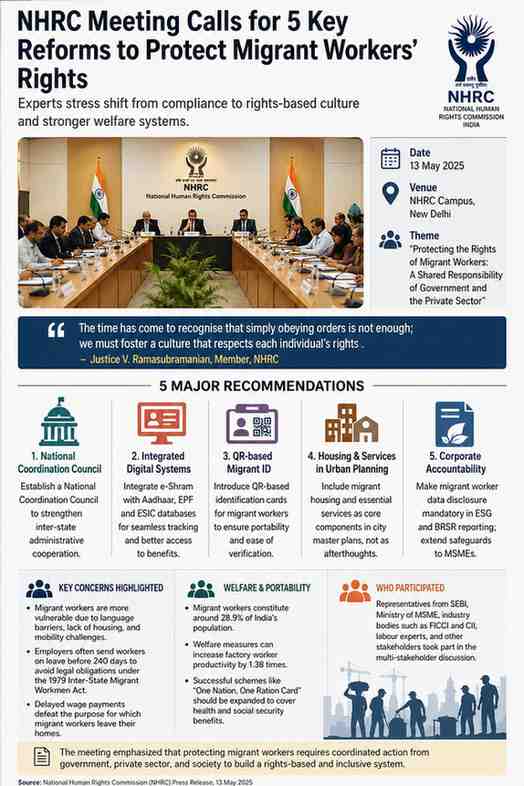
The meeting focused on the theme, “Protecting the Rights of Migrant Workers: A Shared Responsibility of Government and the Private Sector,” and brought together officials, regulators, policymakers, industry representatives, and labour experts to discuss gaps in the protection framework for migrant labourers in India.
Held at the NHRC campus in New Delhi, the discussion centered on practical reforms, welfare delivery, corporate accountability, and interstate coordination rather than introducing policies that remain limited to paper implementation.
Rights-Based Culture Needed for Migrant Labour Protection
Addressing the gathering, Justice V. Ramasubramanian said migrant workers continue to face higher vulnerability compared to many other sections of the workforce due to unstable living conditions, language barriers, lack of documentation, and weak access to legal protections.
He stressed that merely following administrative rules is insufficient if workers’ basic rights are not protected in practice.
According to him, India needs to move away from a system where institutions focus only on technical compliance and instead promote a rights-based culture that treats workers with dignity and fairness.
The former Supreme Court judge also highlighted loopholes in the legal framework governing migrant workers. Referring to the Inter-State Migrant Workmen Act of 1979, he pointed out that some employers reportedly send workers on leave before they complete the statutory threshold of 240 working days. This practice can prevent workers from qualifying for legal protections and employment benefits tied to continuous service.
The remarks reflected growing concern among policymakers and labour rights experts that existing labour protections often fail during implementation, especially in sectors dependent on seasonal or temporary labour.
Concerns Raised Over Delayed Wages and Worker Databases
Justice (Dr.) Bidyut Ranjan Sarangi, member of the NHRC, also emphasized the need for timely wage payments and better welfare tracking mechanisms.
He observed that delayed salary payments undermine the primary reason migrant workers leave their hometowns in search of employment. Many migrant labourers relocate to industrial hubs and urban centers because of limited economic opportunities in their native regions, making regular income essential for household survival.
Sarangi proposed creating comprehensive databases not only for workers but also for their accompanying family members. According to him, such databases could help authorities ensure access to essential public services including education, healthcare, nutrition schemes, and social welfare programs.
Labour experts at the meeting noted that migrant families often struggle to access government services because welfare systems remain tied to permanent addresses or state-specific documentation. Children of migrant workers, in particular, frequently face disruptions in schooling due to repeated relocation.
Migrant Workers Form Nearly One-Third of India’s Population
NHRC Secretary-General Bharat Lal underlined the significant contribution migrant workers make to India’s economy and industrial growth.
Citing official estimates discussed during the meeting, he said migrant workers account for approximately 28.9 percent of India’s population. Their labour supports sectors such as construction, manufacturing, transportation, logistics, hospitality, agriculture, and urban infrastructure.
Bharat Lal also referred to studies suggesting that welfare measures and improved working conditions can substantially increase productivity in factories and industrial establishments. He noted that evidence presented during the meeting indicated worker welfare initiatives could improve productivity by up to 1.38 times.
He argued that successful welfare portability initiatives should be expanded further. In particular, he referred to the “One Nation, One Ration Card” scheme, which allows beneficiaries to access subsidized food grains outside their home states.
Officials and experts at the meeting suggested that similar portability mechanisms could be extended to healthcare, insurance, pensions, and other social security benefits to support migrant workers who frequently move across state borders for employment.
Experts Recommend Structural and Administrative Reforms
The multi-stakeholder discussion led to several recommendations aimed at improving the long-term protection of migrant workers.
One of the major proposals involved the establishment of a National Coordination Council to strengthen interstate administrative cooperation. Since migrant workers regularly move between states, experts argued that labour records, welfare data, and grievance systems should function seamlessly across regions.
Participants also recommended integrating the government’s e-Shram portal with Aadhaar, Employees’ Provident Fund (EPF), and Employees’ State Insurance Corporation (ESIC) databases. Such integration, they said, could help improve benefit tracking, reduce duplication, and make welfare delivery more efficient.
The e-Shram portal was launched to create a national database of unorganized workers, including migrant labourers, gig workers, and construction workers. However, experts at the meeting observed that the platform’s effectiveness depends heavily on better coordination between agencies and wider employer participation.
Another proposal discussed was the introduction of QR-code-based identification cards for migrant workers. Supporters of the idea argued that portable digital IDs could simplify verification, welfare access, employment tracking, and emergency support.
Housing also emerged as a major issue during the discussions. Participants said migrant workers are often forced to live in overcrowded or unsafe accommodations near industrial zones and construction sites.
Urban planners and labour experts recommended that city master plans should treat migrant housing, sanitation, transport, and healthcare access as essential infrastructure components rather than temporary add-ons. They argued that better living conditions would improve both worker welfare and economic productivity.
Push for Corporate Accountability Beyond Large Companies
The meeting also focused on increasing corporate accountability in labour welfare practices.
Experts recommended making migrant worker-related disclosures mandatory within ESG (Environmental, Social and Governance) and BRSR (Business Responsibility and Sustainability Reporting) frameworks.
The proposal aims to encourage companies to publicly report data related to migrant labour conditions, welfare measures, safety standards, housing, and wage practices.
Participants argued that transparency requirements could help improve labour standards and push companies to adopt more responsible employment practices.
However, officials also emphasized that labour protections should not remain limited to large listed corporations.
The meeting concluded that regulatory safeguards must extend to workers employed in micro, small and medium enterprises (MSMEs), where a large portion of India’s migrant workforce is concentrated.
Many migrant workers in MSMEs operate in informal environments with limited written contracts, weak social security coverage, and inconsistent wage practices. Labour experts said strengthening compliance and monitoring mechanisms in these sectors remains critical for meaningful reform.
Representatives from the Securities and Exchange Board of India, the Ministry of MSME, industry associations, and business groups including the Confederation of Indian Industry participated in the discussions.
The deliberations come at a time when labour mobility, urban migration, and social security portability are increasingly becoming central policy concerns in India’s fast-growing economy. The COVID-19 pandemic had earlier exposed major vulnerabilities faced by migrant workers, particularly in areas such as transport access, income security, housing, and healthcare.
Experts at the NHRC meeting stressed that protecting migrant workers requires coordinated action from governments, employers, regulators, and civil society groups rather than isolated policy measures. The discussions signaled a growing push toward integrating labour rights into broader economic planning and corporate governance frameworks as India continues to urbanize and expand its industrial workforce.
Inputs and images : Hindusthan Samachar
Edited By E. Devanshi varma
Also Read: Assam Assembly Polls See 7 Major Highlights as Turnout Peaks, Counting Set for May 4
Follow us on Google News: Click Here