

The Himanta Biswa Sarma-led Assam government has placed the proposed Uniform Civil Code at the centre of its new policy agenda while also announcing employment, austerity and cultural initiatives during its first Cabinet meeting.
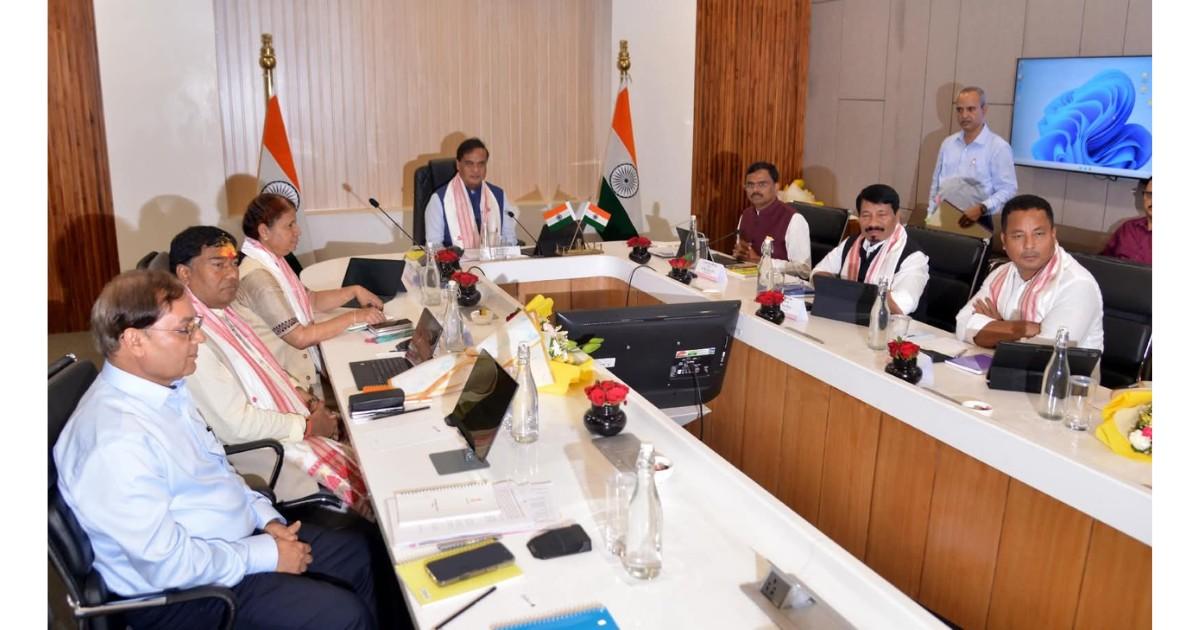
The newly formed Himanta Biswa Sarma 2.0 government on Wednesday outlined a series of administrative and policy decisions in its first Cabinet meeting, with the proposed Uniform Civil Code (UCC) emerging as one of the government’s primary legislative priorities. The Assam government announced that the draft legislation would be introduced in the upcoming session of the Assam Legislative Assembly scheduled later this month.
Addressing the media after the Cabinet meeting in Guwahati, Assam Chief Minister Himanta Biswa Sarma said the new administration had officially taken charge and would soon announce the portfolios of ministers. He also stated that the government’s governance framework would be guided by the Bharatiya Janata Party’s election manifesto, commonly referred to as the Sankalp Patra.
The Cabinet meeting focused not only on the proposed UCC but also on government employment generation, expenditure control measures, administrative appointments and plans to commemorate cultural icon Dr. Bhupen Hazarika.
Assam Government to Introduce UCC Bill in Assembly
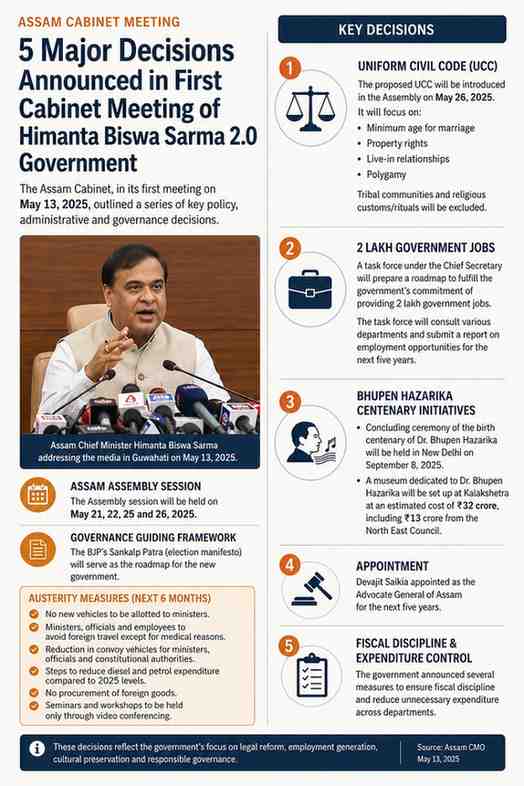
According to the Chief Minister, the Assam Legislative Assembly session will be held on May 21, 22, 25 and 26, during which the government plans to introduce the proposed Uniform Civil Code legislation.
The proposed UCC is expected to address four broad areas — minimum age for marriage, property rights, live-in relationships and polygamy. The government clarified that tribal communities would remain outside the scope of the proposed law. Religious customs and rituals would also not be directly affected by the legislation, according to the state government.
A Uniform Civil Code refers to a common set of personal laws applicable across communities in matters such as marriage, divorce, inheritance and adoption. Currently, many of these issues are governed by religion-specific personal laws in India. The debate around implementing a UCC has remained politically and legally sensitive for decades, with supporters arguing that it promotes equality before law, while critics have raised concerns regarding cultural autonomy and minority rights.
The Assam government’s move comes amid wider national discussions on civil law reforms. Uttarakhand became the first state in independent India to pass legislation related to a Uniform Civil Code earlier, making Assam’s proposal politically significant in the broader national context.
The Chief Minister stated that the proposed legislation in Assam would focus primarily on social and legal safeguards rather than religious practices. The government has indicated that it intends to create a framework dealing with marriage regulations and legal rights while avoiding interference in customary religious traditions.
Employment Roadmap for Two Lakh Government Jobs
Apart from the UCC proposal, employment generation featured prominently in the Cabinet discussions. The government announced the formation of a task force under the Chief Secretary to prepare a roadmap for fulfilling its promise of providing two lakh government jobs.
The task force will conduct consultations with various departments to identify employment opportunities over the next five years. The government said the exercise would focus on assessing vacancies, administrative requirements and future recruitment needs across sectors.
Employment generation has remained a major political issue in Assam, particularly among young job seekers awaiting government recruitment examinations and appointment processes. The Cabinet’s decision indicates that the state government intends to prioritise structured recruitment planning during its new term.
The Chief Minister said the report prepared by the task force would help departments coordinate recruitment strategies and streamline future hiring processes. However, the government has not yet announced a detailed timeline regarding when the recruitment drive would begin or how vacancies would be distributed across departments.
Bhupen Hazarika Museum Planned at Kalakshetra
The Cabinet also approved plans related to the birth centenary celebrations of legendary singer, lyricist and cultural figure Bhupen Hazarika.
The Assam government announced that the concluding ceremony of Dr. Bhupen Hazarika’s birth centenary celebrations would be organised in New Delhi on September 8. The event is expected to mark the culmination of year-long commemorative programmes dedicated to the late artist.
In another cultural initiative, the state government approved the establishment of a museum dedicated to Dr. Bhupen Hazarika at Srimanta Sankardev Kalakshetra in Guwahati. The museum project is estimated to cost around ₹32 crore.
Officials said the North East Council would contribute ₹13 crore towards the project. The museum is expected to preserve archival material, recordings, photographs and memorabilia associated with the life and works of Dr. Hazarika, who remains one of the most influential cultural figures from Northeast India.
Known for songs reflecting themes of humanity, social justice and regional identity, Dr. Bhupen Hazarika’s contributions extended beyond music into cinema, literature and public discourse. The proposed museum is likely to become a significant cultural and tourism project in Assam.
Devajit Saikia Appointed Advocate General
The Cabinet also approved the appointment of Devajit Saikia as the Advocate General of Assam for the next five years.
The Advocate General serves as the highest legal officer of a state government and advises the administration on constitutional, legal and legislative matters. The role becomes particularly significant when governments introduce major legislative reforms or face constitutional litigation.
The appointment comes at a time when the Assam government is preparing to introduce legislation that could face legal scrutiny and public debate, including the proposed Uniform Civil Code framework.
Government Announces Spending Restrictions
Alongside legislative and administrative measures, the Assam Cabinet announced a series of austerity initiatives aimed at reducing government expenditure.
Chief Minister Himanta Biswa Sarma said no new vehicles would be allotted to newly inducted ministers for the next six months. The state government also imposed restrictions on foreign travel by ministers, government officials and employees during this period, except in cases involving medical reasons.
The government further announced plans to reduce the number of convoy vehicles assigned to constitutional authorities, ministers and senior officials. According to the Chief Minister, the administration also intends to lower diesel and petrol expenditure compared to the levels recorded in 2025.
These measures appear to be part of a broader attempt to project fiscal discipline and reduce non-essential expenditure within the state administration. Fuel costs and official travel expenses often form a substantial part of administrative spending, particularly in large state governments.
The Assam government additionally stated that seminars and workshops conducted during the next six months would be held through video conferencing instead of physical events wherever possible. Officials said the decision was intended to minimise operational expenses while also reducing logistical costs.
Push to Reduce Foreign Goods Procurement
In another notable decision, the Cabinet announced that the state government would avoid purchasing foreign goods for the next six months as part of efforts to conserve foreign exchange.
While the government did not specify which categories of goods would be affected, the move aligns with broader national campaigns encouraging domestic procurement and reduced dependence on imports. Such measures are often promoted as part of economic self-reliance initiatives and efforts to strengthen domestic manufacturing sectors.
Analysts believe the announcement may primarily affect government procurement practices rather than consumer markets. However, the effectiveness of such measures will likely depend on the availability of locally manufactured alternatives and implementation guidelines issued by departments.
The decision also reflects a growing trend among state governments to combine fiscal restraint with symbolic economic measures aimed at promoting domestic industries.
The first Cabinet meeting of the Himanta Biswa Sarma 2.0 government has signalled that the administration intends to focus simultaneously on legal reforms, employment generation, fiscal discipline and cultural initiatives. The proposed Uniform Civil Code is likely to dominate political discussions in Assam in the coming weeks as the Assembly session approaches. At the same time, the government’s employment roadmap and austerity measures could shape administrative priorities during the early phase of its new term.
Inputs and images : Hindusthan Samachar
Edited By E. Devanshi varma
Also Read: Assam Assembly Polls See 7 Major Highlights as Turnout Peaks, Counting Set for May 4
Follow us on Google News: Click Here