

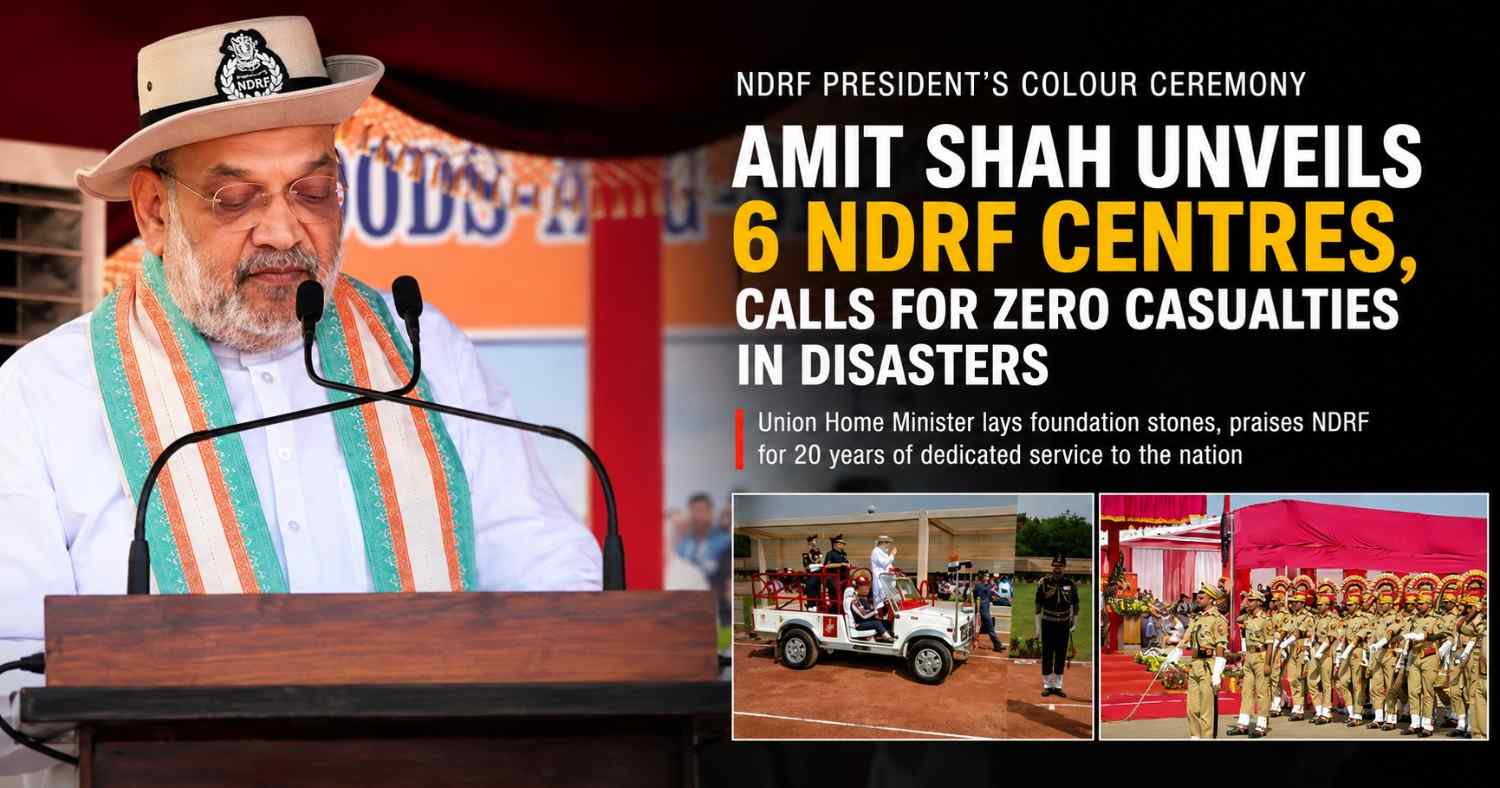
At the NDRF President’s Colour ceremony in Ghaziabad, Union Home Minister Amit Shah said India is strengthening disaster preparedness with new infrastructure, trained volunteers, and technology-driven response systems.
Union Home Minister Amit Shah on Wednesday laid the foundation stones for six new centres of the National Disaster Response Force (NDRF) during the force’s ‘President’s Colour’ investiture ceremony in Ghaziabad, highlighting the government’s push to strengthen disaster response capabilities across the country.
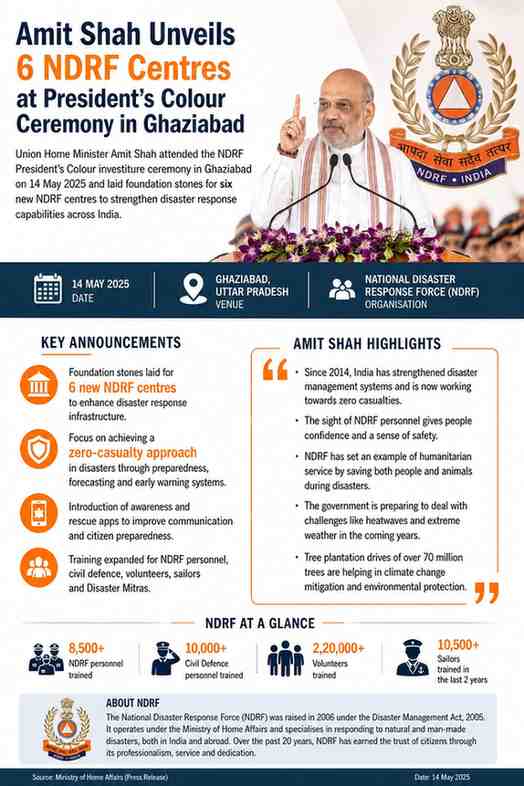
Addressing NDRF personnel and senior officials, Shah said the disaster response force has earned the trust of citizens through its work over the last two decades and has become a symbol of safety during emergencies. He added that the government is now working towards a “zero casualty” approach in disaster management by improving preparedness, forecasting, rescue systems, and public awareness.
The ceremony, held in Ghaziabad, marked a significant occasion for the NDRF, which was awarded the prestigious President’s Colour honour in recognition of its service and contribution in disaster relief operations in India and abroad.
NDRF Expansion to Strengthen Disaster Response
During the event, Shah inaugurated and laid foundation stones for six NDRF-related projects aimed at improving rescue and relief operations. While details of all the projects were not immediately disclosed, the Home Minister said the new facilities would help the force respond faster and more effectively during natural disasters and emergencies.
He noted that India has significantly upgraded its disaster management system since 2014 through institutional reforms, modern technology, and improved coordination between agencies.
According to Shah, the country’s focus has shifted from merely reacting to disasters to preparing in advance through better forecasting and mitigation measures. He stressed that whenever weather departments predict a possible disaster, authorities should work with the objective of ensuring complete safety of both life and property.
“Preparedness and prevention are becoming part of the country’s disaster management culture,” Shah said during his address.
Government Focus on ‘Zero Casualty’ Approach
The Union Home Minister said the government’s long-term goal is to minimise deaths and damage caused by floods, cyclones, landslides, heatwaves, earthquakes, and other natural disasters.
He pointed to improvements in forecasting systems and early warning mechanisms that have helped authorities evacuate vulnerable populations before disasters strike. According to him, the combined efforts of the Home Ministry, weather agencies, and disaster response teams are helping India move closer to reducing casualties during major calamities.
Shah also referred to preparations being made to deal with rising heatwave incidents across several parts of the country. He said authorities are developing systems and awareness measures to reduce the impact of extreme weather conditions in the coming years.
India has witnessed increasingly severe climate-linked weather events in recent years, including prolonged heatwaves, heavy rainfall, floods, and cyclones. Disaster management experts have repeatedly stressed the importance of early warning systems and local-level preparedness to reduce risks.
NDRF’s Role in National and International Rescue Operations
Praising the NDRF’s service record, Shah said the force has established itself as one of the country’s most trusted emergency response organisations over the past 20 years.
Formed in 2006 under the Disaster Management Act, the NDRF functions under the Ministry of Home Affairs and is responsible for specialised disaster response and rescue operations. The force has been deployed in major disasters such as floods, earthquakes, building collapses, industrial accidents, cyclones, and landslides.
The Home Minister said NDRF personnel have not only rescued citizens during emergencies but have also saved animals affected during disasters. He described the force’s work as an example of humanitarian service.
He further said the NDRF has earned recognition beyond India’s borders by participating in international rescue and humanitarian operations. Indian disaster response teams have previously assisted countries affected by earthquakes, floods, and other large-scale emergencies.
“The sight of NDRF personnel gives confidence and reassurance to people during times of crisis,” Shah said.
Large-Scale Training and Volunteer Mobilisation
Shah highlighted the government’s efforts to expand disaster preparedness beyond official agencies by training volunteers and community responders across the country.
According to figures shared during the event, more than 8,500 NDRF personnel have undergone specialised training, along with 10,000 Civil Defence personnel and over 2.2 lakh volunteers. The government has also trained more than 10,500 sailors over the past two years to strengthen water-based rescue operations.
The Home Minister also referred to the role of “Disaster Mitras,” community volunteers trained to assist during emergencies. Several Disaster Mitras attended the ceremony in Ghaziabad.
He said community participation is becoming increasingly important in disaster management, especially in areas vulnerable to floods, storms, and other climate-related events. Volunteers often play a critical role in evacuation drives, relief distribution, and awareness campaigns before official rescue teams arrive.
Experts have frequently noted that local participation can significantly improve disaster response outcomes, particularly in rural and remote regions where immediate access to professional rescue teams may be difficult.
Technology and Awareness Campaigns
Shah said the government has introduced awareness and rescue applications to improve communication and preparedness during emergencies. These digital tools are intended to help authorities share warnings quickly and guide citizens during disasters.
Over the past decade, India has expanded the use of mobile alerts, weather forecasting systems, and real-time monitoring technologies to strengthen disaster preparedness. Several state governments have also introduced district-level disaster management plans and emergency response systems.
The Home Minister said creating awareness among citizens is equally important as strengthening rescue infrastructure. He added that disaster preparedness should become part of public culture rather than remaining limited to government agencies.
Recognition for Environmental Protection Efforts
During his speech, Shah also praised efforts linked to environmental protection and climate resilience. He said tree plantation initiatives involving more than 70 million trees have contributed to environmental conservation and climate change mitigation.
Climate experts have increasingly linked environmental degradation and rising temperatures to the growing intensity of natural disasters worldwide. In India, concerns over extreme weather events have led policymakers to focus more on sustainability, afforestation, and climate adaptation measures.
The Home Minister also commended the work of the Meteorological Department for improving weather forecasting accuracy, which has become crucial in disaster prevention and evacuation planning.
President’s Colour Honour Marks Major Milestone
The President’s Colour is considered one of the highest honours awarded to military and paramilitary forces in India. The recognition is given for exceptional service and contribution to the nation.
For the NDRF, the honour comes as the force completes two decades of operations since its formation. Over the years, the organisation has expanded its capabilities with specialised battalions, modern rescue equipment, and training in chemical, biological, radiological, and nuclear emergencies.
During the ceremony, Shah took the salute at the parade attended by NDRF personnel. NDRF Director General Piyush Kumar Anand welcomed the Home Minister and inspected the parade alongside him in an open jeep.
Senior officials from the Ministry of Home Affairs and disaster management agencies were also present during the investiture ceremony.
The government’s emphasis on strengthening disaster preparedness comes at a time when India is facing increasing risks from climate-related emergencies and extreme weather conditions. With new infrastructure projects, trained volunteers, and expanded rescue capabilities, authorities are aiming to improve response times and reduce losses during future disasters.
Key Insights
- The expansion of NDRF infrastructure reflects India’s broader shift from reactive disaster relief to a prevention-led disaster management strategy. This aligns with global frameworks such as the UN-backed Sendai Framework for Disaster Risk Reduction, which emphasises preparedness, early warning systems, and community resilience.
- The government’s “zero casualty” approach highlights the growing importance of predictive weather technology and coordinated emergency response systems. India has increasingly relied on advance cyclone warnings and evacuation planning in recent years, particularly in coastal states, helping reduce fatalities compared to previous decades.
- The emphasis on volunteer mobilisation and Disaster Mitras indicates a policy focus on decentralised disaster management. Experts have consistently noted that trained local responders are often the first line of support during floods, landslides, and extreme weather events, especially in remote or densely populated regions.
- Climate-linked disasters are becoming more frequent and intense across India, including heatwaves, urban flooding, and extreme rainfall events. The NDRF’s expansion comes amid rising concerns over climate resilience and the need for specialised response forces capable of handling diverse emergencies.
- The President’s Colour honour for the NDRF signals institutional recognition of disaster response as a critical national security and humanitarian function. The force’s increasing deployment in international rescue missions has also strengthened India’s profile in global humanitarian assistance and disaster relief operations.
- The focus on technology-driven preparedness, including mobile alerts and awareness applications, reflects a wider digital transformation in emergency governance. Real-time communication systems are becoming central to reducing response delays and improving coordination between agencies and citizens during crises.
- Increased training for sailors, Civil Defence personnel, and volunteers suggests growing attention toward water-based rescue preparedness, particularly as flood-related disasters continue to affect several Indian states during monsoon seasons.
- The government’s repeated references to environmental protection and afforestation highlight the growing policy link between climate adaptation and disaster mitigation. Experts widely recognise that ecological conservation, sustainable urban planning, and resilient infrastructure are becoming essential components of long-term disaster preparedness in India.
Inputs and images : Hindusthan Samachar
Edited By E. Devanshi varma
Also Read: Assam Assembly Polls See 7 Major Highlights as Turnout Peaks, Counting Set for May 4
Follow us on Google News: Click Here