



India’s domestic stock market opened in positive territory on Thursday, marking a recovery after multiple sessions of volatility and selling pressure. Both benchmark indices — the BSE Sensex and the NSE Nifty — registered gains in early trade, supported by buying activity in banking, automobile, metal, and pharmaceutical stocks.
The BSE Sensex climbed nearly 140 points during the opening session, while the NSE Nifty advanced over 80 points. The rebound comes a day after the market managed to end marginally higher, signaling a possible stabilization in investor sentiment after recent declines.
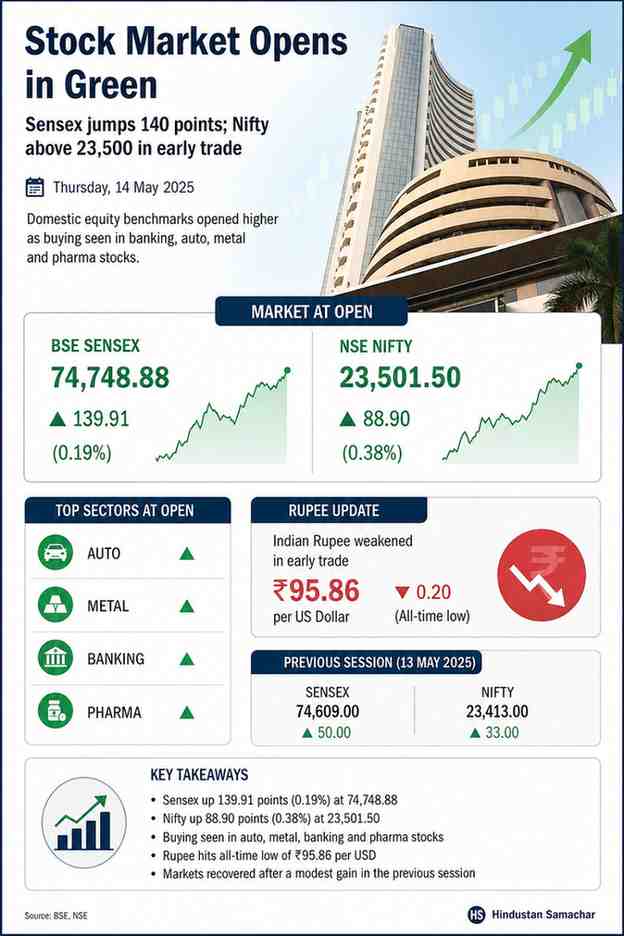
At the opening bell, the Sensex was trading at 74,748.88, up 139.91 points or 0.19 percent. Meanwhile, the Nifty rose 88.90 points, or 0.38 percent, to reach 23,501.50.
Buying Returns to Key Sectors
Market participants witnessed fresh buying interest in several heavyweight sectors on Thursday morning. Banking stocks led the gains, supported by optimism around financial stability and improving liquidity conditions. Auto and metal stocks also saw notable traction, while pharmaceutical companies traded in positive territory.
Analysts said the positive opening reflects cautious optimism among investors after recent corrections in the market. The broader sentiment was supported by value buying in fundamentally strong companies that had witnessed pressure over the past few trading sessions.
Several frontline banking stocks opened with gains, helping benchmark indices maintain momentum in the early hours of trade. Auto companies also attracted investor attention amid expectations of stable demand and improved earnings visibility.
Metal stocks moved higher due to improving global commodity trends and expectations of sustained industrial demand. Pharma shares, which are often viewed as defensive bets during volatile periods, also contributed to the market’s upward movement.
Recovery Follows Previous Session’s Gains
The positive opening on Thursday came after domestic markets closed slightly higher in the previous trading session. On Wednesday, the Sensex had ended around 50 points higher at 74,609, while the Nifty gained 33 points to settle at 23,413.
That recovery had broken a short-term losing streak in the market and provided some relief to investors after several sessions of weakness. Market experts believe Thursday’s opening indicates that traders are cautiously returning to equities, although volatility may continue due to global and domestic economic factors.
The recent market fluctuations have been influenced by mixed global cues, foreign institutional investor activity, inflation concerns, and uncertainty surrounding global interest rates. However, the latest rebound suggests investors are selectively accumulating stocks in sectors considered fundamentally resilient.
Rupee Weakens Against Dollar
Even as equities opened in the green, the Indian rupee remained under pressure in early trade. The domestic currency weakened by 20 paise against the US dollar, touching a record low of 95.86 per dollar.
Currency market experts attributed the weakness to continued demand for the dollar, concerns around global economic uncertainty, and pressure from international crude oil prices. A weaker rupee can increase import costs for India, especially for sectors dependent on foreign commodities and energy imports.
At the same time, some export-oriented sectors may benefit from a weaker currency, particularly information technology and pharmaceutical exporters that earn a significant portion of their revenue in dollars.
The movement of the rupee is likely to remain a closely watched factor for investors in the coming sessions, especially as global financial markets continue reacting to economic data and central bank signals from major economies.
What Is Driving Market Sentiment?
Market sentiment in recent sessions has largely been shaped by a combination of domestic earnings, global economic developments, and investor expectations regarding interest rates.
Investors are also monitoring foreign institutional investor (FII) activity, which plays a major role in determining short-term market direction. Heavy selling by FIIs in recent sessions had contributed to downward pressure on benchmark indices. However, Thursday’s gains indicate that domestic investors and selective institutional buying may be helping stabilize the market.
Another factor supporting sentiment is the expectation that India’s economic growth outlook remains comparatively strong despite global uncertainty. Sectors linked to infrastructure, manufacturing, financial services, and consumption continue to attract long-term investor interest.
Market analysts note that while short-term volatility remains possible, the broader structural outlook for the Indian economy continues to support equity markets over the long term.
Banking Stocks Remain in Focus
Banking shares remained among the top contributors to Thursday’s gains. Financial institutions often influence broader market direction due to their large weightage in benchmark indices like the Sensex and Nifty.
Private sector banks witnessed buying interest during opening trade, while select public sector lenders also traded higher. Analysts believe banking stocks are benefiting from expectations of steady credit growth, improving asset quality, and resilient loan demand.
Strong participation from banking stocks often provides confidence to the broader market because the sector is viewed as a key indicator of economic activity and consumer demand.
The Reserve Bank of India’s monetary policy stance and future interest rate decisions are also expected to remain important triggers for banking shares in the coming months.
Auto Sector Sees Renewed Investor Interest
Automobile stocks also witnessed positive momentum during early trading hours. Investors are closely tracking demand trends in passenger vehicles, commercial vehicles, and electric mobility segments.
Industry experts believe improving rural demand, festive season expectations, and stable raw material prices could support the sector’s outlook in the coming quarters.
Several leading auto manufacturers have also announced expansion plans and new product launches, contributing to positive investor sentiment around the sector.
The auto industry remains an important component of India’s manufacturing economy and is often considered a reflection of broader consumer spending patterns.
Metal and Pharma Stocks Add Support
Metal companies contributed to the market’s upward movement amid improving global commodity prices and expectations of infrastructure demand. Investors are also watching developments in global manufacturing activity, which significantly impacts metal consumption trends.
Meanwhile, pharmaceutical stocks traded positively as investors sought relatively stable sectors amid market uncertainty. The pharma industry has remained an important contributor to India’s export economy and continues to attract investor attention due to its global reach and defensive characteristics.
Healthcare and pharma stocks are often preferred during periods of uncertainty because of their comparatively stable demand outlook.
Analysts Warn Volatility May Continue
Despite Thursday’s positive opening, market experts cautioned that volatility could continue in the near term. Global economic uncertainties, geopolitical developments, crude oil prices, and central bank policies remain major factors influencing investor sentiment worldwide.
Analysts advise investors to focus on fundamentally strong companies and avoid panic-driven decisions during short-term fluctuations. They also suggest that sector-specific opportunities may emerge as markets react to earnings reports and macroeconomic developments.
Retail investors are increasingly participating in Indian equity markets, but experts recommend maintaining a long-term investment perspective rather than reacting to daily market swings.
Why the Market Recovery Matters
The rebound in domestic equities is significant because it reflects improving confidence after a phase of sustained selling pressure. Positive market openings often influence investor psychology and can encourage broader participation from institutional and retail investors.
India’s stock market remains closely tied to economic growth expectations, corporate earnings performance, and global financial trends. As one of the world’s fastest-growing major economies, India continues to attract investor interest despite short-term market fluctuations.
The coming trading sessions are expected to remain important as investors monitor corporate earnings, currency movements, global market trends, and economic indicators for further direction.
With benchmark indices recovering and sectoral buying returning, market participants will be watching whether the current momentum sustains through the remainder of the trading week.
Key Insights
- The recovery in benchmark indices indicates that investors are selectively returning to large-cap and fundamentally strong sectors after recent market corrections, suggesting that confidence in India’s long-term economic outlook remains intact despite short-term volatility.
- Banking stocks leading the gains is significant because financial institutions carry substantial weight in both the Sensex and Nifty. Sustained strength in banking shares is often viewed as a signal of confidence in credit growth, business activity, and broader economic stability.
- The simultaneous rise in equities and decline in the rupee highlights the complex nature of current market conditions. While domestic investors appear optimistic about corporate earnings and economic growth, currency weakness reflects ongoing concerns around global capital flows, crude oil prices, and external economic pressures.
- Auto and metal sector gains suggest that investors continue to track India’s manufacturing and infrastructure outlook closely. These sectors are often considered indicators of industrial demand, consumer spending, and government-led economic activity.
- The rupee touching a record low against the US dollar could have mixed implications for the economy. Import-dependent industries may face higher input costs, while export-oriented sectors such as information technology and pharmaceuticals could benefit from improved overseas revenue realization.
- Continued volatility in global markets, particularly around interest rate expectations and geopolitical developments, is likely to keep foreign institutional investor activity in focus. FII flows remain a major driver of short-term market direction in emerging economies like India.
- The rebound also reflects growing participation by domestic institutional investors and retail investors, which has increasingly helped cushion Indian markets during periods of foreign capital outflows in recent years.
- Market experts continue to emphasize that sector-specific opportunities may emerge even during volatile phases, especially in industries linked to infrastructure, consumption, healthcare, and financial services, which are closely tied to India’s domestic growth story.
- Investors will closely monitor upcoming corporate earnings, inflation data, RBI policy signals, and global economic indicators to assess whether the current recovery can sustain momentum over the coming trading sessions
Inputs and images : Hindusthan Samachar
Edited By E. Devanshi varma
Also Read: Assam Assembly Polls See 7 Major Highlights as Turnout Peaks, Counting Set for May 4
Follow us on Google News: Click Here