

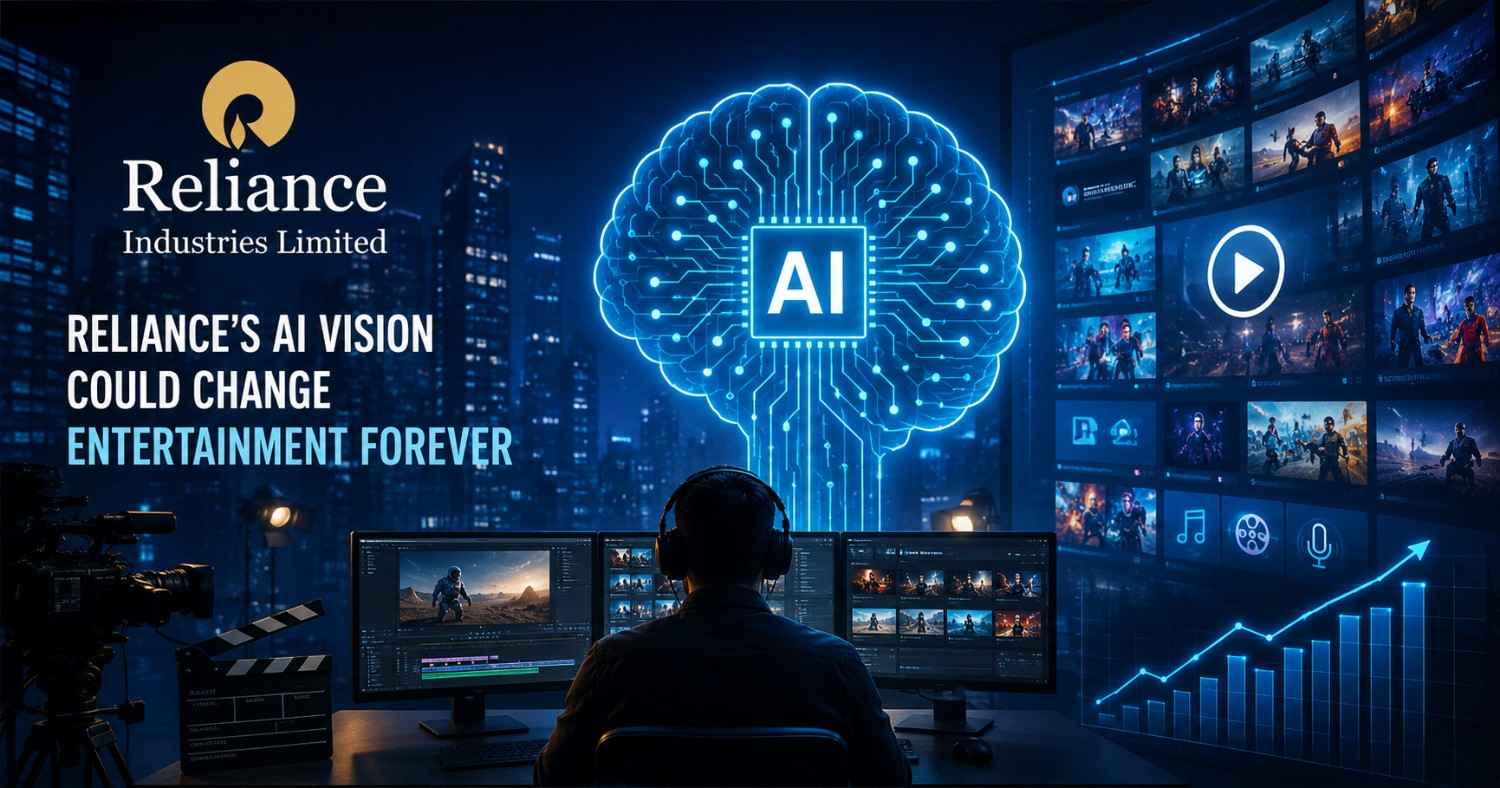
India’s entertainment industry is entering a new phase of transformation as artificial intelligence increasingly becomes part of content creation, distribution, personalization, and audience engagement. Among the companies positioning themselves at the center of this shift is Reliance Industries, whose growing investments across telecommunications, digital infrastructure, media, and technology suggest an ambitious vision for the future of entertainment.
As AI reshapes industries worldwide, media and entertainment companies are exploring how intelligent technologies can streamline production, improve user experiences, reduce costs, and unlock entirely new forms of storytelling. Reliance’s expanding ecosystem—spanning connectivity, streaming platforms, content production, and digital services—places it in a unique position to influence how AI is integrated into India’s entertainment landscape.
The company’s strategy comes at a time when global media giants are rapidly adopting AI-powered tools to gain competitive advantages. From recommendation algorithms and automated editing systems to virtual production environments and AI-assisted content creation, the entertainment sector is undergoing changes that could redefine how audiences consume media over the next decade.
A Strategic Moment for India’s Entertainment Industry
India is one of the world’s fastest-growing media and entertainment markets. Rising smartphone penetration, affordable internet access, expanding digital subscriptions, and increasing demand for regional-language content have created significant opportunities for innovation.
Reliance’s influence in telecommunications through Jio has already transformed internet accessibility for millions of consumers. Industry observers believe the next phase could involve leveraging AI technologies across content ecosystems, potentially changing how entertainment is produced and delivered.
The convergence of high-speed connectivity, cloud computing, data analytics, and artificial intelligence is creating conditions that allow media companies to understand audience behavior with unprecedented precision. This capability may become a critical competitive advantage as consumer preferences continue to evolve.
Personalized Entertainment Could Become More Advanced
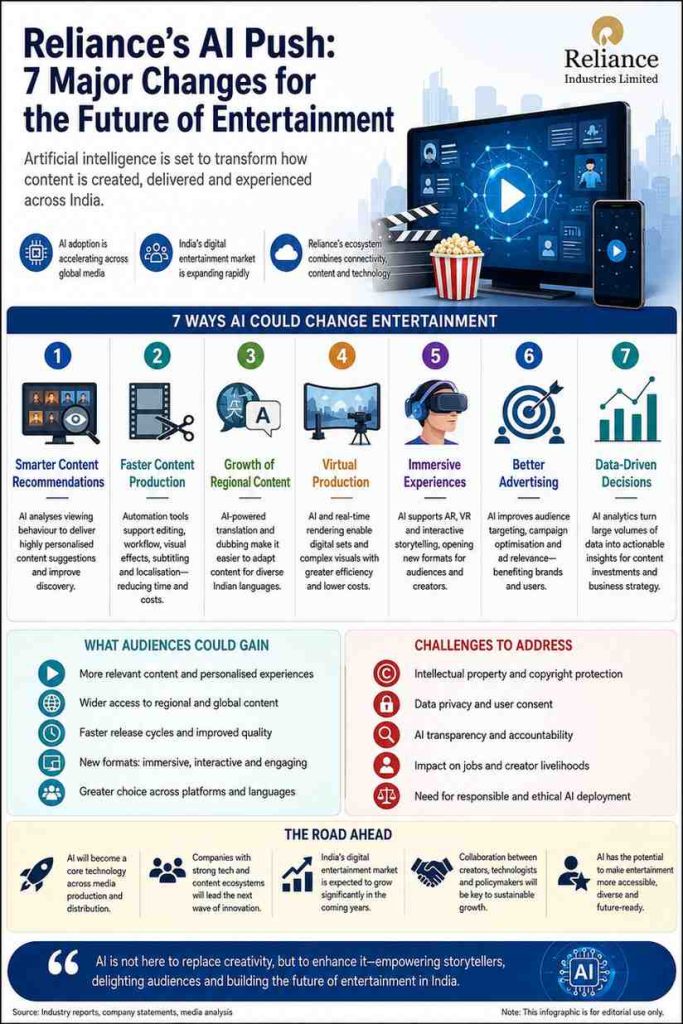
One of the most immediate impacts of AI in entertainment is personalization.
Streaming platforms already use recommendation systems to suggest movies, television shows, and music based on viewing habits. However, newer AI technologies can analyze user preferences at a deeper level, enabling highly customized experiences.
For companies operating large digital ecosystems, AI can help identify content trends, predict audience interests, and improve engagement. This may lead to more relevant recommendations, curated viewing experiences, and personalized content discovery across multiple platforms.
For consumers, the result could be less time spent searching for content and more accurate recommendations aligned with individual interests.
Content Production May Become Faster and More Efficient
Artificial intelligence is increasingly being used throughout the content production process.
AI-powered tools can assist with script analysis, editing, visual effects workflows, subtitling, translation, metadata generation, and production planning. While these technologies are not replacing creative professionals, they are helping production teams work more efficiently.
As India’s entertainment industry produces content in numerous languages and formats, automation could significantly reduce production timelines and operational costs.
Reliance’s broad digital infrastructure could support the deployment of AI-driven production tools across multiple content divisions, helping creators manage larger volumes of content while maintaining quality standards.
The ability to accelerate production may become especially important as audience demand for fresh digital content continues to grow.
Regional Content Could Receive a Major Boost
Regional-language has emerged as one of the strongest growth segments in India’s media industry.
AI-powered translation, dubbing, and localization technologies are improving rapidly, making it easier to adapt content for diverse audiences. Advanced voice synthesis and language processing tools can help media companies expand the reach of content across multiple linguistic markets.
For a country as linguistically diverse as India, these capabilities could create significant opportunities.
Content originally produced for one region could be efficiently adapted for viewers across the country, increasing accessibility and audience reach. This may also help smaller creators connect with larger audiences without the traditional barriers associated with language localization.
Virtual Production and Immersive Experiences Are Expanding
Globally, entertainment companies are investing heavily in virtual production technologies that combine AI, real-time rendering, and advanced digital environments.
These systems allow filmmakers and content creators to produce complex scenes without relying entirely on physical sets and locations. AI can assist in generating realistic environments, visual effects, and production assets, reducing costs while expanding creative possibilities.
As consumer expectations evolve, immersive entertainment experiences—including augmented reality, virtual reality, and interactive storytelling—are expected to become increasingly important.
Companies with strong digital infrastructure and technology capabilities may be better positioned to develop and distribute these next-generation entertainment formats.
Advertising and Audience Engagement Could Be Reimagined
Advertising remains a major revenue source across the entertainment ecosystem.
Artificial intelligence enables more sophisticated audience segmentation, campaign optimization, and content targeting. Instead of broad demographic categories, advertisers can increasingly reach audiences based on behavior, interests, and engagement patterns.
For media companies, this can improve advertising efficiency while potentially creating more relevant experiences for users.
Reliance’s integrated ecosystem of connectivity, digital services, and media platforms could provide valuable data-driven insights that support advanced advertising strategies.
As digital advertising evolves, AI-powered personalization is likely to become a significant differentiator in audience engagement and monetization efforts.
Data Could Become the Foundation of Future Media Strategy
The entertainment industry is increasingly becoming a data-driven business.
AI systems can analyze massive volumes of information related to viewing habits, content performance, subscriber behavior, and market trends. These insights help companies make informed decisions regarding investments, programming, and content development.
For large-scale media organizations, data analytics can reduce uncertainty in content planning while improving operational efficiency.
Reliance’s extensive digital footprint potentially provides access to large-scale consumer insights that could inform future strategies. The ability to combine connectivity data, platform engagement metrics, and content consumption patterns may offer advantages in understanding changing audience preferences.
Challenges and Industry Concerns Remain
Despite the opportunities, the integration of AI into raises important questions.
Industry stakeholders continue to debate issues related to intellectual property rights, transparency, creative ownership, data privacy, and employment impacts. Regulators worldwide are also evaluating how AI technologies should be governed within creative industries.
Balancing innovation with responsible implementation will be essential as AI adoption accelerates.
Media companies deploying AI systems must ensure that technology supports creativity rather than undermines it. Maintaining audience trust and protecting creator rights are likely to remain critical priorities.
Why This Matters
The significance of Reliance’s AI ambitions extends beyond a single company.
India’s entertainment sector is projected to experience substantial growth over the coming years, driven by digital consumption, mobile connectivity, and evolving audience expectations. AI has the potential to become a foundational technology underpinning this expansion.
If successfully integrated across content creation, distribution, personalization, and monetization, AI could reshape how entertainment is produced and consumed throughout the country.
For audiences, this may mean more personalized experiences, broader content choices, improved accessibility, and innovative forms of storytelling. For creators and businesses, it could unlock new efficiencies, revenue opportunities, and creative possibilities.
As technology and media continue to converge, the companies that successfully combine connectivity, content, and artificial intelligence may help define the next chapter of entertainment. Reliance appears determined to be among the organizations competing for that role, and the outcome could influence the future direction of India’s digital media ecosystem for years to come.
Highlights
- Reliance is positioning artificial intelligence as a major component of its future media and entertainment strategy.
- AI technologies could improve content personalization, helping audiences discover more relevant movies, shows, and digital content.
- Automation tools are expected to streamline content production, editing, localization, and distribution processes.
- Regional-language entertainment may benefit from advances in AI-powered translation and dubbing technologies.
- Virtual production, immersive experiences, and interactive storytelling are emerging as important growth areas.
- AI-driven analytics could help media companies better understand audience behavior and optimize business decisions.
- Industry experts continue to monitor concerns around intellectual property, data privacy, and responsible AI deployment.
FAQ
What is Reliance’s AI vision for entertainment?
Reliance is expanding its focus on artificial intelligence across digital services, media platforms, content distribution, and audience engagement, aiming to enhance entertainment experiences through technology.
How can AI change the entertainment industry?
AI can improve content recommendations, automate production tasks, support localization, enhance advertising, and help companies better understand audience preferences.
Why is AI important for streaming platforms?
AI enables personalized recommendations, improved content discovery, targeted engagement strategies, and data-driven decision-making for content investments.
How could AI benefit regional-language content?
Advanced translation, dubbing, and language-processing technologies can help content reach audiences across multiple linguistic regions more efficiently.
Will AI replace human creators in entertainment?
Most industry experts view AI as a tool that assists creators rather than replacing them entirely. Human creativity, storytelling, and artistic judgment remain essential.
What role does data play in AI-powered entertainment?
Data helps AI systems identify audience preferences, content trends, engagement patterns, and viewing behaviors that can inform business and creative decisions.
What challenges are associated with AI in media?
Key concerns include copyright protection, content authenticity, creator rights, data privacy, transparency, and ethical use of AI-generated content.
Why is India’s market significant for AI adoption?
India’s large digital audience, expanding internet access, growing streaming market, and demand for regional content create strong opportunities for AI-driven innovation.
Edited By E. Devanshi varma
Also Read: IPL Honey-Trap Row Sparks 7 Big Questions Before Playoffs
Follow us on Google News: Click Here