

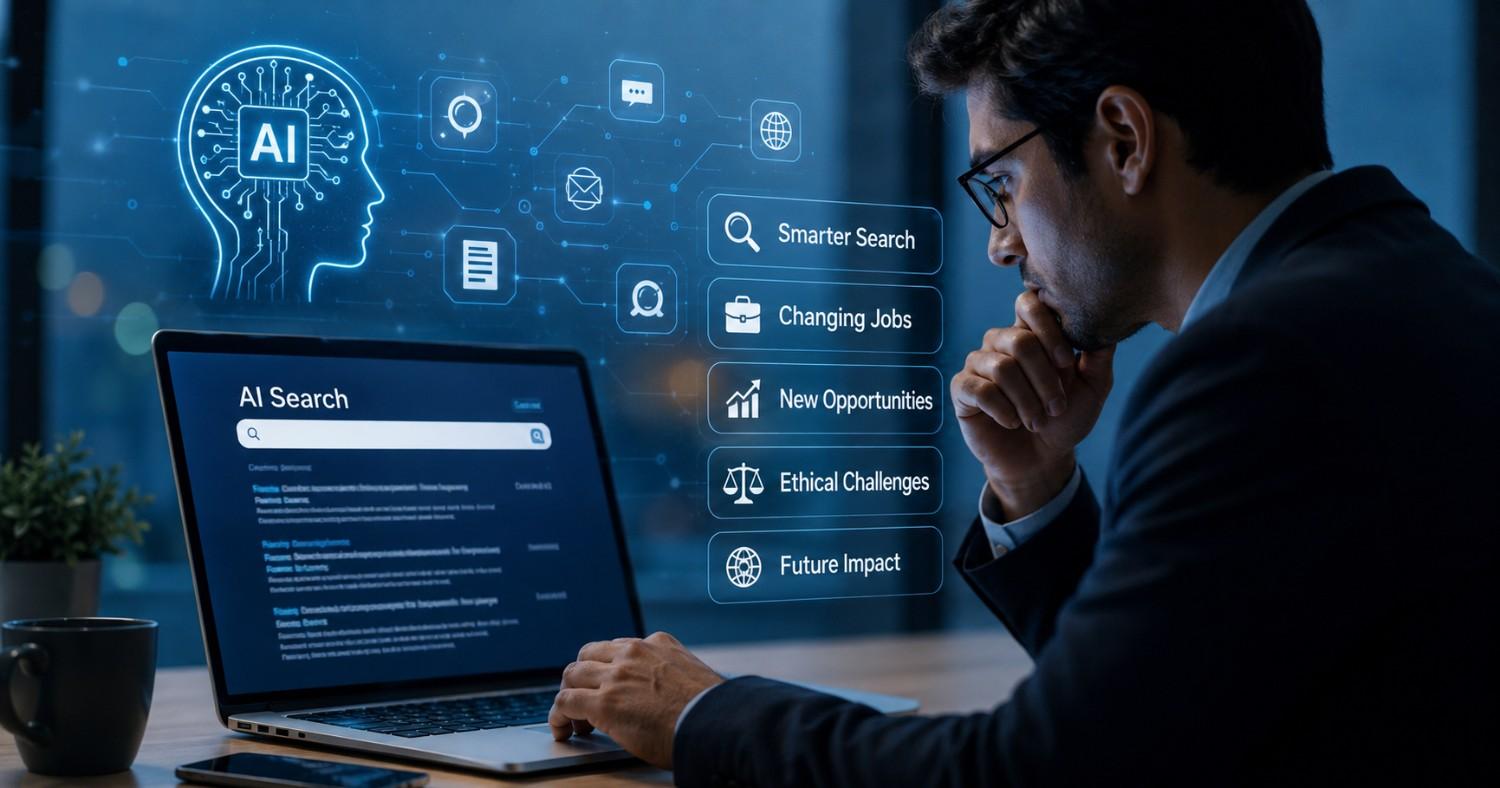
Artificial intelligence is rapidly reshaping the way people interact with the internet, raising major questions about the future of traditional search engines, online businesses, and millions of jobs connected to the digital economy. From AI chatbots answering questions instantly to automated systems generating content, coding software, and assisting businesses, the pace of change has accelerated significantly over the past two years.
What was once considered an experimental technology has now become part of mainstream consumer behavior. AI-powered assistants are increasingly being used for research, recommendations, writing, learning, and productivity tasks that were previously handled through traditional search engines or human-driven workflows.
The shift is prompting intense debate across industries: Will AI eventually replace traditional search? And how deeply will automation affect jobs in the years ahead?
Search Is Changing Faster Than Many Expected
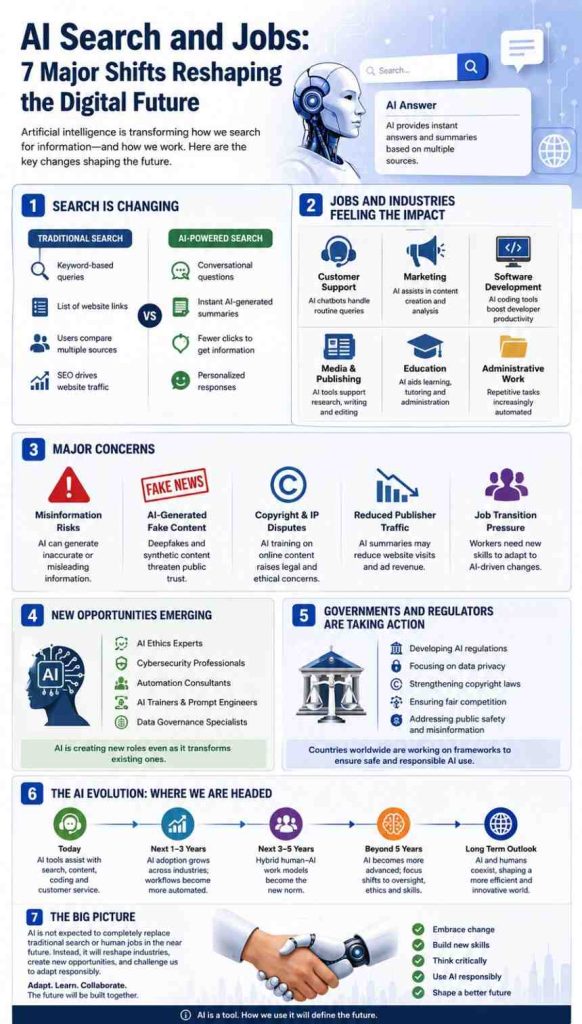
For decades, internet search followed a familiar model. Users typed keywords into a search engine, browsed links, compared sources, and visited websites for information. That ecosystem supported publishers, advertisers, businesses, and creators worldwide.
AI-driven systems are beginning to change that structure.
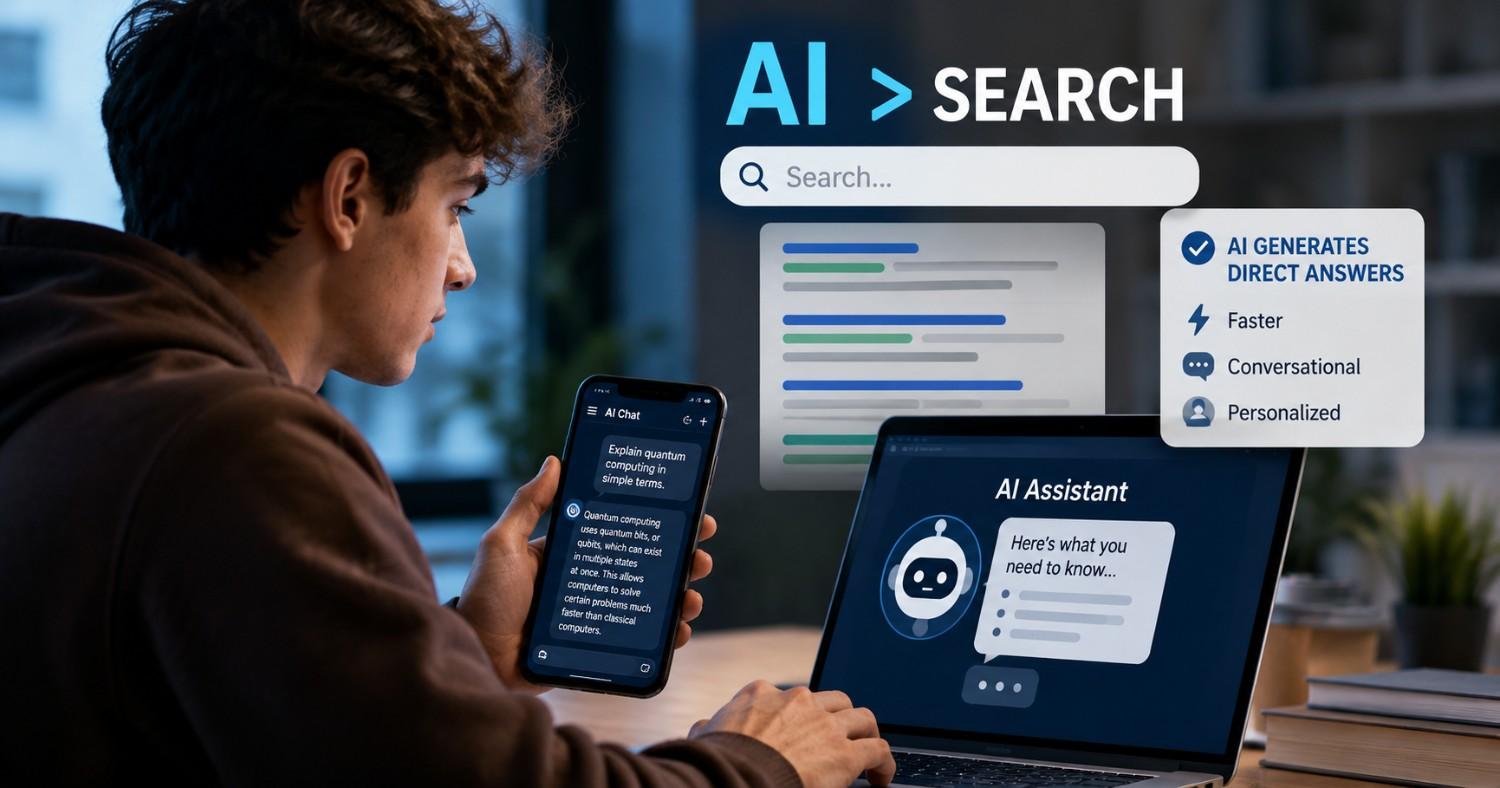
Instead of displaying a list of links, many AI tools now provide direct conversational answers. Users can ask complex questions in natural language and receive summarized responses within seconds. Major technology companies are integrating AI-generated results directly into search products, while standalone AI assistants are becoming everyday tools for students, professionals, and consumers.
This shift has significant implications for the broader web economy. Publishers and content creators depend heavily on website traffic generated through search engines. If users increasingly receive answers without clicking through to websites, advertising revenue and audience engagement models may face disruption.
Industry analysts have noted that AI search systems may fundamentally alter how information is distributed online. Rather than rewarding websites that rank highly through traditional SEO strategies, AI systems often prioritize synthesized responses generated from multiple sources.
That transition could reshape digital publishing, online marketing, and content discovery in the coming years.
Traditional Search Engines Are Adapting
Despite growing interest in AI assistants, traditional search engines are far from disappearing. Instead, many companies are aggressively evolving their products to remain competitive.
Search platforms are increasingly incorporating AI-generated summaries, conversational interfaces, and predictive tools into existing systems. The goal is to retain users while improving speed and personalization.
However, AI-generated answers have also created concerns about reliability. Researchers, educators, and journalists have repeatedly highlighted cases where AI systems produced inaccurate information, fabricated citations, or misleading responses presented confidently as facts.
This has reinforced the continued importance of trusted reporting, verified sources, and editorial oversight.
Many experts believe traditional search and AI-assisted search may coexist rather than one completely replacing the other. Conventional search still plays a major role in shopping, navigation, news verification, academic research, and source comparison — areas where users often prefer direct access to websites and primary information.
At the same time, AI tools are increasingly becoming the first stop for quick explanations, summaries, brainstorming, and workflow support.
The Job Market Is Already Feeling the Impact
The debate around AI and employment has intensified as companies adopt automation tools across sectors. While fears of widespread job replacement continue, labor economists generally describe the current phase as one of transformation rather than immediate mass elimination.
Several industries are already seeing noticeable changes.
Customer support teams are using AI chat systems to handle routine queries. Marketing departments are automating content drafting and data analysis. Software developers are integrating AI coding assistants into daily workflows. Media organizations are experimenting with AI-assisted research and transcription tools.
Administrative and repetitive digital tasks are particularly vulnerable to automation because AI systems can process information quickly and operate continuously.
However, many experts argue that AI also creates new opportunities alongside disruption. Historically, major technological shifts — including the rise of computers and the internet — eliminated certain roles while generating entirely new industries and professions.
New demand is already emerging for AI trainers, prompt engineers, AI ethics specialists, automation consultants, cybersecurity professionals, and data governance experts. Companies also continue to require human oversight for strategy, decision-making, legal accountability, and creative direction.
The larger concern for many workers is not necessarily complete job loss, but changing skill requirements. Employees across industries may increasingly need digital literacy, adaptability, and AI collaboration skills to remain competitive.
Creative Industries Face Complex Challenges
One of the most debated areas of AI disruption involves creative and knowledge-based professions.
Generative AI systems can now produce articles, illustrations, music, marketing copy, code, and video content at remarkable speed. This has raised concerns among writers, designers, artists, educators, and media professionals about long-term career stability and intellectual property protection.
Critics argue that some AI systems are trained using large datasets sourced from publicly available online content, including copyrighted material. Lawsuits and regulatory disputes involving AI companies, publishers, and creative professionals are continuing in multiple countries.
Supporters of AI technology argue that these tools should be viewed as productivity enhancers rather than direct replacements for human creativity. They point out that AI-generated outputs often still require editing, verification, originality checks, and contextual judgment.
In practice, many businesses are currently adopting hybrid models where AI accelerates production while human professionals supervise quality and accuracy.
The outcome may depend heavily on regulation, licensing frameworks, and how industries adapt to new workflows over time.
Misinformation and Trust Remain Major Concerns
As AI-generated content becomes easier to create at scale, misinformation risks are also increasing.
Deepfakes, synthetic media, AI-generated fake articles, and manipulated audio clips have raised alarm among governments, cybersecurity experts, and media organizations. The ability to generate convincing but false information quickly poses challenges for elections, public trust, and online safety.
AI search systems themselves can sometimes amplify inaccuracies if responses are generated from unreliable or conflicting data sources.
This has renewed discussions around media literacy and fact-checking. Experts increasingly encourage users to verify important information through multiple trusted sources rather than relying entirely on a single AI-generated answer.
News organizations and educational institutions are also adapting their policies around AI usage, transparency, and verification standards.
The broader issue extends beyond technology alone. The future of AI-driven information systems may ultimately depend on whether users continue to value credible reporting, transparent sourcing, and accountable journalism.
Governments and Regulators Are Watching Closely
Countries worldwide are beginning to develop frameworks for AI governance as adoption accelerates.
Regulators are examining issues including data privacy, algorithmic transparency, copyright protections, labor disruption, competition policy, and online misinformation. Policymakers are also debating how to balance innovation with public safeguards.
Some governments have proposed risk-based AI regulations targeting high-impact sectors such as healthcare, finance, education, and law enforcement. Others are investing heavily in AI infrastructure to remain competitive globally.
Technology companies, meanwhile, are competing aggressively for dominance in AI services, cloud computing, and search integration. The race has intensified investment across the sector, with billions of dollars flowing into AI research and infrastructure development.
This competition is likely to influence not only technology markets but also geopolitical and economic strategies over the next decade.
Why the Debate Matters Beyond Technology
The discussion around AI replacing search or jobs is ultimately larger than technology itself. It touches education, employment, media sustainability, business models, public trust, and economic inequality.
Small businesses that rely on web traffic may need to rethink digital strategies. Students may need different career preparation. Workers may face pressure to continuously adapt to changing tools and expectations.
At the same time, AI also offers potential benefits including faster access to information, improved productivity, medical research support, accessibility tools, and operational efficiency across industries.
The long-term outcome may depend less on whether AI exists and more on how societies choose to integrate it responsibly.
Most analysts do not expect traditional search engines or human employment to disappear entirely in the near future. Instead, the current transition appears more likely to produce a hybrid digital environment where AI systems handle routine processes while humans focus on judgment, oversight, creativity, ethics, and complex decision-making.
The next few years will likely determine how balanced that relationship becomes — and whether AI evolves into a tool that broadly enhances human capability or one that deepens economic and informational disruption.
Highlights
- AI-powered search tools are changing how people discover information online, reducing reliance on traditional search engines in some areas.
- Industries including customer service, content creation, software development, and digital marketing are already seeing workflow changes due to generative AI.
- Experts believe AI is more likely to reshape jobs rather than completely eliminate most professions in the near term.
- Search engines are increasingly integrating conversational AI features to compete with standalone AI assistants and chatbots.
- Concerns around misinformation, accuracy, copyright, and internet traffic distribution continue to grow as AI search adoption expands.
- Businesses and workers are being pushed to adapt quickly as automation and AI-assisted productivity tools become mainstream.
- Governments and regulators worldwide are beginning to debate how AI systems should be governed, monitored, and ethically deployed.
FAQ
What is AI-powered search?
AI-powered search uses artificial intelligence to provide conversational or summarized answers to user questions instead of only displaying a list of website links.
Will AI completely replace traditional search engines?
Most experts believe traditional search engines will continue to exist, but they are expected to evolve with more AI-assisted features and conversational tools.
Which jobs are most vulnerable to AI automation?
Roles involving repetitive digital tasks, basic data processing, routine customer support, and standardized content generation may face higher automation risk.
Is AI already affecting employment?
Yes. Many industries are using AI tools to automate workflows, improve productivity, and reduce time spent on repetitive tasks.
Can AI-generated information be inaccurate?
Yes. AI systems can sometimes produce incorrect or misleading information, which is why verification through trusted sources remains important.
Why are publishers concerned about AI search?
Publishers worry that AI-generated summaries may reduce website traffic, affecting advertising revenue and audience engagement.
Are governments regulating AI technology?
Many governments are developing regulations related to AI safety, privacy, copyright, competition, and misinformation risks.
Will AI create new jobs as well?
Historically, technological shifts have created new industries and roles. AI is already generating demand for specialists in AI ethics, cybersecurity, automation, and data management.
How can workers prepare for AI-driven changes?
Experts recommend improving digital literacy, learning AI-assisted tools, adapting to evolving technologies, and focusing on skills involving creativity, strategy, and critical thinking.
Why is the AI debate important for ordinary internet users?
AI affects how people access information, interact online, consume news, work, study, and protect themselves from misinformation or digital manipulation.
Edited By E. Devanshi varma
Also Read: Assam Assembly Polls See 7 Major Highlights as Turnout Peaks, Counting Set for May 4
Follow us on Google News: Click Here