


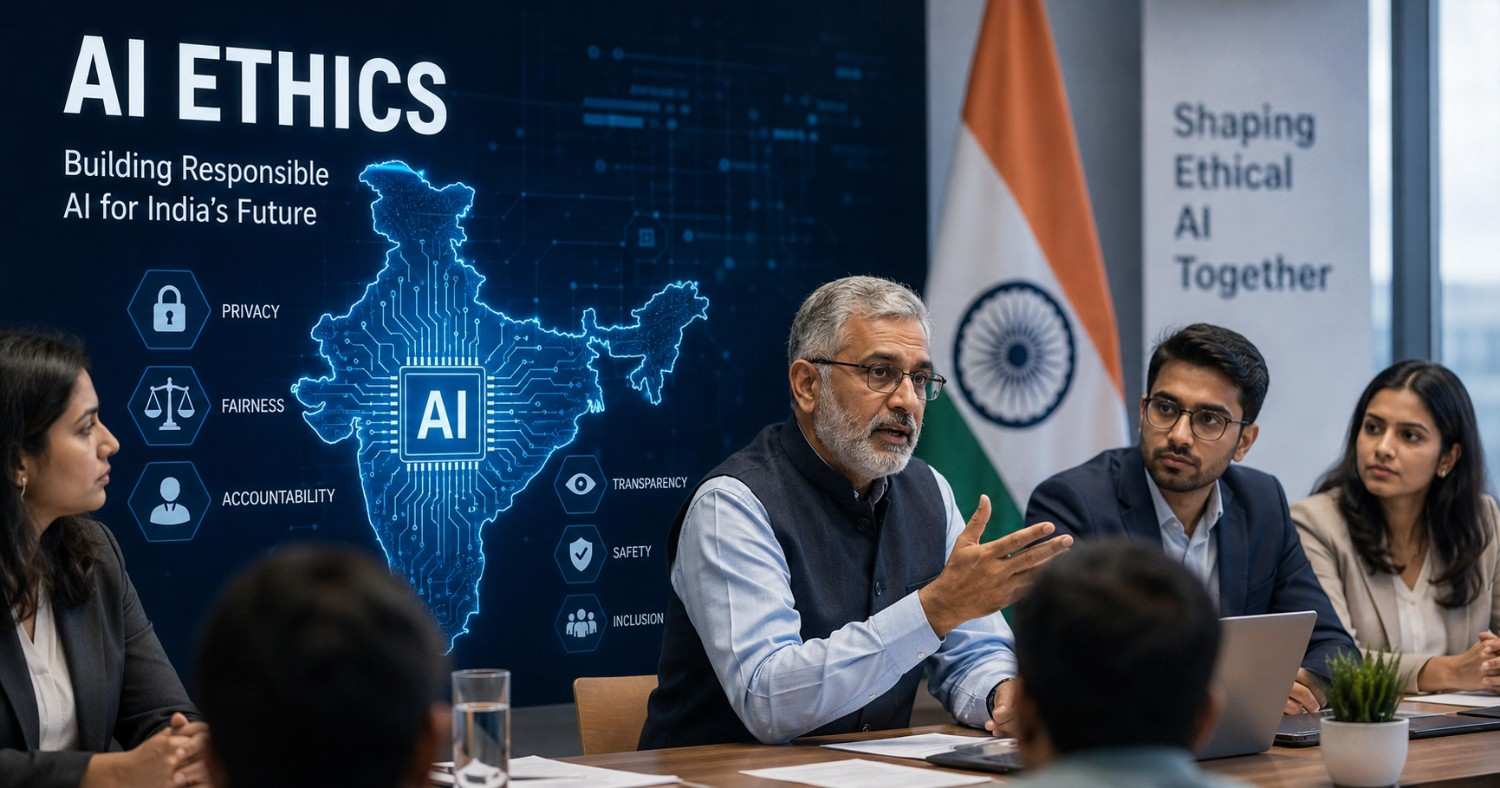
India’s conversation around artificial intelligence is entering a new phase. While the country continues to embrace AI-powered innovation across industries, discussions about ethical safeguards, accountability, transparency, privacy and responsible deployment are becoming increasingly prominent.
Government agencies, technology companies, academic institutions, industry associations and policy experts are now examining how India can balance rapid AI adoption with public trust and social responsibility. As AI systems become more influential in decision-making, content creation, healthcare, education, finance and governance, questions surrounding ethical standards are gaining urgency.
The growing debate reflects a broader global trend. Countries around the world are exploring frameworks to ensure that AI technologies remain safe, transparent and beneficial to society. For India, which aims to become a leading digital economy, the challenge lies in encouraging innovation while preventing misuse and unintended consequences.
Why the Discussion Is Gaining Momentum
Artificial intelligence is no longer a futuristic concept. AI tools are increasingly embedded in everyday life, from recommendation systems and customer service chatbots to advanced analytics and generative AI applications capable of creating text, images, audio and video.
The rapid expansion of these technologies has raised concerns about how AI systems are developed, trained and deployed. Questions surrounding data privacy, algorithmic bias, misinformation, intellectual property rights and accountability have become central to policy discussions.
India’s growing digital ecosystem makes these conversations particularly significant. With one of the world’s largest internet user bases and a rapidly expanding startup environment, decisions made today could influence how AI affects millions of citizens in the coming years.
Industry experts argue that ethical frameworks are not obstacles to innovation but essential foundations for sustainable technological growth. Establishing trust may ultimately determine how widely AI technologies are accepted by businesses, governments and the public.
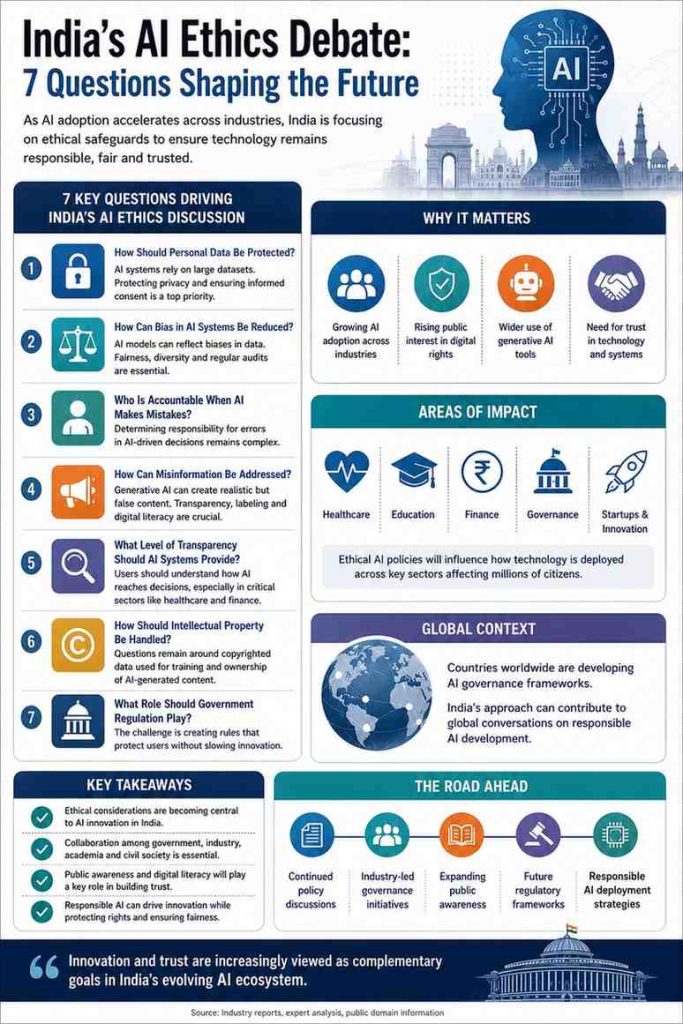
The Seven Questions Driving India’s AI Ethics Debate
1. How Should Personal Data Be Protected?
One of the most important issues involves the use of personal information for AI training and deployment.
AI systems often rely on vast datasets to improve performance and accuracy. This has led to discussions about consent, data collection practices and privacy protections. Policymakers and privacy advocates are exploring how existing regulations and future frameworks can ensure that individuals retain control over their personal information.
The challenge is particularly relevant as organizations increasingly use AI-driven services that process large volumes of user data.
2. How Can Bias in AI Systems Be Reduced?
AI models learn from historical datasets, which may contain social, cultural or demographic biases.
If left unchecked, these biases can influence hiring decisions, lending assessments, healthcare recommendations and other critical applications. Experts argue that developers should regularly evaluate AI systems for fairness and inclusivity.
Ensuring diverse training datasets and conducting independent audits are among the approaches frequently discussed in policy and academic circles.
3. Who Is Accountable When AI Makes Mistakes?
As AI becomes more autonomous, determining responsibility for errors becomes increasingly complex.
If an AI-powered system generates inaccurate information, makes a flawed recommendation or causes harm through an automated decision, questions arise regarding accountability. Should responsibility rest with developers, organizations deploying the technology, service providers or another stakeholder?
Establishing clear accountability structures is viewed as a crucial component of responsible AI governance.
4. How Can Misinformation Be Addressed?
The rise of generative AI has transformed content creation. While these tools offer significant benefits, they have also increased concerns about synthetic media, deepfakes and misinformation.
AI-generated content can sometimes be difficult to distinguish from authentic material, creating challenges for public discourse, journalism and online trust.
Experts suggest that transparency mechanisms, content labeling practices and digital literacy initiatives could help address these concerns while preserving innovation.
5. What Level of Transparency Should AI Systems Provide?
Many advanced AI models operate as complex systems that users may not fully understand.
This has led to calls for greater transparency regarding how AI systems reach conclusions or recommendations. In sectors such as healthcare, finance and public services, explainability is often considered especially important.
Supporters of transparency argue that individuals affected by AI-driven decisions should have access to understandable explanations whenever possible.
6. How Should Intellectual Property Be Handled?
The growth of generative AI has sparked debates about copyright, ownership and content creation.
Questions have emerged regarding the use of copyrighted materials in AI training datasets, as well as the ownership of AI-generated outputs. These discussions are taking place globally and are increasingly relevant for India’s creative industries, technology companies and legal experts.
Finding a balance between innovation and intellectual property protections remains an evolving challenge.
7. What Role Should Government Regulation Play?
Perhaps the most significant question involves the future regulatory landscape.
Technology companies often emphasize the need for innovation-friendly policies, while consumer advocates and researchers stress the importance of safeguards. Policymakers must determine how regulations can address risks without unnecessarily slowing technological progress.
The debate is likely to shape India’s broader digital policy framework over the coming years.
India’s Position in the Global AI Landscape
India’s AI ambitions extend beyond domestic applications. The country is increasingly positioning itself as a major contributor to global AI development through research initiatives, startup ecosystems, digital infrastructure and talent development programs.
Indian technology firms are expanding investments in AI solutions across sectors such as agriculture, healthcare, education, manufacturing and financial services. Universities and research institutions are also increasing focus on machine learning, data science and responsible AI research.
As international discussions around AI governance evolve, India’s approach could influence broader conversations among emerging digital economies seeking to balance growth with ethical oversight.
Industry Leaders Emphasize Responsible Innovation
Business leaders and technology experts generally agree that public trust will play a decisive role in AI adoption.
Organizations that prioritize transparency, accountability and responsible development may gain stronger user confidence over time. Increasingly, companies are introducing internal governance frameworks, ethics review processes and risk assessment mechanisms designed to identify potential concerns before products reach the market.
The concept of responsible innovation is becoming a recurring theme across industry conferences, academic forums and policy discussions.
Rather than viewing ethics as a compliance exercise, many experts argue that it should be integrated into the entire AI development lifecycle, from data collection and model training to deployment and monitoring.
Public Awareness Is Becoming More Important
The AI ethics discussion is not limited to governments and technology companies. Public understanding of AI technologies is becoming an equally important part of the conversation.
As AI tools become more accessible, citizens are increasingly interacting with automated systems in both professional and personal contexts. Improving awareness about how these technologies work, what their limitations are and how personal data may be used could help individuals make more informed decisions.
Educational initiatives, digital literacy programs and transparent communication from organizations may play an important role in strengthening public confidence.
What Comes Next?
India’s AI ethics debate is expected to evolve alongside technological advancements. New applications, regulatory developments and industry practices will likely continue shaping discussions around privacy, fairness, accountability and transparency.
While there is broad recognition of AI’s potential to accelerate economic growth and innovation, there is also growing agreement that long-term success depends on responsible deployment. The challenge for policymakers, businesses and researchers will be creating frameworks that encourage technological progress while protecting public interests.
As AI becomes increasingly integrated into everyday life, the decisions made during today’s ethics discussions could influence how technology is governed, trusted and utilized across India for years to come.
Highlights
- India’s AI ethics discussion is gaining momentum as AI adoption expands across industries and public services.
- Data privacy, transparency, accountability and algorithmic fairness have emerged as major policy concerns.
- Generative AI has intensified debates around misinformation, deepfakes and content authenticity.
- Experts are calling for responsible AI frameworks that balance innovation with public trust.
- Questions surrounding copyright and AI-generated content are becoming increasingly important.
- Policymakers are examining how future regulations can address risks without limiting technological growth.
- India’s approach to AI governance could influence broader digital policy discussions among emerging economies.
FAQ
1. Why is AI ethics becoming a major topic in India?
AI technologies are being adopted rapidly across multiple sectors, creating new questions about privacy, fairness, transparency and accountability.
2. What is meant by AI ethics?
AI ethics refers to principles and guidelines designed to ensure artificial intelligence is developed and used responsibly, fairly and safely.
3. Why is data privacy important in AI development?
AI systems often rely on large datasets, making the protection of personal information a significant concern for users and policymakers.
4. What is algorithmic bias?
Algorithmic bias occurs when AI systems produce unfair or discriminatory outcomes because of biases present in training data or model design.
5. How can AI contribute to misinformation?
Generative AI tools can create realistic text, images, audio and videos that may be misused to spread false or misleading information.
6. What does AI transparency mean?
Transparency involves helping users understand how AI systems operate and how important decisions or recommendations are generated.
7. Why are copyright issues being discussed in AI?
Questions have emerged regarding the use of copyrighted content for AI training and ownership rights over AI-generated material.
8. Will India introduce AI-specific regulations?
Policy discussions are ongoing, and future frameworks may address governance, accountability, privacy and responsible AI deployment.
9. How could AI ethics affect businesses?
Organizations may need to adopt stronger governance practices, improve transparency and demonstrate responsible AI use to maintain public trust.
10. Why does public awareness matter in AI governance?
Informed users are better equipped to understand AI systems, evaluate risks and make responsible decisions when using AI-powered services.
Edited By E. Devanshi varma
Also Read: IPL Honey-Trap Row Sparks 7 Big Questions Before Playoffs
Follow us on Google News: Click Here