



As manufacturing companies face increasing regulatory requirements, labour audits, workforce restructuring, and compliance expectations, transparent communication is becoming essential for maintaining trust, protecting reputation, and ensuring long-term business success.
India’s manufacturing sector is evolving rapidly.
Driven by global supply chains, regulatory reforms, ESG expectations, workplace safety standards, and increasing investor scrutiny, manufacturing companies are operating in a more transparent business environment than ever before.
Recent reports highlighting the growing focus on labour audits across manufacturing organizations demonstrate how workforce management and compliance have become strategic priorities.
However, implementing workplace changes is only part of the challenge.
The way organizations communicate those changes can significantly impact employee trust, stakeholder confidence, and brand reputation.
Whether a company is introducing new compliance procedures, conducting labour audits, restructuring operations, updating workplace policies, or implementing automation technologies, effective communication plays a critical role in ensuring smooth transitions.
In today’s manufacturing landscape, transparency is no longer optional—it is a competitive advantage.
The Growing Importance of Compliance in Manufacturing
Manufacturing companies operate within highly regulated environments.
Organizations must comply with numerous requirements related to:
- Labour laws
- Workplace safety
- Environmental regulations
- Wage structures
- Employee welfare
- Industrial relations
- ESG reporting
- Supply chain accountability
Failure to meet these standards can result in:
- Regulatory penalties
- Operational disruptions
- Legal disputes
- Reputational damage
As a result, companies are investing heavily in compliance frameworks and workforce monitoring systems.
However, compliance initiatives are most effective when supported by clear communication.
Why Workforce Changes Often Create Uncertainty
Workforce-related changes can generate anxiety among employees.
When workers hear about:
- Labour audits
- Policy changes
- Organizational restructuring
- Automation projects
- Technology upgrades
- New compliance requirements
they often have questions and concerns.
Common fears include:
- Job security
- Increased monitoring
- Workload changes
- Performance evaluations
- Future employment opportunities
If organizations fail to communicate effectively, misinformation can spread quickly.
This can negatively impact morale, productivity, and workplace culture.
The Cost of Poor Communication
Many manufacturing companies focus heavily on operational planning but underestimate communication challenges.
Poor communication can result in:
Employee Resistance
Workers may oppose changes they do not fully understand.
Reduced Productivity
Uncertainty often leads to distraction and disengagement.
Increased Turnover
Employees who feel uninformed may seek opportunities elsewhere.
Reputation Risks
Negative employee experiences can reach customers, investors, and media outlets.
Stakeholder Concerns
Investors and partners often expect transparency regarding workforce practices.
The cost of communication failures can be significant.
Why Transparency Builds Trust
Trust is one of the most valuable assets any organization can possess.
Transparent communication helps build trust by demonstrating:
- Honesty
- Accountability
- Leadership confidence
- Respect for employees
- Commitment to ethical practices
Employees are more likely to support organizational changes when leaders explain:
- Why changes are necessary
- How decisions are made
- What outcomes are expected
- How employees will be affected
Transparency reduces uncertainty and encourages collaboration.
Labour Audits and Communication
Labour audits are becoming increasingly common across manufacturing industries.
Their purpose is typically to evaluate:
- Wage compliance
- Working conditions
- Safety procedures
- Employee documentation
- Regulatory adherence
While audits are designed to strengthen organizational practices, employees may perceive them differently if communication is lacking.
Companies should clearly explain:
- Audit objectives
- Expected timelines
- Employee involvement
- Benefits of compliance improvements
Open communication helps reduce misconceptions and encourages cooperation.
Communicating During Workforce Restructuring
Manufacturing companies occasionally restructure operations to improve efficiency.
This may involve:
- Departmental changes
- Process optimization
- Technology implementation
- Workforce realignment
Restructuring often generates concern among employees.
Leaders should communicate:
Early
Avoid allowing rumors to fill information gaps.
Clearly
Use simple language and avoid ambiguity.
Consistently
Ensure messaging remains aligned across departments.
Empathetically
Recognize employee concerns and address them respectfully.
Organizations that communicate openly often experience smoother transitions.
The Role of Leadership Communication
Employees look to leadership for guidance during periods of change.
Visible leadership communication can:
- Strengthen confidence
- Reduce uncertainty
- Reinforce organizational values
- Encourage engagement
Manufacturing leaders should regularly communicate through:
- Town hall meetings
- Internal newsletters
- Video messages
- Employee forums
- Department briefings
Consistent communication demonstrates commitment and accountability.
Compliance Communication and Employer Branding
Employer branding has become increasingly important within manufacturing industries.
Companies compete for:
- Engineers
- Technicians
- Automation Specialists
- Data Analysts
- Plant Managers
Today’s professionals evaluate organizations based on:
- Workplace culture
- Leadership quality
- Employee treatment
- Transparency
- Ethical standards
Organizations that communicate openly about workforce practices often strengthen their employer brand.
This improves recruitment and retention outcomes.
Why Investors Care About Workforce Communication
Investors increasingly evaluate non-financial factors when assessing companies.
They examine:
- Governance practices
- Employee relations
- Compliance frameworks
- Workplace culture
- Reputation management
Transparent communication signals organizational maturity.
Companies that demonstrate accountability are often viewed as lower-risk investments.
As ESG considerations continue to grow, workforce communication will become even more important.
The Role of a Manufacturing PR Agency
A Manufacturing PR Agency helps organizations communicate effectively during periods of change.
Services may include:
Internal Communications
Supporting employee engagement initiatives.
Corporate Communications
Managing stakeholder messaging.
Reputation Management
Protecting organizational credibility.
Crisis Communication
Addressing sensitive workforce issues.
Leadership Positioning
Helping executives communicate confidently.
Employer Branding
Strengthening workplace reputation.
These services help manufacturing companies maintain trust and stability.
Technology, Automation, and Communication
As manufacturers adopt automation and artificial intelligence, communication becomes even more important.
Employees often worry that technology investments may impact job security.
Organizations should communicate:
- The purpose of automation
- Expected benefits
- Workforce development plans
- Upskilling opportunities
When employees understand how technology supports organizational growth, resistance often decreases.
The Future of Manufacturing Communication
The future manufacturing workforce expects greater transparency.
Organizations that embrace open communication will be better positioned to:
- Attract talent
- Retain employees
- Strengthen reputation
- Improve compliance
- Increase stakeholder confidence
Communication will become as important as operational excellence in determining long-term success.
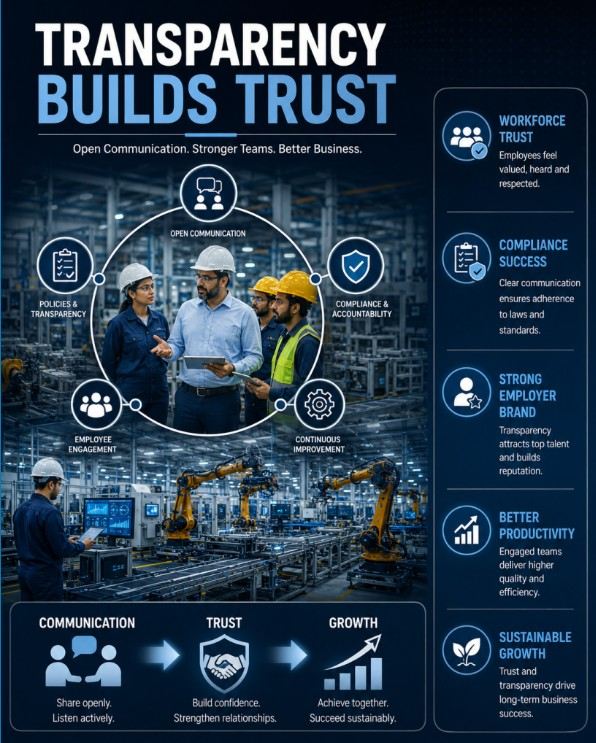
Workforce and compliance changes are inevitable in today’s manufacturing environment.
However, the success of these initiatives depends not only on policies and procedures but also on communication.
Transparent communication helps organizations build trust, reduce uncertainty, strengthen employer branding, and protect their reputation.
As manufacturing companies continue adapting to regulatory changes, workforce expectations, and technological transformation, organizations that prioritize transparency will gain a significant competitive advantage.
For modern manufacturers, communication is no longer simply a support function—it is a strategic business asset.