



India’s artificial intelligence race is entering a new phase, and Reliance Industries is positioning itself at the center of that transformation. The conglomerate, led by billionaire entrepreneur Mukesh Ambani, has outlined an ambitious strategy aimed at building AI infrastructure, expanding digital capabilities, and supporting India’s growing demand for advanced computing technologies.
The company’s latest initiatives come at a time when governments, technology firms, and enterprises worldwide are investing heavily in artificial intelligence. From generative AI systems and cloud services to data processing infrastructure, the competition to establish leadership in the sector has intensified significantly over the past two years.
For India, the development is particularly significant. The country has emerged as one of the world’s largest digital markets, yet it continues to face challenges related to computing capacity, semiconductor access, and AI infrastructure. Reliance’s expansion plans are being viewed by industry observers as a potential catalyst that could help address some of these gaps while strengthening India’s position in the global technology ecosystem.
Why Reliance Is Betting Big on AI
Artificial intelligence is increasingly becoming a foundational technology across industries. Businesses are using AI tools to automate processes, improve customer experiences, enhance decision-making, and develop new products and services.
Reliance’s interest in AI aligns with broader market trends. Global technology giants have invested billions of dollars in AI-focused infrastructure, recognizing that future economic growth and digital competitiveness will depend heavily on access to advanced computing resources.
India’s rapidly growing internet user base, expanding digital economy, and rising adoption of cloud services have created favorable conditions for AI-driven innovation. Reliance appears to be seeking an opportunity to leverage its existing telecommunications, digital services, and infrastructure businesses to create a comprehensive AI ecosystem.
Building Large-Scale AI Infrastructure
One of the most significant aspects of Reliance’s strategy involves investment in large-scale computing infrastructure.
Artificial intelligence systems require enormous amounts of computational power. Training advanced models often involves thousands of specialized processors working simultaneously to analyze massive datasets. This demand has led to a global surge in investments in data centers and AI-focused computing facilities.
Reliance has indicated plans to expand its infrastructure capabilities to support AI workloads, cloud computing services, and enterprise digital transformation initiatives. Such facilities could provide Indian businesses with greater access to advanced AI resources without relying entirely on overseas infrastructure providers.
Industry experts note that domestic AI infrastructure can offer benefits including lower latency, improved data sovereignty, enhanced regulatory compliance, and reduced dependence on international technology ecosystems.
Strengthening India’s Data Center Ecosystem
Data centers have become one of the most critical components of the modern digital economy. Every AI application, cloud service, and digital platform depends on robust infrastructure capable of storing and processing vast amounts of information.
Reliance has already demonstrated interest in expanding its presence in the data center sector. As AI adoption accelerates, demand for high-performance computing facilities is expected to increase substantially.
Analysts believe India could witness significant growth in data center investments over the coming decade as organizations across sectors digitize operations and adopt AI technologies. Financial services, healthcare, manufacturing, retail, education, and government services are among the industries likely to drive demand.
The expansion of domestic infrastructure could also support India’s broader digital economy goals while attracting additional technology investments from global firms seeking regional computing capacity.
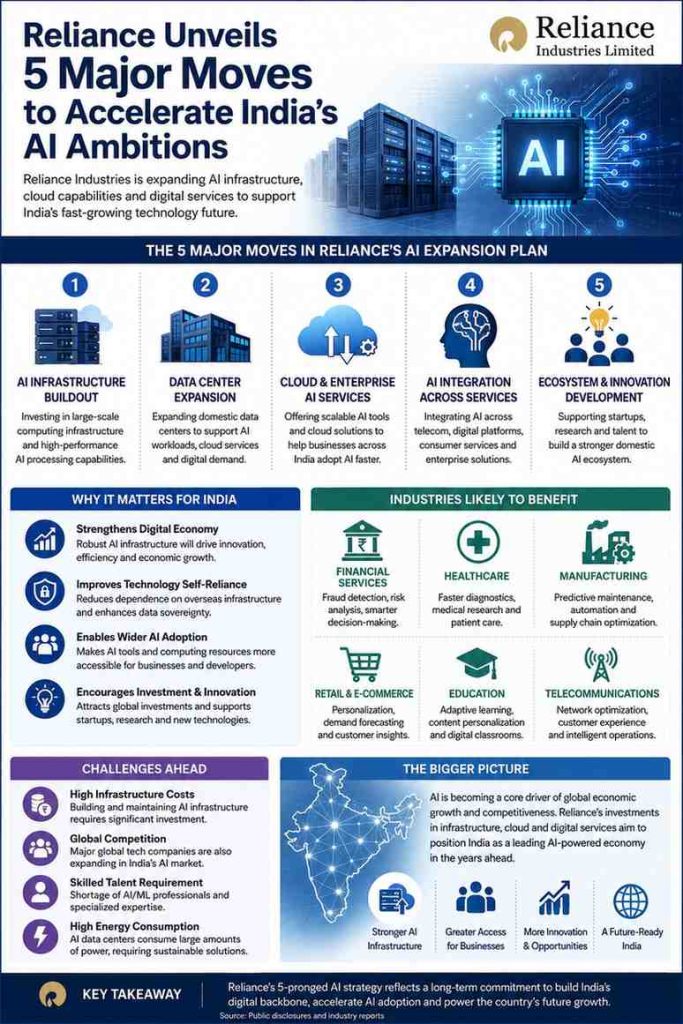
Integrating AI Across Digital Services
Reliance’s strategy extends beyond infrastructure. The company is also expected to incorporate AI technologies across its various digital platforms and consumer services.
The group’s digital ecosystem already reaches hundreds of millions of users through telecommunications, digital connectivity, entertainment, commerce, and enterprise solutions. Integrating artificial intelligence into these services could enhance personalization, improve efficiency, and create new user experiences.
AI-powered customer support systems, predictive analytics, intelligent network management, and advanced digital assistants are among the technologies increasingly being adopted across industries. By deploying such solutions at scale, Reliance could strengthen its competitive position while improving operational performance.
The integration of AI into consumer-facing services may also contribute to wider public adoption of artificial intelligence technologies across India.
Supporting Enterprise AI Adoption
Many businesses recognize the potential benefits of AI but face barriers related to infrastructure costs, technical expertise, and implementation challenges.
Reliance’s expansion plans could help address some of these obstacles by offering cloud-based AI services and enterprise solutions designed for Indian organizations.
Small and medium-sized enterprises, in particular, may benefit from greater access to scalable AI tools without requiring significant upfront investments in computing infrastructure. This could accelerate digital transformation efforts across multiple sectors of the economy.
Enterprise AI adoption is expected to become increasingly important as organizations seek productivity gains, operational efficiencies, and competitive advantages in rapidly evolving markets.
The Strategic Importance of Domestic AI Capabilities
Governments around the world have identified artificial intelligence as a strategic priority. Concerns surrounding technology sovereignty, cybersecurity, economic competitiveness, and innovation have prompted many nations to invest heavily in domestic AI ecosystems.
India is no exception.
The country’s policymakers have emphasized the importance of developing indigenous technology capabilities while supporting innovation and entrepreneurship. Investments in AI infrastructure, research, and digital ecosystems are viewed as important components of long-term economic development strategies.
Reliance’s initiatives align with these broader national objectives. By investing in domestic infrastructure and digital capabilities, the company could contribute to strengthening India’s technological self-reliance and reducing dependence on external resources.
Such developments may also support emerging startups, research institutions, and technology developers that require access to advanced computing capabilities.
Challenges Ahead
Despite the opportunities, significant challenges remain.
Building and operating AI infrastructure requires substantial capital investments. The cost of advanced processors, networking equipment, cooling systems, and energy resources continues to be significant.
Competition is another factor. Global technology companies and cloud service providers are also expanding their presence in India, creating a highly competitive environment for AI and cloud computing services.
Talent development represents an additional challenge. The success of AI ecosystems depends not only on infrastructure but also on the availability of skilled engineers, researchers, data scientists, and technology professionals.
Energy requirements could become another important consideration. AI data centers consume considerable amounts of electricity, making sustainable energy strategies increasingly important for long-term operations.
Reliance will likely need to address these challenges while maintaining operational efficiency and ensuring competitive service offerings.
What It Means for India’s Technology Future
Reliance’s AI expansion strategy reflects a broader shift taking place across India’s technology landscape. Artificial intelligence is moving from an emerging technology to a core component of digital infrastructure and economic development.
The company’s investments could have implications that extend beyond its own business operations. Expanded infrastructure, improved access to computing resources, and greater AI adoption may benefit startups, enterprises, researchers, and consumers alike.
As AI becomes increasingly integrated into everyday life, the availability of domestic infrastructure and technology capabilities will play a crucial role in shaping India’s digital future.
The coming years are likely to determine how effectively India can convert its large talent pool, growing digital economy, and expanding technology ecosystem into global leadership in artificial intelligence. Reliance’s latest initiatives suggest that one of the country’s largest corporations intends to be a major participant in that journey, helping build the infrastructure and capabilities needed for the next phase of India’s digital transformation.
Highlights
- Reliance Industries has outlined an ambitious strategy to expand its artificial intelligence and digital infrastructure capabilities.
- The company is investing in computing resources, cloud technologies, and data center expansion to support growing AI demand.
- AI infrastructure development could strengthen India’s domestic technology ecosystem and reduce reliance on overseas resources.
- Reliance aims to integrate artificial intelligence across multiple digital services used by businesses and consumers.
- Expanded AI capabilities may accelerate enterprise adoption of advanced technologies across sectors including finance, healthcare, and manufacturing.
- The initiative aligns with India’s broader push to enhance digital competitiveness and technological self-reliance.
- Industry experts view AI infrastructure as a critical component of future economic growth and innovation.
FAQ
1. What is Reliance’s AI expansion plan?
Reliance is investing in artificial intelligence infrastructure, data centers, cloud computing capabilities, and AI-powered digital services to strengthen its position in India’s technology sector.
2. Why is Reliance focusing on artificial intelligence?
AI is becoming a foundational technology across industries, helping organizations improve efficiency, automate processes, and develop new digital products and services.
3. How could the plan benefit India?
The expansion could improve access to AI infrastructure, support digital innovation, create technology jobs, and strengthen India’s domestic technology capabilities.
4. What role do data centers play in AI development?
Data centers provide the computing power, storage, and networking resources required to train and operate advanced artificial intelligence systems.
5. Which industries could benefit from greater AI adoption?
Finance, healthcare, manufacturing, retail, education, logistics, telecommunications, and government services are among the sectors expected to benefit.
6. What challenges could Reliance face?
Major challenges include infrastructure costs, competition from global technology firms, talent availability, and the significant energy requirements of AI facilities.
7. How does this align with India’s technology goals?
The initiative supports broader national objectives related to digital transformation, innovation, technology self-reliance, and economic growth.
8. Why is AI infrastructure considered strategically important?
Access to advanced computing resources is increasingly viewed as essential for economic competitiveness, technological innovation, and digital sovereignty.
Edited By E. Devanshi varma
Also Read: IPL Honey-Trap Row Sparks 7 Big Questions Before Playoffs
Follow us on Google News: Click Here