



Maharashtra’s growing emphasis on artificial intelligence is beginning to reshape conversations across India’s startup ecosystem, with entrepreneurs, investors, and technology professionals increasingly viewing the state as an emerging hub for AI-led innovation.
The renewed momentum comes amid a broader national push toward digital transformation, automation, and advanced technology adoption. As governments across India compete to attract high-value technology investments, Maharashtra’s scale, industrial base, startup density, and financial ecosystem are placing it at the center of the AI conversation.
From Mumbai’s financial technology sector to Pune’s engineering and software ecosystem, the state already hosts some of the country’s most established startup clusters. The addition of AI-focused initiatives, infrastructure discussions, research collaborations, and innovation-driven policy planning is now creating fresh expectations around long-term technology growth.
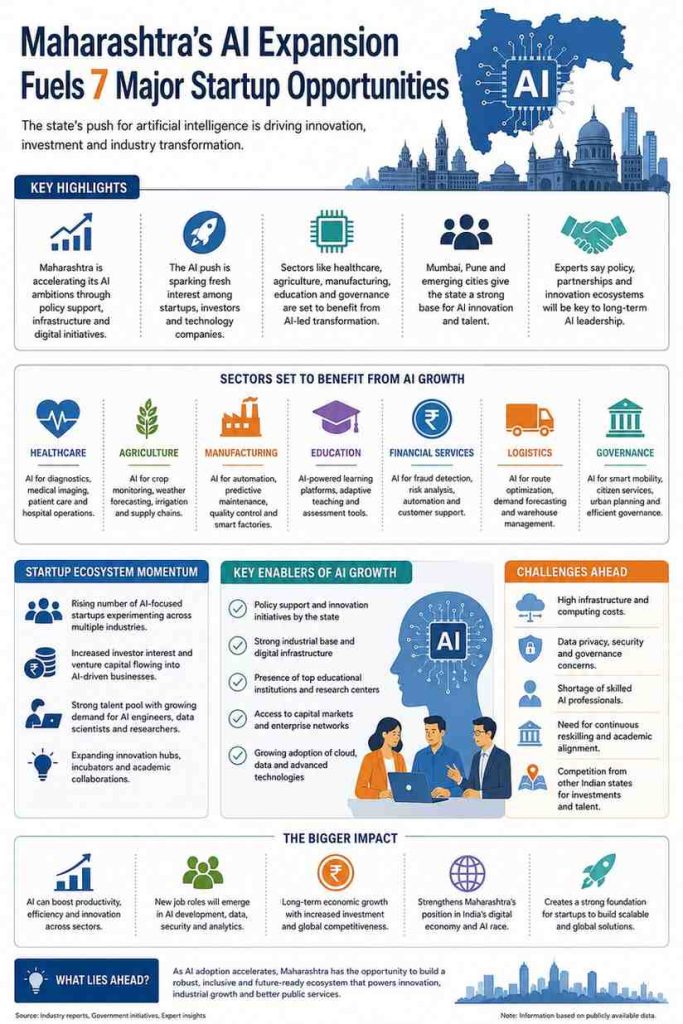
Industry observers say the development could have implications beyond the technology sector alone. Artificial intelligence is increasingly influencing industries such as healthcare, agriculture, logistics, manufacturing, education, retail, and public administration. Maharashtra’s attempt to position itself strongly in this space may therefore shape employment trends, investment flows, and digital competitiveness over the coming years.
Why Maharashtra’s AI Push Matters
Artificial intelligence has become one of the most strategically important sectors globally, with governments and corporations investing heavily in automation, machine learning, data analytics, and generative AI systems. In India, states are now attempting to create local ecosystems capable of supporting AI startups, attracting skilled professionals, and building technology infrastructure.
Maharashtra enters this race with several structural advantages.
Mumbai remains India’s financial capital and a major center for venture capital activity, while Pune has developed into a significant technology and engineering hub. Cities including Nagpur and Nashik are also witnessing increased interest in digital infrastructure and startup development.
Analysts believe this geographic spread gives Maharashtra the ability to support both enterprise-level AI adoption and early-stage startup experimentation.
The state’s strong industrial presence could also play an important role. Manufacturing companies are increasingly using AI for predictive maintenance, automation, supply chain optimization, and quality control. Maharashtra’s industrial ecosystem may therefore become an important testing ground for AI implementation across factories and logistics networks.
In addition, the rise of AI-powered public services and governance systems is opening new areas for collaboration between governments and technology firms. Areas such as smart mobility, digital administration, urban planning, and citizen services are expected to witness growing AI integration.
Startup Ecosystem Sees New Momentum
The possibility of policy-backed AI expansion is already generating optimism among startup founders and investors.
Technology entrepreneurs are increasingly exploring AI-driven business models in areas such as healthcare diagnostics, fintech automation, language technology, cybersecurity, education platforms, and enterprise software solutions.
Several investors believe regional AI ecosystems could become more important in the next few years as startups look beyond traditional technology centers. Maharashtra’s access to capital markets, educational institutions, corporate networks, and digital talent pools could strengthen its position in this environment.
The growing startup interest also reflects larger global trends. Venture capital investment in AI companies has expanded rapidly worldwide, especially after the rise of generative AI tools and enterprise automation platforms. Indian startups are attempting to capture a share of this growing market by building localized AI products suited to domestic industries and consumers.
For Maharashtra, this creates an opportunity to combine traditional industrial strength with emerging digital capabilities.
AI’s Impact Across Industries
One reason AI is attracting sustained attention is its ability to influence multiple sectors simultaneously.
In healthcare, AI tools are increasingly being used for diagnostics support, medical imaging analysis, patient data management, and hospital workflow optimization. Maharashtra’s large urban healthcare network could provide opportunities for AI-based medical startups and health-tech collaborations.
In agriculture, AI-powered systems are being tested for crop monitoring, weather forecasting, irrigation management, and supply chain analysis. Given Maharashtra’s agricultural importance, technology companies may look at rural-focused AI applications as a long-term growth segment.
Education is another sector witnessing rapid transformation. AI-powered learning platforms, assessment systems, and personalized education tools are becoming more common, particularly in digital-first learning environments.
Meanwhile, financial institutions are using AI for fraud detection, customer support automation, risk analysis, and predictive analytics. Since Mumbai serves as India’s financial center, fintech innovation could remain one of the strongest areas for AI expansion within the state.
Experts say the broad applicability of AI is one reason governments are treating it as both an economic and strategic priority.
Talent Development Becomes Critical
While investment and infrastructure are important, industry leaders argue that talent development may ultimately determine the success of Maharashtra’s AI ambitions.
The demand for AI engineers, data scientists, machine learning specialists, and cybersecurity professionals has risen significantly across the technology sector. Educational institutions and training centers are therefore expected to play a major role in supporting future growth.
Engineering colleges, universities, and private technology institutes in Maharashtra may increasingly align courses toward AI-focused skills and research programs. Industry partnerships could also expand as companies look for specialized talent trained in emerging technologies.
At the same time, experts caution that rapid AI adoption may also reshape employment patterns. Automation could change certain traditional job roles while creating new opportunities in technology development, digital operations, and advanced analytics.
This transition may require workforce reskilling initiatives to help professionals adapt to evolving industry requirements.
Infrastructure and Data Challenges
Despite the growing excitement around AI, industry experts say infrastructure readiness remains an important challenge.
Artificial intelligence systems often require strong cloud infrastructure, computing power, data processing capabilities, and cybersecurity frameworks. Building these systems at scale requires significant investment and coordination between government agencies, private companies, and technology providers.
Data governance is another critical issue. AI systems rely heavily on large datasets, raising questions around privacy, security, ethical use, and regulatory oversight.
As AI adoption expands, policymakers are expected to face increasing pressure to balance innovation with safeguards related to responsible technology use.
There are also concerns about unequal access to AI resources. Smaller startups may struggle to compete with large technology firms that possess greater computational infrastructure and financial capacity.
Industry groups have therefore emphasized the importance of accessible innovation ecosystems, startup incubation programs, and collaborative research environments.
Competition Among Indian States Intensifies
Maharashtra’s AI ambitions are emerging at a time when several Indian states are attempting to strengthen their positions in advanced technology sectors.
States including Karnataka, Telangana, Tamil Nadu, and Gujarat have also expanded digital innovation initiatives and startup-focused programs in recent years. This has created increasing competition to attract technology investment, skilled professionals, and research partnerships.
However, Maharashtra’s supporters argue that its diversified economy provides a unique advantage. Unlike purely software-driven ecosystems, the state combines finance, manufacturing, logistics, entertainment, media, and enterprise services within a single regional economy.
This diversity could allow AI adoption to spread across multiple sectors rather than remaining concentrated within traditional IT services.
Industry observers believe the next phase of India’s startup growth may depend heavily on how effectively states create integrated ecosystems linking policy, infrastructure, academia, venture capital, and industrial demand.
Investors Watching Long-Term Signals
Investors are expected to monitor how Maharashtra translates AI-related announcements and ambitions into measurable execution.
For startups, long-term clarity around policy frameworks, innovation incentives, infrastructure support, and regulatory stability often plays a significant role in investment decisions.
Market analysts say AI-related optimism alone may not be enough to sustain startup momentum unless accompanied by practical implementation and ecosystem development.
At the same time, the broader direction appears clear. Artificial intelligence is likely to remain one of the defining technology themes shaping India’s digital economy over the next decade.
As governments, businesses, and educational institutions increasingly align around AI adoption, Maharashtra’s growing push into the sector is positioning the state as a major participant in India’s next technology expansion cycle.
Highlights
- Maharashtra is accelerating its artificial intelligence ambitions through policy support, infrastructure expansion, and digital innovation initiatives.
- The state’s AI push is generating increased interest among startups, investors, technology firms, and research institutions.
- Sectors including healthcare, agriculture, manufacturing, governance, and education are expected to benefit from AI-led transformation.
- Industry experts believe Maharashtra’s strong urban tech ecosystem gives it an advantage in attracting AI-driven businesses.
- Startup founders are closely watching government-backed AI policies, incentives, and innovation partnerships for long-term growth opportunities.
FAQ
What is driving Maharashtra’s growing focus on artificial intelligence?
Maharashtra is expanding its AI focus as part of broader efforts to strengthen digital infrastructure, attract technology investment, support startups, and improve innovation across industries.
Why is Maharashtra important in India’s startup ecosystem?
The state hosts major business and technology centers including Mumbai and Pune, which already have strong venture capital networks, startup ecosystems, and technology talent pools.
Which industries could benefit from Maharashtra’s AI expansion?
Healthcare, finance, agriculture, manufacturing, logistics, education, governance, and retail are among the sectors expected to see increased AI integration.
Why are startups paying attention to AI initiatives in Maharashtra?
Startups view AI as a high-growth technology sector with opportunities for innovation, investment, and enterprise adoption across multiple industries.
Could AI create new jobs in Maharashtra?
AI is expected to generate demand for roles related to data science, machine learning, cybersecurity, cloud infrastructure, and digital operations, although automation may also reshape some traditional job categories.
What challenges could affect AI growth in the state?
Infrastructure costs, data privacy concerns, regulatory issues, computing requirements, and talent shortages remain important challenges for large-scale AI adoption.
How does Maharashtra compare with other Indian states in AI development?
Maharashtra is competing with states such as Karnataka, Telangana, Tamil Nadu, and Gujarat, all of which are investing in digital innovation and startup ecosystems.
Why is AI becoming strategically important for governments?
AI is increasingly viewed as a major driver of economic growth, industrial efficiency, digital governance, and technological competitiveness.
What role do educational institutions play in AI expansion?
Universities and engineering colleges are expected to support AI growth through research, skill development, specialized training, and industry collaboration.
What could Maharashtra’s AI push mean for India’s digital economy?
If successfully implemented, Maharashtra’s AI initiatives could strengthen India’s broader technology ecosystem and encourage more AI-led innovation across industries.
Edited By E. Devanshi varma
Also Read: Assam Assembly Polls See 7 Major Highlights as Turnout Peaks, Counting Set for May 4
Follow us on Google News: Click Here