

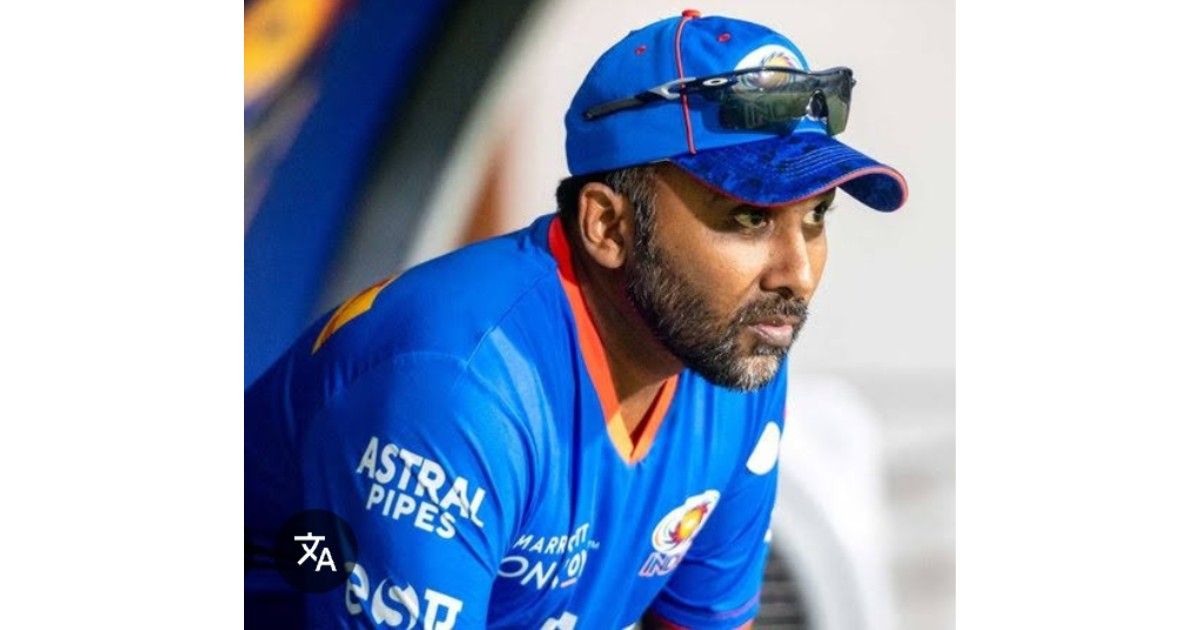
Mumbai Indians’ playoff hopes came to an end after a narrow defeat to Royal Challengers Bengaluru in Raipur, with head coach Mahela Jayawardene admitting the five-time champions failed to maintain consistency throughout IPL 2026.
The Mumbai Indians’ campaign in the 2026 edition of the Indian Premier League came to a disappointing close after a tense two-wicket defeat against Royal Challengers Bengaluru at the Shaheed Veer Narayan Singh Stadium in Raipur. The result officially knocked Mumbai out of the playoff race and extended what has been one of the franchise’s most inconsistent seasons in recent years.
Following the match, Mumbai head coach Mahela Jayawardene acknowledged that the side had not performed at the level expected from a team with a strong history in the tournament. While reflecting on the campaign, Jayawardene said there were several moments during the season where the team could have changed its fortunes, but ultimately failed to deliver when it mattered most.
The former Sri Lankan captain described the season as frustrating, saying Mumbai were left with too many “if-only” moments after dropping crucial matches during the league stage. According to him, the team lacked continuity in both batting and bowling, which prevented them from building momentum across the tournament.
Mumbai’s Season Ends After Another Close Finish
The defeat against Royal Challengers Bengaluru was particularly painful because Mumbai remained in contention until the final moments of the match. However, repeated mistakes in pressure situations once again proved costly.
Defending a modest target, Mumbai pushed the contest into the last over, but Bengaluru managed to hold their nerve and chase down the total with two wickets remaining. The loss not only ended Mumbai’s playoff hopes but also raised further questions about the team’s decision-making under pressure.
Jayawardene admitted after the match that the side had struggled to execute complete plans throughout the season. While the players often managed to perform well in phases, Mumbai repeatedly failed to put together consistent performances over an entire match.
He explained that the gap between preparation and execution became one of the defining issues of their IPL 2026 campaign. According to the coach, the team frequently entered games with solid strategies but could not sustain them once the pressure intensified during key moments.
Final Over Drama Puts Spotlight on Raj Angad Bawa
One of the biggest talking points from the match was Mumbai’s decision to hand the final over to young all-rounder Raj Angad Bawa. With Bengaluru needing manageable runs in the last six balls, the responsibility was placed on the inexperienced bowler in one of the biggest moments of the season.
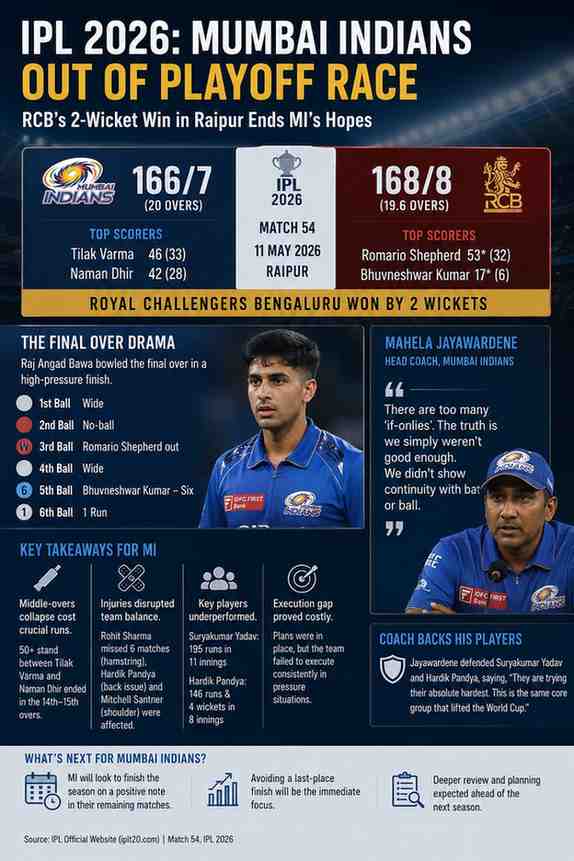
Bawa’s over started poorly with a wide delivery followed by a no-ball, immediately easing the pressure on Bengaluru. Although he briefly brought Mumbai back into the contest by dismissing Romario Shepherd, the momentum quickly shifted again.
Another wide delivery added to Mumbai’s problems before veteran pacer Bhuvneshwar Kumar struck a decisive six to finish the chase and secure victory for Bengaluru.
The decision to trust Bawa in such a high-pressure situation attracted criticism, particularly because the young player had limited experience bowling at the death in IPL matches. Questions were also raised over the field placements and tactical choices made during the closing stages of the contest.
Jayawardene, however, defended the call after the match. He explained that Mumbai’s frontline bowlers had already completed their quota of overs, leaving the management with limited options. While there were a few spin alternatives available, the coaching staff believed Bawa had the temperament and skillset to handle the situation.
The coach pointed out that Bawa had consistently bowled accurate yorkers during training sessions and had shown signs of composure under pressure in practice. However, Jayawardene admitted that the young player made a couple of costly errors in the intensity of the moment.
Batting Collapse in Middle Overs Hurt Mumbai
Earlier in the evening, Mumbai Indians posted 166 for 7 after being asked to bat first. While the total gave their bowlers something to defend, Jayawardene felt the side missed an opportunity to push the score closer to the 180-run mark.
Mumbai looked stable during a promising partnership between Tilak Varma and Naman Dhir. The pair added more than fifty runs and appeared ready to accelerate during the final overs.
However, the dismissal of both batters within a short period during the 14th and 15th overs shifted momentum back towards Bengaluru. Jayawardene identified that phase as the turning point of the innings.
According to the coach, Mumbai had positioned themselves well to launch a late assault but failed to capitalize after losing wickets in quick succession. He suggested that an additional 15 to 20 runs could have significantly changed the outcome of the match, especially on a pitch where batting became easier later in the innings.
The inability to maximize scoring opportunities in the middle overs has been a recurring problem for Mumbai throughout the season. Despite possessing experienced hitters in the lineup, the team often struggled to convert promising starts into match-winning totals.
Injuries Disrupted Team Balance Throughout IPL 2026
Jayawardene also highlighted injuries as a major factor behind Mumbai’s disappointing campaign. Throughout the season, the franchise was forced to reshuffle combinations due to the absence or limited availability of key players.
Former captain Rohit Sharma missed six matches because of a hamstring injury, while skipper Hardik Pandya reportedly dealt with recurring back issues during the tournament. Spin-bowling all-rounder Mitchell Santner was also sidelined later in the season due to a shoulder problem.
The repeated injury setbacks prevented Mumbai from fielding a settled playing XI for most of the tournament. Jayawardene said many of the changes made to the lineup were not tactical experiments but forced adjustments due to player fitness concerns.
He noted that maintaining balance became increasingly difficult because every injury affected both batting depth and bowling combinations. The constant changes, according to him, disrupted the rhythm of the side and made it difficult for players to settle into defined roles.
In a tournament as competitive as the IPL, where momentum and continuity often decide qualification chances, Mumbai’s inability to maintain a stable lineup became a major disadvantage.
Pressure Mounts on Senior Players After Poor Returns
Another major concern for Mumbai this season has been the underperformance of senior players. Much of the scrutiny has centered on Suryakumar Yadav and Hardik Pandya, both of whom endured difficult campaigns with the bat.
Suryakumar managed only 195 runs across 11 innings, far below the standards expected from one of India’s leading T20 batters. Hardik, meanwhile, scored 146 runs in eight innings and picked up just four wickets during the season.
The lack of impact from experienced match-winners placed additional pressure on younger players in crucial situations. Mumbai often depended heavily on individual performances rather than collective contributions, which affected their consistency across matches.
Despite criticism surrounding the duo, Jayawardene strongly defended both players. He insisted there was no lack of effort or commitment from either cricketer and emphasized that the team continued to trust its experienced core.
The coach reminded critics that several members of the squad had previously succeeded at the highest level of international cricket. According to him, difficult seasons are part of professional sport, and teams must continue backing established players even during lean phases.
A Season That Failed to Meet Expectations
For a franchise with five IPL titles and a reputation for thriving under pressure, Mumbai’s early elimination represents a significant setback. Expectations were high entering IPL 2026, especially after the team retained a core group of experienced international players alongside emerging domestic talent.
However, inconsistency remained the defining feature of their campaign. Mumbai frequently showed flashes of quality but failed to maintain control during decisive moments. Close defeats, injury setbacks, tactical errors, and poor finishing collectively contributed to their downfall.
Jayawardene admitted that the responsibility for the disappointing season belonged to the entire group rather than a few individuals. While individual performances came under scrutiny, the coach stressed that the failures were collective.
With playoff qualification now impossible, Mumbai’s immediate focus will shift toward finishing the season on a positive note in their remaining matches. Avoiding a bottom-place finish in the 10-team standings could become an important short-term objective as the franchise begins evaluating changes ahead of next season.
The coming months are likely to bring deeper discussions about squad balance, player form, fitness management, and tactical planning. For one of the IPL’s most successful franchises, IPL 2026 will ultimately be remembered as a season filled with missed opportunities, narrow margins, and a campaign that never truly found stability.
Inputs and images : Hindusthan Samachar
Edited By E. Devanshi varma
Also Read: Assam Assembly Polls See 7 Major Highlights as Turnout Peaks, Counting Set for May 4
Follow us on Google News: Click Here