

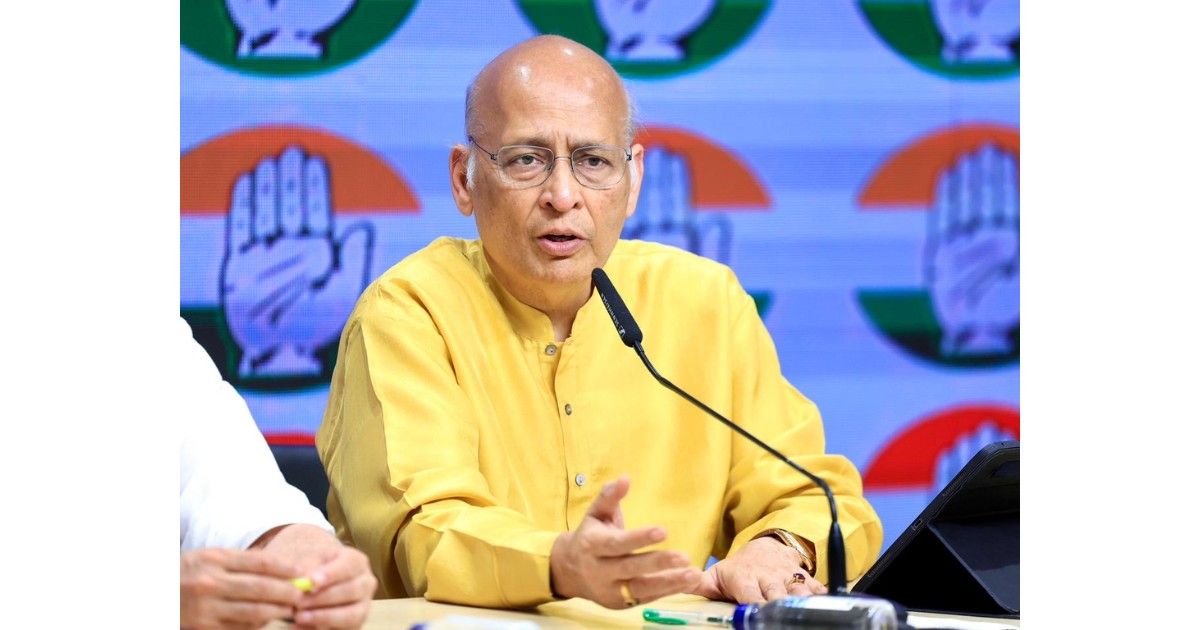
Congress leader Abhishek Manu Singhvi has questioned the Tamil Nadu Governor’s handling of the government formation process, arguing that constitutional conventions require the single largest party to be invited first to prove its majority on the Assembly floor.
New Political Dispute Emerges Over Government Formation in Tamil Nadu
A fresh political debate has erupted in Tamil Nadu over the process of government formation after Congress MP and senior advocate Abhishek Manu Singhvi criticized the Governor’s approach in dealing with claims made by actor-turned-politician Vijay and his party, Tamilaga Vetri Kazhagam.
Speaking in New Delhi on Wednesday, Singhvi argued that constitutional conventions, legal precedent, and democratic norms require the Governor to invite the single largest party to form the government, particularly when no rival alliance has formally staked claim.
The controversy comes amid intense political negotiations in the state after an unclear electoral mandate left parties attempting to gather support required to cross the majority mark in the Tamil Nadu Assembly.
Singhvi Questions Delay in Inviting Largest Party
Addressing reporters, Singhvi said the Governor’s role in such situations is guided not only by constitutional provisions but also by long-established parliamentary traditions followed across several states in India.
According to him, once a party emerges as the single largest formation and no competing coalition submits a claim with stronger numerical backing, the Governor is expected to provide an opportunity to form the government and prove majority in the Assembly.
Singhvi stressed that this process has been followed repeatedly in past political situations across different states, irrespective of which party was in power at the Centre or in the state.
He argued that the Governor should allow the legislative process to determine majority support rather than delaying the invitation process. In parliamentary democracies like India, governments are ultimately tested on the floor of the House through confidence votes.
The Congress leader also criticized what he described as an “erosion of constitutional conventions,” saying unnecessary delays by constitutional authorities could weaken democratic functioning and create uncertainty during government formation.
TVK Claims Support but Falls Short of Majority Mark
The dispute gained momentum after Vijay met the Governor and reportedly expressed his intention to form the government with support from other parties, including the Congress.
However, the central issue remains the numerical requirement needed to secure a majority in the Assembly. In the Tamil Nadu Assembly, a party or coalition requires the support of 118 MLAs to prove majority.
Sources familiar with the discussions indicated that TVK initially submitted documents carrying signatures of around 112 legislators, reportedly including support from allied members. The Governor is understood to have asked the party to return only after securing signatures from the full majority figure.
At present, Vijay has publicly claimed that he possesses the required support, though formal letters from all 118 legislators have reportedly not yet been submitted.
This has created a constitutional and political debate over whether a Governor can insist on written proof of majority before inviting a party to form the government, or whether the claim should instead be tested through a floor vote in the Assembly.
Congress Extends Support to Vijay-Led Formation Effort
The Congress party has publicly backed TVK’s efforts to form the government. Tamil Nadu Congress in-charge Girish Chodankar said the decision was aimed at respecting the mandate delivered by voters.
The support from Congress is politically significant because it could help smaller parties bridge the gap needed to secure a legislative majority.
Political observers note that post-election alliances and outside support arrangements are common in Indian politics, especially when elections produce fractured mandates. In several earlier cases across states, parties lacking an outright majority were invited to form governments and later asked to prove their strength on the Assembly floor within a specified period.
Singhvi referred to this practice while arguing that Governors usually provide around 10 to 12 days for a government to demonstrate majority support in the legislature.
Constitutional Debate Over Governor’s Discretion
The latest controversy has once again brought attention to the discretionary powers of Governors during government formation.
Under India’s constitutional framework, Governors play a crucial role when election results do not produce a clear majority. However, the Constitution does not provide a detailed step-by-step process for inviting parties to form governments in such circumstances.
As a result, constitutional conventions, Supreme Court observations, and recommendations from commissions such as the Sarkaria Commission and Punchhi Commission often guide these decisions.
Traditionally, Governors have followed a sequence while inviting parties to form governments:
- A pre-poll alliance with a clear majority
- The single largest party with support from others
- A post-poll coalition with majority backing
- A minority government capable of proving confidence in the House
Over the years, several government formation disputes in states including Maharashtra, Karnataka, Goa, and Bihar have triggered legal and political debates over the Governor’s discretion.
Experts frequently argue that the most democratic method of testing majority is through a floor test conducted in the Assembly rather than relying solely on letters of support submitted outside the legislature.
Singhvi’s remarks appear to align with that broader constitutional interpretation.
Why the Numbers Matter in Tamil Nadu
The ongoing developments are significant because even a small shortfall in numbers can decide the fate of a government.
According to available information, TVK and its supporting parties are currently believed to be short by a handful of legislators. Singhvi highlighted this aspect while arguing that such gaps are often resolved before a confidence vote takes place.
In many instances, parties continue negotiations with independents and smaller groups after staking claim to government formation. Governors generally permit this process, provided the party appears reasonably capable of securing majority support within the stipulated timeframe.
The Governor’s insistence on obtaining all 118 signatures beforehand has therefore become the central point of political criticism from Congress leaders.
Supporters of the Governor’s position, however, may argue that ensuring numerical clarity before inviting a party helps avoid instability or allegations of unconstitutional conduct later.
The issue is likely to remain politically sensitive because the Governor’s office is expected to function as a neutral constitutional authority during transitions of power.
Political Importance of Vijay’s Entry Into Governance Debate
The developments are also being closely watched because of Vijay’s growing political presence in Tamil Nadu.
The actor launched Tamilaga Vetri Kazhagam amid rising public interest in alternative political leadership in the state. His political entry has drawn attention from both supporters and established parties due to his significant popularity among younger voters and cinema audiences.
Although TVK remains relatively new in electoral politics, the current government formation discussions suggest the party may already hold considerable influence in the evolving political landscape of Tamil Nadu.
If TVK succeeds in gathering the required legislative support, it could mark a major turning point in the state’s political history and further strengthen Vijay’s position as a serious political contender.
At the same time, the uncertainty surrounding numbers indicates that negotiations among parties are still ongoing.
Opposition Voices Raise Concerns Over Democratic Norms
The controversy has also reopened wider debates over the role of Governors in India’s federal structure.
Opposition parties in several states have previously accused Governors of delaying decisions, favoring particular political formations, or acting in ways perceived to align with the Union government. On the other hand, constitutional authorities have often maintained that they act strictly within legal boundaries and established procedures.
Singhvi’s criticism reflects a larger concern repeatedly raised by opposition leaders regarding delays in inviting parties to form governments despite claims of support.
Constitutional experts generally agree that prolonged uncertainty after elections can affect governance, administration, and public confidence in democratic institutions.
For ordinary citizens, such political standoffs often create confusion over who will ultimately govern and how quickly a stable administration can be formed.
Focus Shifts to Governor’s Next Decision
Attention is now centered on the Governor’s next course of action and whether TVK can secure the remaining support needed to cross the majority threshold.
If the party submits letters from 118 legislators, the Governor may formally invite Vijay to form the government and prove majority on the Assembly floor within a limited timeframe.
If the numbers remain incomplete, alternative political combinations could emerge, potentially leading to fresh negotiations among parties and independents.
The coming days are expected to be crucial for Tamil Nadu’s political future as competing constitutional interpretations, coalition arithmetic, and political strategy continue to shape the government formation process.
Inputs and images : Hindusthan Samachar
Edited By E. Devanshi varma
Also Read: Assam Assembly Polls See 7 Major Highlights as Turnout Peaks, Counting Set for May 4
Follow us on Google News: Click Here