

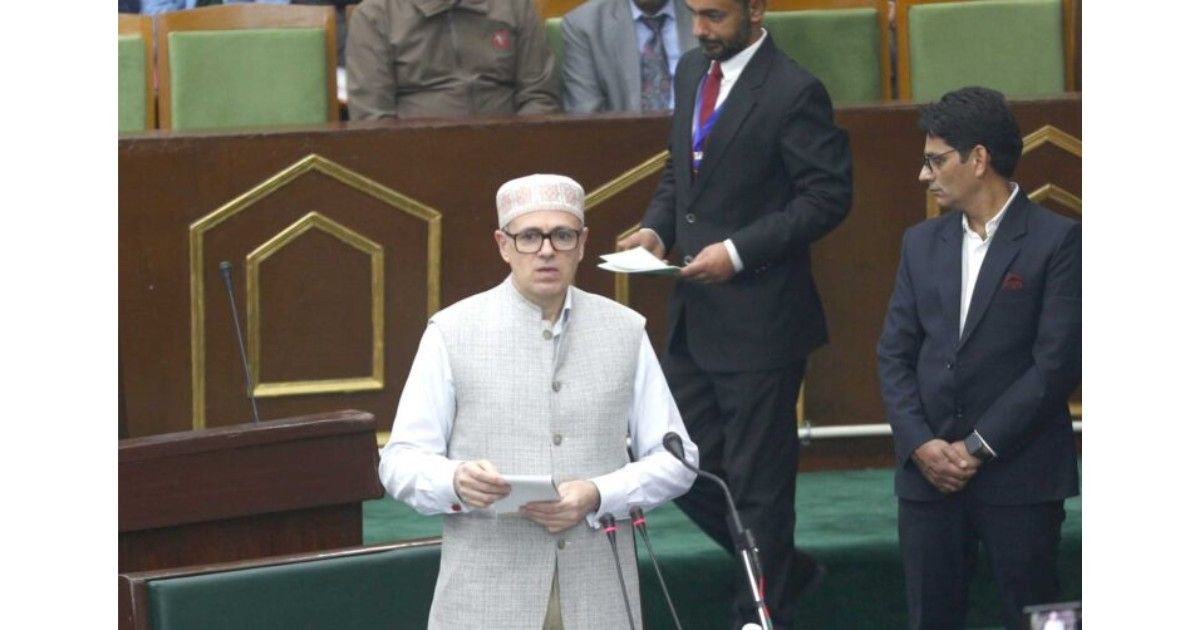
Jammu, April 1: The Jammu and Kashmir (J&K) government has approved a key amendment to the Constituency Development Fund (CDF) guidelines, allowing Members of the Legislative Assembly (MLAs) to allocate up to ₹50 lakh for housing assistance to families affected by disasters, including fire incidents. The announcement was made by Chief Minister Omar Abdullah during a session of the legislative assembly.
The move is aimed at strengthening local-level response to emergencies by giving elected representatives more flexibility in addressing urgent housing needs caused by calamities. The revised provision will come into effect for the financial year 2026–27.
Expanded Scope Under Revised CDF Guidelines
The Constituency Development Fund (CDF) is a financial allocation provided to elected representatives to support development works in their constituencies. Traditionally, its use has been limited to infrastructure and community-level projects. However, the latest amendment significantly broadens its scope.
Under the revised rules:
- MLAs can allocate up to ₹50 lakh from their CDF for housing assistance.
- The funds can be used for both reconstruction and repair of damaged houses.
- The assistance is applicable to families affected by various calamities, including fires and other disasters.
- Individual families can receive financial aid of up to ₹1 lakh.
This shift marks a move toward more people-centric governance, enabling quicker intervention in times of crisis.
Assembly Discussion and Official Statement
The announcement came in response to a Calling Attention Motion raised by National Conference MLA Shamim Firdous, who sought clarity on relief measures for families impacted by fire incidents and other disasters.
Addressing the assembly, Chief Minister Omar Abdullah explained that the amendment was introduced to ensure broader and more inclusive assistance.
He stated that the revised guidelines now permit MLAs to directly support affected families through housing aid, adding that the government has deliberately widened the eligibility criteria to include all victims of calamities, regardless of socio-economic status.
Importantly, the Chief Minister clarified that the benefits are no longer restricted to specific categories such as Below Poverty Line (BPL) or tribal families. Instead, any family impacted by a qualifying calamity can be considered for assistance, subject to verification and approval.
What Qualifies as a “Calamity”?
A key aspect of the revised policy is the clarification of the term “calamity.” According to the government, it includes any event that results in significant damage or harm to property or life.
This includes:
- Fire accidents
- Natural disasters such as floods or landslides
- Other unforeseen incidents causing severe damage to homes
By explicitly including fire incidents, the government has acknowledged the growing number of such cases in urban and semi-urban areas, where densely populated neighborhoods are particularly vulnerable.
Case Study: Srinagar Fire Incidents
To illustrate how the revised guidelines are being implemented, the Chief Minister referred to recent cases from Srinagar district.
A total of 24 cases related to fire victims were submitted by MLA Shamim Firdous from the Habba Kadal constituency. The estimated financial requirement for these cases stands at ₹12.80 lakh.
Out of these:
- Five cases have already been approved for additional financial assistance after completing the required documentation and verification process.
- The remaining 19 cases are currently under review by the Deputy Commissioner of Srinagar.
The Chief Minister assured the assembly that all eligible cases recommended by MLAs would be processed in accordance with the updated guidelines.
Why This Policy Matters
The amendment to the CDF guidelines addresses a long-standing gap in disaster response at the local level. While large-scale disaster relief is typically managed by state and national agencies, smaller incidents—especially individual house fires—often fall through the cracks.
This policy is significant for several reasons:
1. Faster Relief at the Local Level
MLAs, being closer to their constituencies, can now respond more quickly to urgent needs without waiting for broader administrative approvals.
2. Inclusive Assistance
By removing restrictions tied to income or social categories, the government has ensured that relief is based on need rather than eligibility labels.
3. Focus on Housing Security
Housing is one of the most critical needs following a disaster. Immediate financial assistance can help families rebuild faster and reduce long-term displacement.
4. Decentralized Decision-Making
Empowering MLAs with financial discretion enhances accountability and ensures that funds are directed where they are most needed.
Understanding the Financial Limits
While the total allocation per MLA is capped at ₹50 lakh, the assistance to individual families is limited to ₹1 lakh. This means:
- The funds are designed to support multiple beneficiaries within a constituency.
- The assistance acts as supplementary relief rather than full compensation.
Experts note that this approach balances resource distribution while ensuring wider coverage.
Administrative Process and Safeguards
The implementation of the revised guidelines involves several checks to ensure transparency and proper use of funds:
- Recommendation by MLA: Cases must be identified and recommended by the concerned MLA.
- Verification: Local authorities, including the Deputy Commissioner’s office, verify the extent of damage and eligibility.
- Approval: Only after completing formalities is financial assistance approved.
- Disbursement: Funds are allocated in line with government norms and guidelines.
These steps are intended to prevent misuse while ensuring that genuine beneficiaries receive timely support.
Broader Policy Context
The decision aligns with a broader trend in governance that emphasizes decentralized and responsive administration. In recent years, several states have expanded the scope of local development funds to include welfare-oriented interventions.
In Jammu and Kashmir, the move also reflects efforts to strengthen public trust in governance by making relief mechanisms more accessible and transparent.
Additionally, the policy comes at a time when urban fire incidents and localized disasters have been reported with increasing frequency, highlighting the need for targeted interventions.
Public Impact and Beneficiaries
The revised policy is expected to benefit:
- Families affected by house fires in congested urban areas
- Rural households impacted by natural disasters
- Middle-income families who may not qualify under traditional welfare schemes but still face financial distress after a calamity
By broadening the eligibility criteria, the government has ensured that relief reaches a wider segment of society.
For many families, even a ₹1 lakh grant can make a significant difference in initiating repairs or rebuilding efforts. It can also reduce dependence on loans or informal borrowing, which often leads to long-term financial strain.
Challenges and Considerations
While the policy has been widely welcomed, its effectiveness will depend on implementation. Some key challenges include:
- Ensuring timely processing of applications
- Maintaining transparency in beneficiary selection
- Avoiding delays at the verification stage
- Monitoring fund utilization
Administrative efficiency and coordination between MLAs and district authorities will be critical to achieving the intended outcomes.
Looking Ahead
The government has indicated that all eligible cases recommended under the revised guidelines will be processed as per established norms. As the policy rolls out in FY 2026–27, its real impact will become clearer based on how effectively it addresses ground-level needs.
The amendment represents a shift toward more responsive governance, where elected representatives are equipped with the tools to address immediate concerns of their constituents.
If implemented efficiently, the revised CDF framework could serve as a model for other regions looking to strengthen localized disaster relief mechanisms while ensuring inclusivity and accountability.
Inputs and images : Hindusthan Samachar
Edited By E. Devanshi varma
Also Read: Odisha Census Goes Digital with 33-Question Self-Enumeration Drive Open Till April 15
Follow us on Google News: Click Here