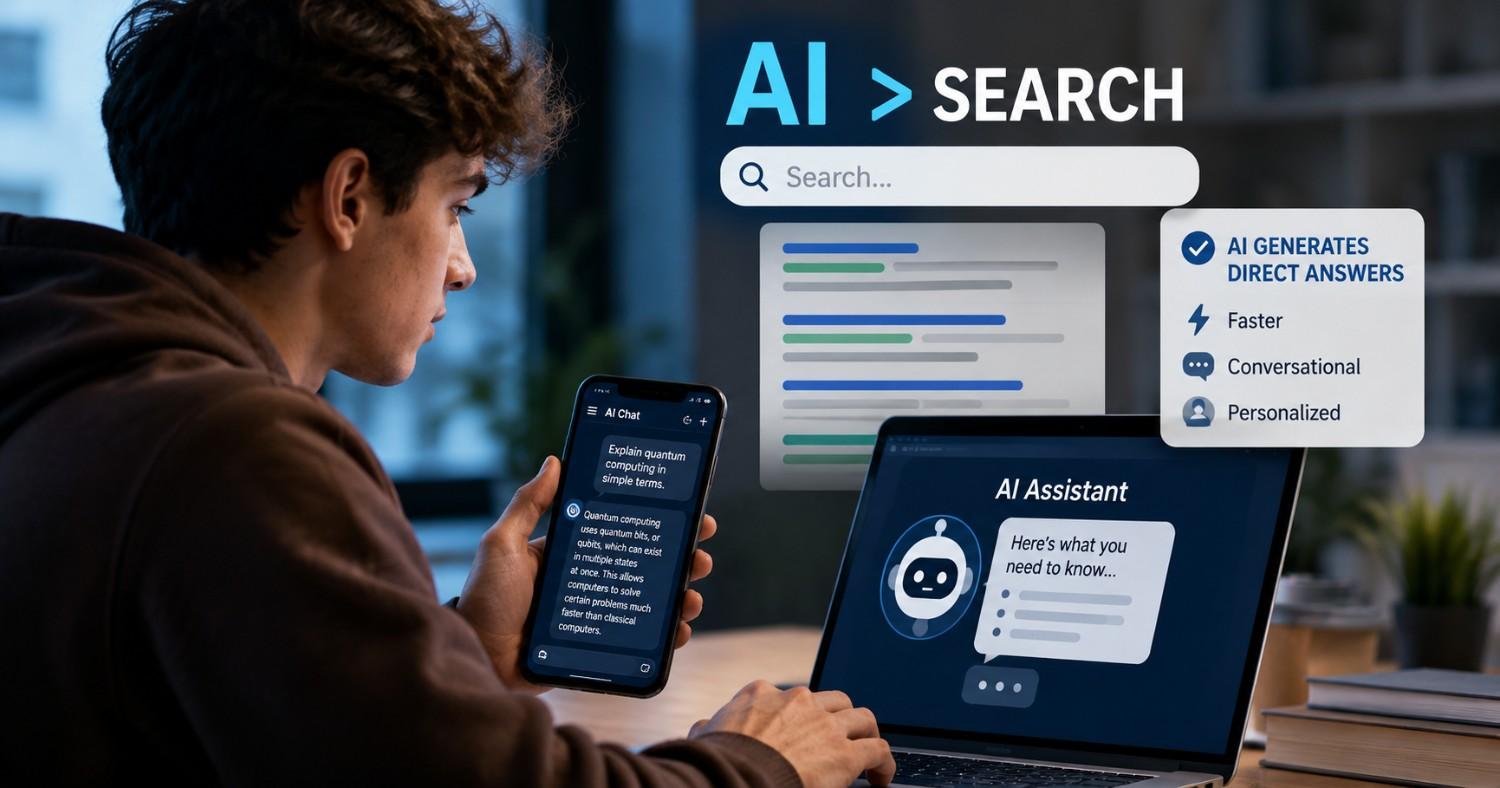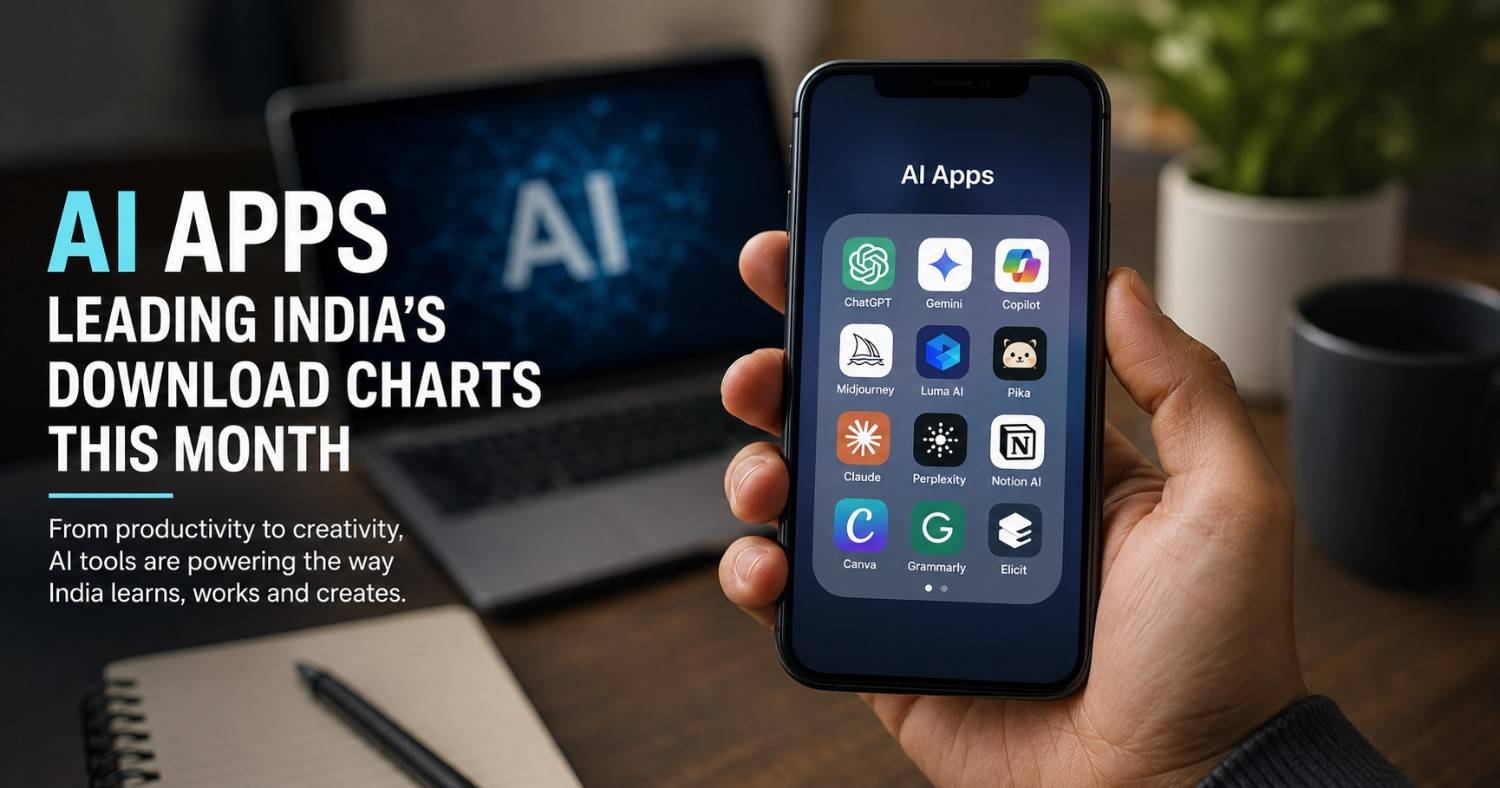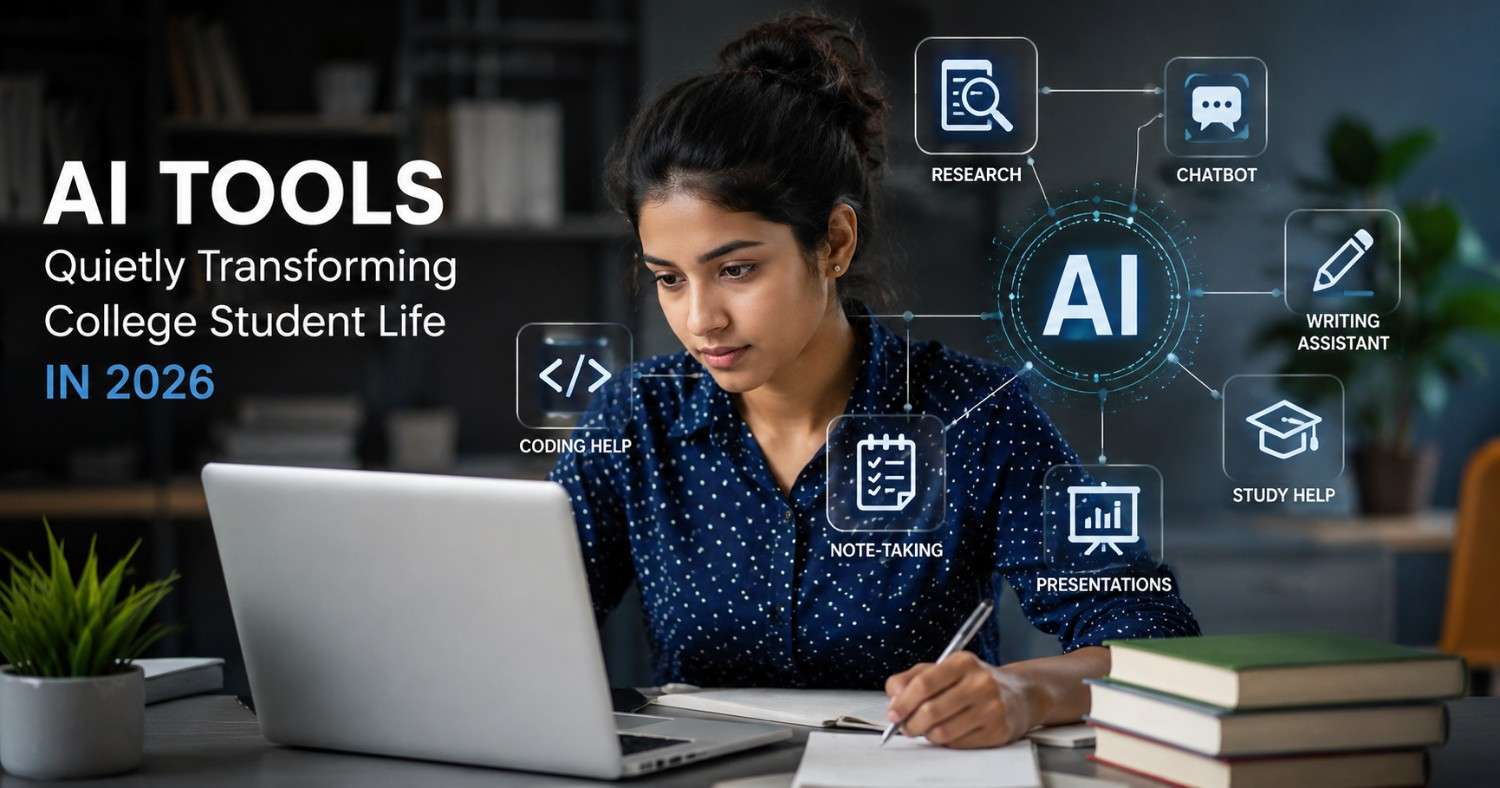


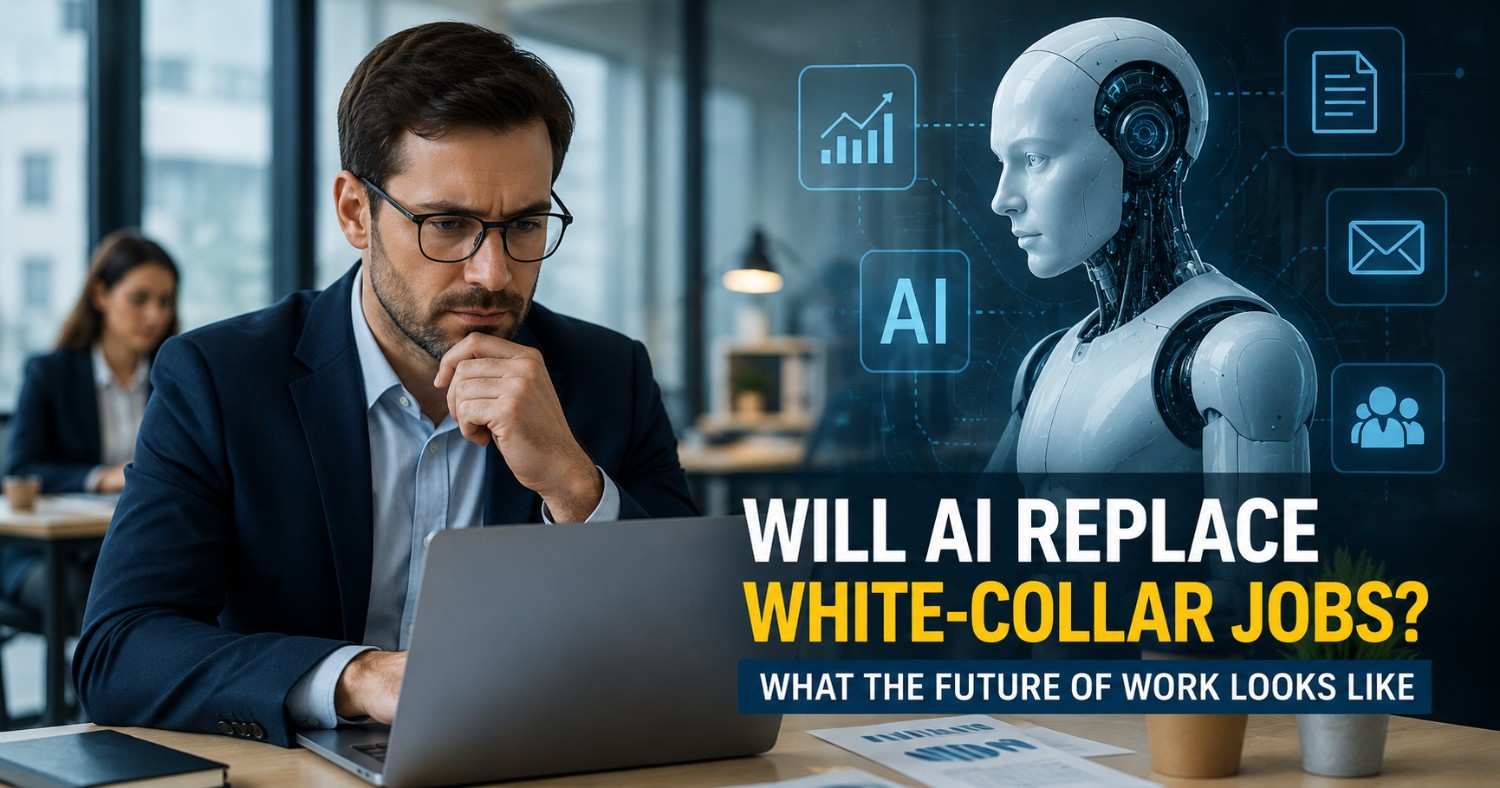
Artificial intelligence has rapidly evolved from a niche technology into a powerful force shaping industries, workplaces, and economies worldwide for Future. Over the past few years, advances in machine learning, generative AI, automation tools, and large language models have sparked intense debate about the future of employment. Among the most frequently discussed questions is whether AI will eventually replace white-collar jobs that have traditionally required specialized education, analytical skills, and professional expertise.
The concern is understandable. AI systems are now capable of drafting reports, analyzing large datasets, generating software code, assisting with legal research, creating marketing content, and even performing customer service functions. Tasks that once required significant human effort can increasingly be completed within seconds by advanced algorithms.
However, experts suggest that the reality is more complex than a simple replacement narrative. While AI is expected to transform many professions, its impact is likely to vary across industries, job functions, and skill levels. Rather than eliminating all white-collar employment, AI may fundamentally reshape how knowledge workers perform their jobs.
Why White-Collar Jobs Are Under the Spotlight
Historically, automation primarily affected manufacturing and routine physical labor. Robots and machines replaced repetitive tasks on factory floors, while professional occupations remained relatively insulated from technological disruption.
The emergence of modern AI has altered that assumption. Unlike traditional automation, AI can process language, recognize patterns, summarize information, and support decision-making processes. This means many office-based roles are now exposed to automation in ways that were previously unimaginable.
Jobs involving repetitive administrative work, data processing, documentation, scheduling, and routine analysis are particularly susceptible to AI-driven efficiencies. Organizations seeking productivity gains and cost reductions are increasingly exploring how AI tools can handle these functions.
At the same time, businesses face growing pressure to remain competitive in a rapidly changing digital economy. As AI capabilities improve, companies may redesign workflows to integrate technology into daily operations.
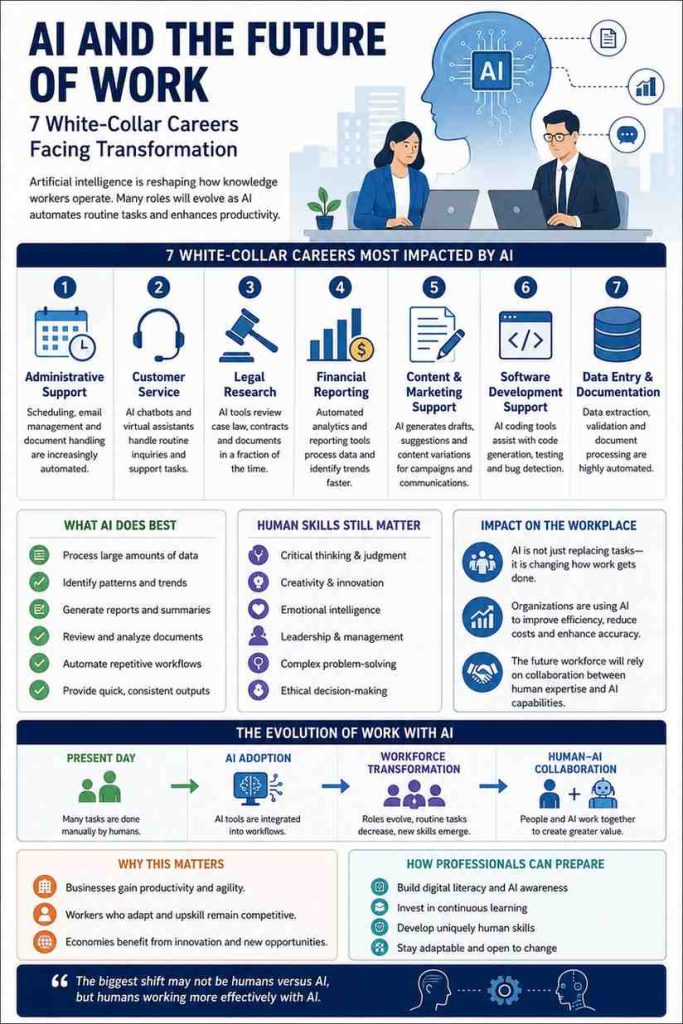
Seven Careers Likely to Experience Significant AI Transformation
1. Administrative and Executive Support Roles
Administrative professionals perform a wide range of tasks, including scheduling meetings, organizing documents, managing communications, and coordinating workflows.
Many of these responsibilities are becoming increasingly automated through AI-powered assistants. Intelligent scheduling tools can coordinate calendars, virtual assistants can respond to routine emails, and document management systems can categorize and retrieve information automatically.
While human oversight remains important, the number of hours devoted to routine administrative work may decline significantly as organizations adopt AI-enhanced productivity platforms.
2. Customer Service Professionals
Customer service has already experienced substantial automation through chatbots and virtual support systems.
Modern AI assistants can answer frequently asked questions, process requests, troubleshoot common issues, and provide personalized responses around the clock. Businesses across banking, retail, telecommunications, and technology sectors are expanding the use of conversational AI to improve efficiency and reduce response times.
However, complex cases involving emotional sensitivity, negotiation, or unusual circumstances still require human intervention, making complete replacement unlikely in the near future.
3. Entry-Level Legal Research Positions
The legal profession has traditionally relied on junior associates and researchers to review documents, search case law, and prepare preliminary legal analyses.
AI-powered legal tools can now rapidly examine vast databases of legal documents, identify relevant precedents, summarize lengthy materials, and assist with contract review. These capabilities can significantly reduce the time spent on routine legal research.
As a result, law firms may increasingly shift junior employees toward higher-value analytical and client-facing responsibilities while relying on AI for foundational research tasks.
4. Financial Analysis and Reporting Roles
Financial institutions and corporations process enormous amounts of data to support budgeting, forecasting, compliance, and investment decisions.
AI systems can identify trends, generate reports, monitor market developments, and detect anomalies far more quickly than traditional methods. Automated analytics platforms are already helping finance teams improve accuracy and efficiency.
Although strategic decision-making will continue to require human judgment, many routine reporting and data-processing functions may become increasingly automated.
5. Content Creation and Marketing Support
Generative AI has dramatically altered the content landscape. Businesses now use AI tools to create drafts, generate ideas, write social media posts, produce product descriptions, and assist with campaign planning.
This development has raised concerns among writers, editors, marketers, and communications professionals. However, most industry experts believe human creativity, brand understanding, audience insight, and editorial judgment remain essential.
Instead of replacing content professionals entirely, AI is more likely to function as a productivity tool that accelerates research, drafting, and content development processes.
6. Software Development Support Functions
The software industry has witnessed rapid adoption of AI coding assistants capable of generating code snippets, identifying bugs, suggesting improvements, and automating repetitive programming tasks.
While these tools can significantly increase developer productivity, building complex software systems still requires architecture planning, problem-solving, quality assurance, security expertise, and collaboration among teams.
The role of software developers may evolve toward supervision, integration, and higher-level design responsibilities rather than routine coding alone.
7. Data Entry and Documentation Specialists
Among white-collar occupations, data entry positions face some of the highest automation risks.
AI-powered optical character recognition, document processing systems, and workflow automation tools can extract, organize, and validate information with increasing accuracy. Tasks that previously required large teams of employees can now be completed through automated systems operating at scale.
As organizations digitize operations, demand for traditional data entry roles may continue to decline while creating opportunities in data management, analytics, and technology oversight.
Why AI Is More Likely to Transform Than Eliminate Jobs
Although headlines often focus on job losses, many economists argue that technological revolutions historically create new opportunities alongside disruption.
The introduction of computers, the internet, and cloud computing transformed countless professions. While certain roles disappeared, entirely new industries and occupations emerged. Similar patterns may occur with AI.
Many organizations are discovering that AI performs best when combined with human expertise rather than operating independently. Professionals who understand how to leverage AI effectively may become more productive and valuable than those who rely solely on traditional methods.
This concept, often referred to as “human-AI collaboration,” is gaining traction across sectors. Workers who can interpret AI outputs, verify accuracy, apply critical thinking, and provide contextual judgment may remain essential components of future workplaces.
Skills Likely to Grow in Importance
As AI becomes more integrated into professional environments, employers are expected to place greater emphasis on uniquely human capabilities.
Critical thinking, strategic planning, emotional intelligence, leadership, creativity, negotiation, ethical decision-making, and interpersonal communication are areas where humans continue to maintain significant advantages.
Technical literacy is also becoming increasingly important. Employees who understand AI systems, data analytics, digital workflows, and automation technologies may be better positioned to adapt to evolving job requirements.
Continuous learning is expected to become a defining characteristic of career success in the AI era. Workers who regularly update their skills and embrace new technologies may be more resilient to workplace disruption.
Economic and Workplace Implications
The widespread adoption of AI presents both opportunities and challenges for businesses and policymakers.
On one hand, increased productivity could drive economic growth, improve efficiency, reduce operational costs, and accelerate innovation. Companies may be able to deliver services faster while reallocating resources toward strategic initiatives.
On the other hand, workforce transitions may create uncertainty for employees whose responsibilities become partially automated. Governments, educational institutions, and employers may face growing pressure to invest in reskilling programs and workforce development initiatives.
The speed at which AI is adopted will likely influence how smoothly labor markets adapt. Gradual implementation may provide workers with time to acquire new skills, while rapid disruption could intensify employment concerns in certain sectors.
The Future of White-Collar Employment
The question of whether AI will replace white-collar jobs does not have a simple yes-or-no answer. AI is undoubtedly changing the nature of professional work, and some roles may experience significant reductions in routine responsibilities. Certain occupations could shrink as automation becomes more capable and widely adopted.
Yet the broader picture suggests transformation rather than wholesale replacement. Many professions are likely to evolve, with humans focusing on judgment, creativity, relationship-building, and strategic thinking while AI handles repetitive and data-intensive tasks. Organizations that successfully combine technological efficiency with human expertise may gain the greatest advantage in the years ahead.
For workers, the challenge will not simply be competing against AI but learning how to work alongside it. Those who adapt to new tools, embrace continuous learning, and develop uniquely human skills may find themselves well-positioned in an increasingly AI-driven economy.
Highlights
- AI is increasingly automating routine white-collar tasks across administration, finance, customer service, and content creation.
- Experts suggest AI is more likely to transform many professional roles rather than eliminate them entirely.
- Administrative support, data entry, legal research, and customer service functions face some of the highest automation exposure.
- Human skills such as creativity, critical thinking, leadership, and emotional intelligence remain difficult to automate.
- Businesses are adopting AI to improve productivity, reduce costs, and streamline workflows.
- Workforce reskilling and continuous learning are expected to play a major role in adapting to AI-driven workplace changes.
- The future workplace is likely to emphasize collaboration between human expertise and AI-powered tools.
FAQ
1. Will AI completely replace white-collar jobs?
Most experts believe AI will transform many white-collar jobs rather than completely replace them. Human judgment, creativity, and interpersonal skills remain important in many professions.
2. Which white-collar jobs face the highest automation risk?
Administrative support, data entry, customer service, routine legal research, and repetitive reporting functions are among the most vulnerable to automation.
3. Can AI replace lawyers, accountants, or software developers?
AI can automate portions of these professions, particularly repetitive tasks, but complex decision-making, client relationships, and strategic thinking still require human involvement.
4. Why are white-collar workers concerned about AI?
Modern AI can perform language-based and analytical tasks that were previously considered exclusive to highly educated professionals, creating uncertainty about future job requirements.
5. What skills are becoming more valuable in the AI era?
Critical thinking, creativity, communication, leadership, emotional intelligence, and technical literacy are increasingly important as workplaces adopt AI technologies.
6. How are companies using AI today?
Organizations use AI for customer support, data analysis, content generation, scheduling, document management, coding assistance, and workflow automation.
7. Will AI create new jobs?
Historically, technological advancements have generated new industries and employment opportunities. Many analysts expect AI to create new roles focused on oversight, implementation, governance, and innovation.
8. How can professionals prepare for AI-driven changes?
Workers can improve adaptability by learning new technologies, developing specialized expertise, strengthening human-centered skills, and participating in ongoing professional development.
Edited By E. Devanshi varma
Also Read: IPL Honey-Trap Row Sparks 7 Big Questions Before Playoffs
Follow us on Google News: Click Here