

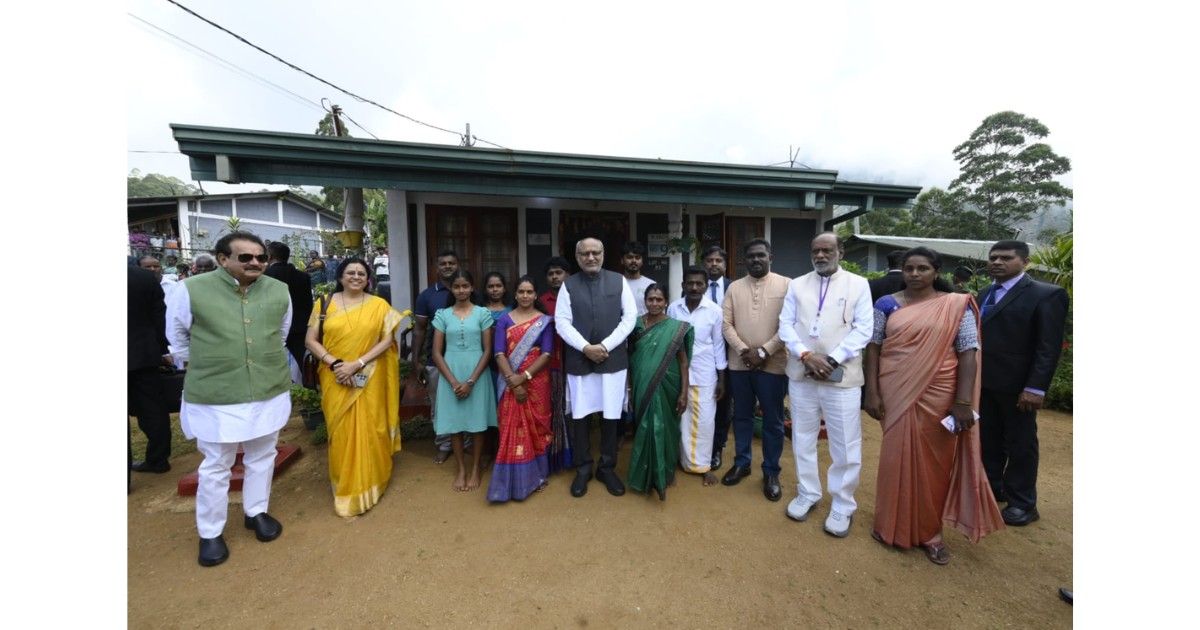
India’s Vice President C. P. Radhakrishnan visited the central highlands of Sri Lanka on Monday as part of his ongoing two-day official trip, where he inspected progress under the India-funded “Indian Housing Project.” The visit included a stop in Nuwara Eliya, a region known for its plantation estates and large population of Indian-origin Tamil workers.
The visit marks Radhakrishnan’s first bilateral engagement with Sri Lanka since assuming office and comes at a time when India is expanding its development partnerships in the region.
Key Highlights of the Visit
The Vice President toured housing units constructed under the third phase of the Indian Housing Project at Lidl’sdale Estate in Ragala. During the visit, he interacted directly with beneficiaries, many of whom are members of the Indian-origin Tamil community working in plantation sectors.
Officials from the Ministry of External Affairs stated that the project represents one of India’s largest grant-based development initiatives abroad. The initiative aims to improve living conditions for historically marginalized communities in Sri Lanka.
Key takeaways from the visit include:
- Inspection of newly constructed housing units under Phase III of the project
- Interaction with beneficiary families residing in plantation areas
- Assessment of ongoing implementation and quality of infrastructure
- Reaffirmation of India’s continued support for Tamil communities in Sri Lanka
The Vice President expressed satisfaction with the progress and emphasized the importance of ensuring timely completion of future phases.
Official Statement and Diplomatic Messaging
During his interaction with residents, Radhakrishnan conveyed a message of solidarity and long-term commitment from India. He highlighted that the welfare of Tamils in Sri Lanka remains a priority for both the Indian government and its citizens.
In his remarks, he underscored that development partnerships like the Indian Housing Project are not just infrastructure initiatives but also symbols of shared history and cultural ties between the two nations.
He noted that India’s engagement in Sri Lanka is guided by principles of mutual respect, partnership, and people-centric development. His comments also reflected India’s broader diplomatic approach in the region, where development cooperation is increasingly becoming a key pillar of foreign policy.
Background: The Indian Housing Project
The Indian Housing Project is a flagship initiative launched by the Government of India to address housing shortages among vulnerable communities in Sri Lanka, particularly those affected by decades of civil conflict and economic hardship.
The project primarily targets:
- Tamil families in Sri Lanka’s Northern and Eastern Provinces
- Indian-origin Tamil communities living in plantation estates in central regions
So far, approximately 50,000 houses have been constructed under various phases of the programme. These homes have been provided as grants, meaning beneficiaries are not required to repay the cost, making it a critical intervention for low-income households.
The project is being implemented in multiple phases:
- Phase I & II: Focused on conflict-affected areas in the north and east
- Phase III: Expanded to plantation areas like Nuwara Eliya
- Phase IV: Will include construction of an additional 10,000 houses
The initiative has been widely regarded as one of the most impactful development collaborations between India and Sri Lanka in recent years.
Why This Visit Matters
Radhakrishnan’s visit carries both developmental and diplomatic significance.
From a development perspective, it provides an opportunity to review on-ground progress and ensure that the benefits of the project are reaching intended recipients. Direct interaction with beneficiaries allows policymakers to understand challenges, including delays, quality concerns, or gaps in implementation.
From a diplomatic standpoint, the visit reinforces India’s role as a key development partner for Sri Lanka. At a time when the island nation is navigating economic recovery, such projects highlight India’s continued support beyond financial aid, focusing on grassroots-level impact.
The visit also signals India’s ongoing commitment to the welfare of Tamil communities in Sri Lanka, an issue that holds political and cultural importance in bilateral relations.
Public Impact: Who Benefits and How
The Indian Housing Project directly benefits thousands of low-income families who previously lived in substandard housing conditions, particularly in plantation regions where estate workers have historically faced socio-economic disadvantages.
For beneficiaries, the impact includes:
- Improved Living Conditions: Transition from temporary or dilapidated housing to permanent structures
- Enhanced Safety: Stronger homes provide protection against weather and environmental risks
- Social Stability: Ownership of a house contributes to long-term financial and emotional security
- Access to Basic Amenities: Many new housing units are integrated with improved sanitation and utilities
For Indian-origin Tamils in plantation areas, the project represents a significant step toward addressing decades-old disparities in housing and living standards.
Broader Context: India–Sri Lanka Development Cooperation
India and Sri Lanka share deep historical, cultural, and economic ties. Over the years, development cooperation has become a cornerstone of their relationship.
India has been involved in several key projects in Sri Lanka, including:
- Infrastructure development
- Railway rehabilitation
- Healthcare and education initiatives
- Housing and community welfare programmes
The Indian Housing Project stands out due to its scale and direct impact on ordinary citizens.
In recent years, India has also extended financial assistance and credit lines to support Sri Lanka during economic challenges, further strengthening bilateral ties.
Challenges and Implementation Considerations
While the project has achieved significant milestones, large-scale housing initiatives often face challenges such as:
- Delays in construction due to logistical or administrative issues
- Rising costs of materials
- Coordination between multiple agencies
- Ensuring uniform quality across all units
The Vice President’s visit serves as a mechanism to address such concerns by bringing high-level attention to implementation on the ground.
Future Outlook
With an additional 10,000 houses planned under the fourth phase, the Indian Housing Project is set to expand its reach further. The focus will likely remain on completing pending units while ensuring that new constructions meet quality and sustainability standards.
India’s continued involvement in such initiatives indicates a long-term commitment to people-centric development in Sri Lanka. As both countries navigate evolving regional dynamics, projects like these are expected to play a key role in strengthening bilateral trust and cooperation.
Radhakrishnan’s visit, though brief, underscores the importance of maintaining momentum in development partnerships that directly impact communities. It also highlights how infrastructure initiatives, when implemented effectively, can serve as powerful tools of diplomacy and social upliftment.
Inputs and images : Hindusthan Samachar
Edited By E. Devanshi varma
Also Read: Probe Ordered in 1 Lok Bhavan Incident Involving IRS Officers in Bhubaneswar
Follow us on Google News: Click Here