

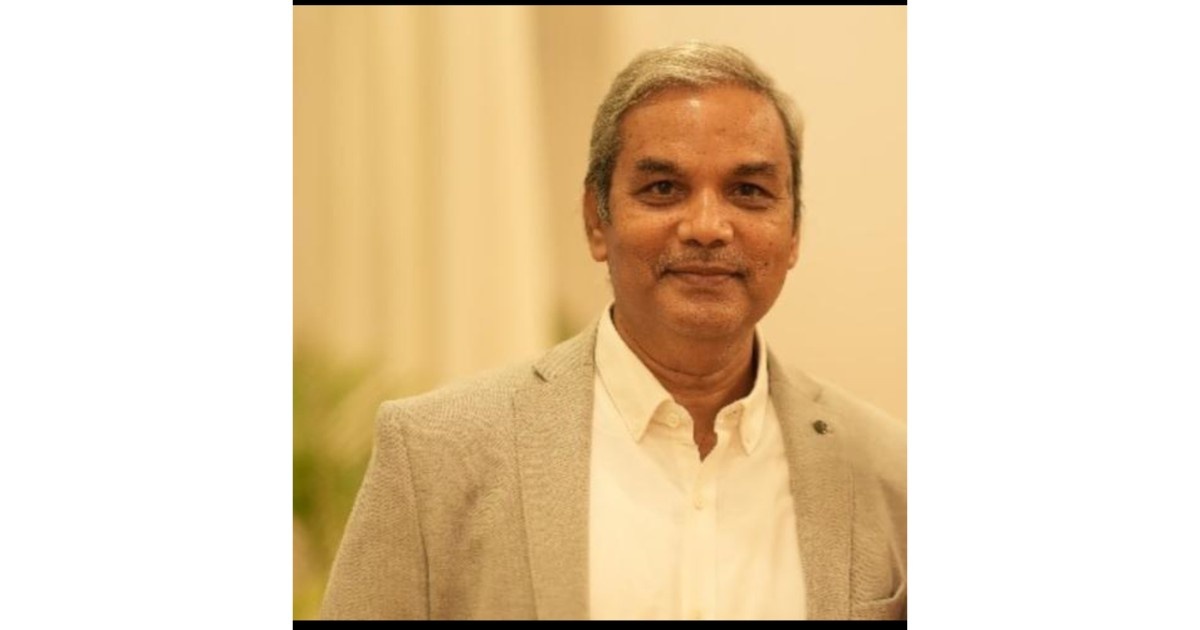
A retirement celebration in Bengaluru turned into an emotional musical evening as former BARC scientist Prakash Hadagali revealed a lifelong passion for singing that even many colleagues had never known about.
In an era where professional success often overshadows personal passions, the story of Prakash Hadagali stands out as a reminder that talent can quietly thrive for decades before coming into public view.
The retired scientist from the prestigious Bhabha Atomic Research Centre recently drew attention at a family wedding function in Bengaluru, not for his long scientific career, but for his soulful singing that moved relatives and guests to tears.
The occasion was the Mehendi ceremony of Neha, daughter of Indira Priyadarshini and Suresh Hadagali, ahead of her marriage to Kiran. What began as a small family gathering gradually transformed into an evening filled with music, nostalgia, and emotional performances from several members of the Hadagali family.
A Musical Evening at a Family Celebration
Family members from Bengaluru, Bagalkot, Hubballi and other places gathered for the pre-wedding celebrations. Singing quickly became the highlight of the evening as relatives performed popular Hindi and Kannada songs.
The musical session began with Sadananda Hiremath from Bagalkot, followed by Sharada, who is now settled in Bengaluru. Their performances encouraged other family members to join in, creating an informal but lively musical atmosphere.
Among those who took the stage was Prakash Hadagali, elder brother of Suresh Hadagali and a retired senior scientist from BARC. Guests were surprised by the depth and emotion in his singing, especially because many were unaware that he had nurtured the talent for decades.
Suresh Hadagali, daughter Srushti Hadagali, and cousin Ravindra Hadagali from Hubballi also participated in the performances. Ravindra, in particular, entertained the audience with his unique ability to whistle songs, a skill family members jokingly linked to habits developed during his school and college days.
Former principal of the College of Fine Arts at Karnataka Chitrakala Parishat, Prof. Babu Jattakar, also joined the evening with a rendition of the Kannada classic “Kaanada Kadalige,” popularised by late singer C. Ashwath. Other relatives and guests later added to the celebration through spontaneous performances and dance.
One of the most memorable moments of the night came when Sharada and her elderly mother danced while singing, drawing applause from the audience.
Emotional Performance Leaves Guests in Tears
The emotional peak of the evening arrived when Prakash Hadagali sang “Babul Ki Duwayein,” a song closely associated with weddings and a daughter’s farewell from her parental home.
The performance deeply affected the gathering. Neha, her parents, relatives and several guests became emotional as the lyrics resonated with the significance of the occasion. Even Hadagali himself struggled to hold back tears while completing the song.
For many in attendance, the moment revealed not just a gifted singer, but a deeply sensitive individual whose artistic side had remained largely hidden throughout his professional life.
From Bagalkot to BARC
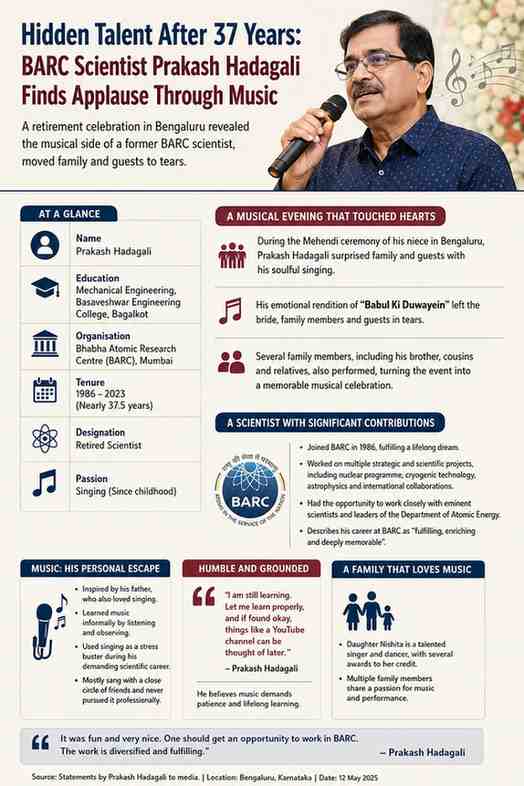
Prakash Hadagali’s journey began in Bagalkot, Karnataka, where he completed his Mechanical Engineering degree from Basaveshwar Engineering College. Academically strong from an early stage, he briefly worked as a lecturer at the same institution before receiving an opportunity that would shape his career.
In 1986, he joined the Bhabha Atomic Research Centre, one of India’s leading nuclear research institutions.
Reflecting on that period, Hadagali described joining BARC as a dream achievement.
He said the recruitment process was highly competitive and rigorous, adding that he never expected to clear it so easily. According to him, the selection process at BARC was known for being merit-driven and unbiased.
Work Across Strategic Scientific Projects
During his nearly 37-and-a-half-year career at BARC, Hadagali worked on several scientific and strategic initiatives linked to India’s nuclear and research programmes.
He said his work included contributions to international collaborative projects, nuclear programme development, cryogenic technology, astrophysics-related initiatives and departmental research activities.
Hadagali also recalled interactions with senior scientists and leadership within the Department of Atomic Energy. According to him, working alongside eminent researchers was one of the most enriching aspects of his career.
His comments provide a glimpse into the highly diversified nature of work at BARC, where scientists are often exposed to multiple disciplines and long-term national projects.
Singing Remained a Personal Escape
Despite the demands of scientific work, music remained an important part of Hadagali’s life.
He said his interest in singing began during childhood, inspired largely by his father, who also enjoyed music. His brother Suresh shared the same passion, making music a natural part of family life.
However, Hadagali never pursued formal training or attempted to build a professional music career. Instead, singing remained a personal hobby that helped him manage stress and maintain balance alongside professional responsibilities.
According to him, the pressures of deadlines and project targets at BARC made music an effective emotional outlet. During weekends, he would occasionally sing with close friends, though he kept the hobby largely private.
He described his learning process as similar to the “Ekalavya approach” — learning independently through observation and listening rather than through structured training.
Hidden Talent Revealed Only After Retirement
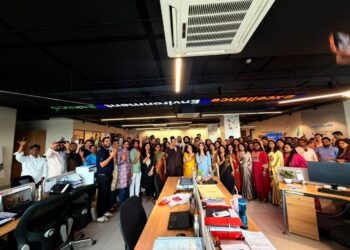
Interestingly, many of Hadagali’s colleagues at BARC reportedly discovered his singing ability only during his retirement function.
He recalled that senior officers and coworkers were surprised that he had never performed during official events despite working there for more than three decades.
Their reaction, he said, made him realise how closely guarded his musical side had remained throughout his career.
Even after retirement, Hadagali has continued to maintain a modest attitude toward his talent. Although friends and well-wishers have encouraged him to launch a YouTube channel or explore public performances more seriously, he has not taken that step yet.
He believes music requires continuous learning and patience, qualities he says he still wants to develop further.
Humility Defines His Artistic Journey
What stands out most in Hadagali’s story is not only the contrast between nuclear science and music, but also the humility with which he speaks about both.
Despite singing for more than five decades, he insists that he is “still learning” and does not consider himself formally trained enough to claim expertise.
He admitted there were moments earlier in life when he could have explored music professionally. However, he said he lacked the patience needed for the disciplined training required in classical or professional singing careers.
According to him, music demands long-term dedication, something difficult to balance alongside a demanding scientific profession.
Yet he views singing as deeply rewarding. He described it as a stress reliever and a source of emotional satisfaction that helped him remain grounded through years of technical and scientific work.
A Family That Continues the Musical Legacy
Music appears to run strongly within the Hadagali family.
Prakash Hadagali spoke proudly about his daughter Nishita, a software engineer settled in the United States, whom he described as an even better singer and dancer than himself.
According to him, she has received several awards for singing and has participated in multiple dance performances. However, like her father, she too has not pursued the arts professionally despite her abilities.
The family’s shared connection with music was clearly visible during the wedding celebration, where multiple generations participated with ease and enthusiasm.
A Different Perspective on Scientific Careers
Hadagali also reflected on the difference between working in a research institution like BARC and working in many private sector companies.
According to him, BARC offered exposure to a wide range of projects and disciplines, unlike jobs where employees may spend decades repeating similar tasks.
He described the institution as intellectually diverse and professionally fulfilling, saying it gave him opportunities to work on varied scientific initiatives throughout his career.
His remarks also highlight a broader reality about scientists and researchers — many often carry artistic or creative interests alongside their technical professions, though such talents rarely become publicly visible.
In Hadagali’s case, it took retirement and a family wedding celebration for many people around him to fully discover the singer behind the scientist.
Inputs and images : Hindusthan Samachar
Edited By E. Devanshi varma
Also Read: Assam Assembly Polls See 7 Major Highlights as Turnout Peaks, Counting Set for May 4
Follow us on Google News: Click Here