


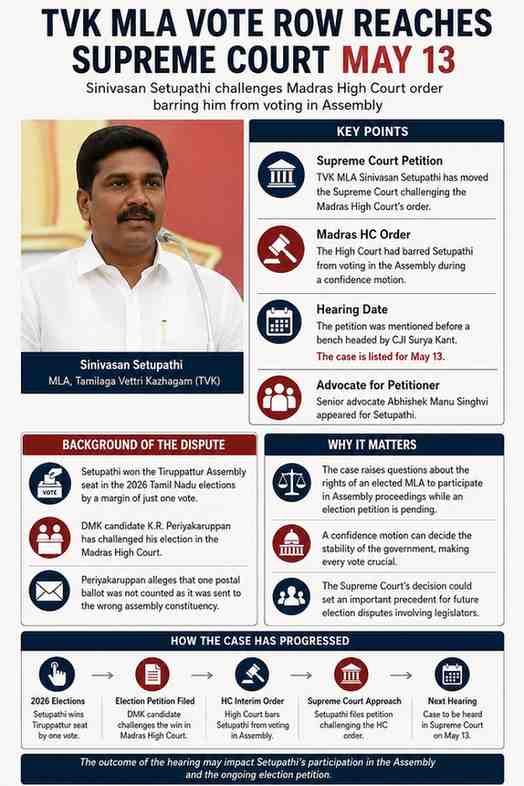
Tamilaga Vettri Kazhagam MLA Sinivasan Setupathi has approached the Supreme Court after the Madras High Court barred him from participating in a confidence motion vote amid an ongoing election dispute in Tamil Nadu. The top court is scheduled to hear the matter on May 13.
A fresh political and legal controversy has emerged in Tamil Nadu after Tamilaga Vettri Kazhagam (TVK) MLA Sinivasan Setupathi moved the Supreme Court against a Madras High Court order that prevented him from voting in the state assembly during a confidence motion.
The petition was mentioned before a bench headed by Chief Justice Surya Kant on Monday, following which the apex court agreed to list the matter for hearing on May 13. Senior advocate Abhishek Manu Singhvi appeared on behalf of Setupathi and sought an urgent hearing in the case.
The dispute stems from the closely contested Tiruppattur Assembly constituency election in the 2026 Tamil Nadu Assembly polls, where Setupathi secured victory by a margin of just one vote. The razor-thin result has since triggered legal scrutiny and political debate over the validity of the election process.
Madras High Court Order Challenged
The controversy intensified after the Madras High Court restrained Setupathi from casting his vote in the Tamil Nadu Assembly during a confidence motion linked to the ruling dispensation.
Setupathi has now argued before the Supreme Court that the High Court’s interim direction directly affects his constitutional role as an elected legislator. His plea seeks relief against the restriction imposed on his participation in assembly proceedings while the election petition remains pending.
The Supreme Court’s decision in the matter is likely to have wider political implications, particularly because confidence motions can determine the stability of governments and legislative majorities.
Background of the Election Dispute
The legal challenge against Setupathi’s election was initiated by DMK candidate K.R. Periyakaruppan, who lost the Tiruppattur seat by a single vote. Periyakaruppan approached the Madras High Court alleging irregularities in the counting process and seeking to invalidate the election result.
According to the petition, one postal ballot was allegedly not included in the final count because it had been sent to the wrong assembly constituency. The petitioner has argued that the exclusion of the ballot may have materially impacted the election outcome, given the narrow margin of victory.
Postal ballots often become crucial in closely fought elections, particularly when the victory margin is extremely small. Election disputes involving rejected or disputed postal ballots have frequently led to prolonged legal proceedings in India’s electoral system.
The High Court has been examining the allegations as part of the ongoing election petition.
Why the Case Matters
The case has attracted significant attention because it touches upon two critical constitutional issues — the sanctity of electoral outcomes and the rights of elected representatives.
Election petitions in India are governed by the Representation of the People Act, 1951, under which courts can examine allegations of improper counting, rejection of votes, corrupt practices, or procedural violations during elections.
When courts find sufficient grounds, they may issue interim directions while the final adjudication of the election dispute is pending. However, restrictions imposed on sitting legislators during ongoing proceedings often become politically sensitive, especially when legislative voting numbers are closely balanced.
In Setupathi’s case, the High Court’s direction preventing him from voting in the assembly has elevated the dispute beyond a standard election petition into a matter involving legislative functioning and constitutional interpretation.
Legal experts note that courts generally exercise caution while passing interim orders that may affect democratic representation, particularly before the final outcome of an election challenge is decided.
Confidence Motion Adds Political Significance
The timing of the dispute has added to its political importance because the issue arose in the context of a confidence motion in the Tamil Nadu Assembly.
A confidence motion is a parliamentary procedure through which a government proves that it continues to enjoy the support of the majority of legislators in the house. Such motions become crucial during periods of political instability, coalition disagreements, or internal party tensions.
Even a single vote can become decisive in closely contested assemblies. As a result, the exclusion of an MLA from participating in the voting process can significantly influence political outcomes.
While details regarding the broader political arithmetic in the assembly have not yet emerged officially, the Supreme Court’s intervention could become important in clarifying the extent to which courts can regulate the participation of elected lawmakers during pending election disputes.
Supreme Court to Hear Matter on May 13
During Monday’s proceedings, senior advocate Abhishek Manu Singhvi informed the Supreme Court bench about the urgency of the matter and requested an expedited hearing.
The bench headed by Chief Justice Surya Kant agreed to hear the petition on May 13. The hearing is expected to focus on whether the interim restriction imposed by the Madras High Court was legally justified and whether it infringes upon the democratic mandate received by the MLA.
The Supreme Court may also examine broader constitutional questions relating to judicial intervention in legislative voting processes before the final adjudication of election petitions.
The outcome of the hearing could set an important precedent for future disputes involving elected representatives facing pending election challenges.
Narrow Victory and Electoral Sensitivity
Winning an election by a margin of one vote is exceptionally rare in Indian electoral politics and often results in heightened scrutiny of every stage of the counting process.
Such contests frequently lead to recount demands, examination of rejected ballots, and legal challenges concerning procedural compliance by election authorities.
In Setupathi’s case, the disputed postal ballot has become central to the controversy because even a single additional valid vote could potentially alter the declared result.
Election law experts point out that courts handling such cases usually undertake a detailed review of counting records, ballot validity, and procedural documentation before arriving at a final decision.
Until the election petition is conclusively decided, the legal status and legislative participation of the elected representative can become subjects of interim judicial orders, as seen in the present dispute.
Political Reactions Likely to Intensify
The case is also expected to trigger political debate between the ruling TVK and opposition DMK in Tamil Nadu.
Opposition parties are likely to argue that electoral irregularities must be thoroughly examined to preserve public trust in democratic institutions. On the other hand, the ruling side may contend that restricting an elected MLA’s voting rights before the final verdict undermines the mandate of voters.
The legal battle may therefore evolve into a larger political issue surrounding electoral fairness, judicial oversight, and legislative autonomy.
Observers say the Supreme Court’s decision on interim relief could influence not only the immediate assembly proceedings but also future judicial approaches to election-related disputes involving sitting lawmakers.
Broader Constitutional Questions
The matter highlights the delicate balance between judicial review and legislative independence in India’s constitutional framework.
Courts possess the authority to examine election disputes and ensure compliance with electoral laws. At the same time, legislatures operate as democratically elected bodies whose functioning is protected under constitutional principles.
The Supreme Court’s hearing may therefore address whether interim judicial restrictions on assembly voting should be imposed only in exceptional circumstances and what standards should apply before limiting the participation of elected representatives.
The decision could become particularly relevant in tightly contested assemblies where even temporary voting restrictions may alter political outcomes.
For now, all eyes remain on the apex court hearing scheduled for May 13, which could determine whether Sinivasan Setupathi regains the right to participate in assembly proceedings while the election challenge continues before the Madras High Court.
Inputs and images : Hindusthan Samachar
Edited By E. Devanshi varma
Also Read: Assam Assembly Polls See 7 Major Highlights as Turnout Peaks, Counting Set for May 4
Follow us on Google News: Click Here