

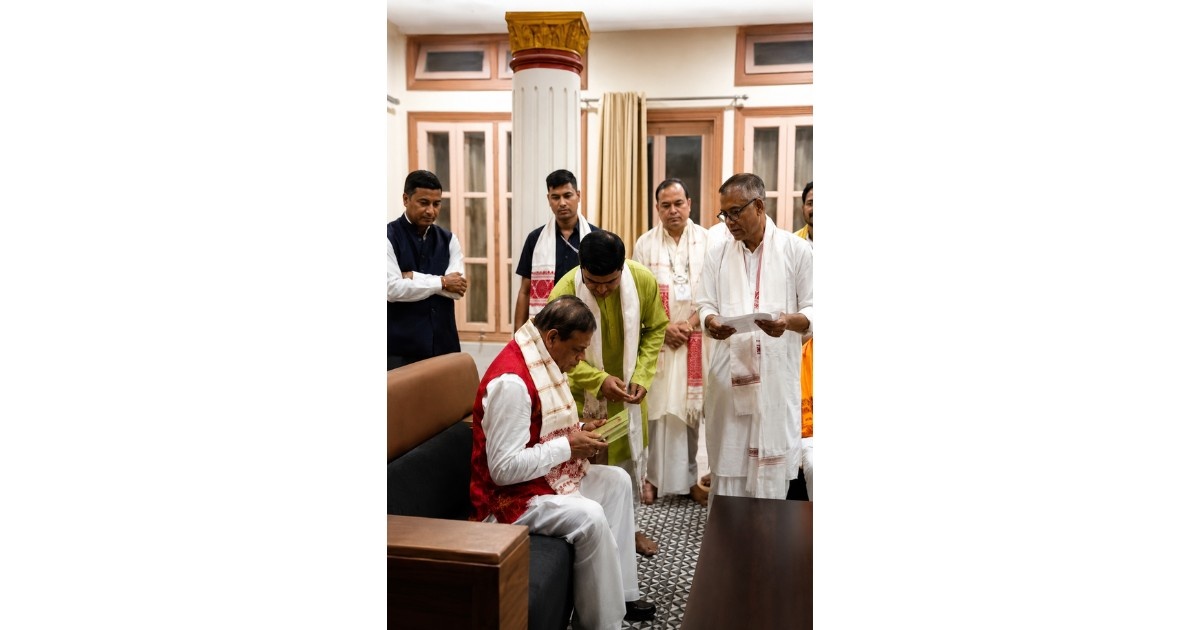
Assam Chief Minister Himanta Biswa Sarma on Friday visited the historic Batadrava Than in Nagaon district shortly after beginning his second term in office, using the occasion to reiterate the state government’s commitment to preserving Assam’s Vaishnavite heritage while addressing long-pending civic and infrastructure concerns around one of the state’s most significant religious centres.
The visit to Batadrava Than — widely regarded as the birthplace of 15th-century saint-scholar and social reformer Srimanta Sankardeva — carried both cultural and political significance. Dressed in traditional Assamese attire, Sarma offered prayers at the Kirtanghar and presented a ceremonial ‘Sarai’, a customary Assamese gesture of respect and devotion. The Chief Minister also interacted with devotees and members of the Than management committee during the visit.
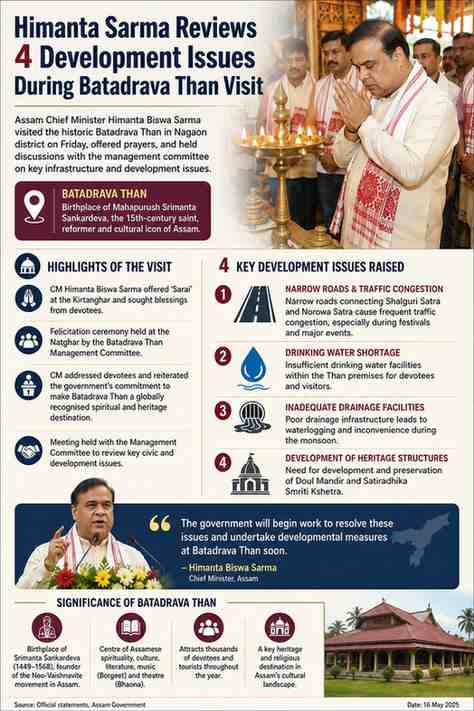
Batadrava Than, also known as Bordowa Than, occupies a central place in Assam’s spiritual and cultural identity. Established by Sankardeva, the site represents the origins of the Neo-Vaishnavite movement in Assam, which played a major role in shaping the region’s literature, music, theatre, social reform traditions, and community-based religious practices over several centuries. The Than attracts thousands of pilgrims annually, particularly during religious festivals and cultural gatherings.
The Chief Minister’s visit comes at a time when the Assam government has increasingly focused on religious tourism and heritage-based infrastructure development as part of a broader strategy to boost local economies and cultural preservation. Over the last few years, the state government has announced development projects linked to major pilgrimage and heritage destinations across Assam, including temples, satras, and historical landmarks associated with Assamese civilisation and spiritual traditions.
During a public interaction with devotees and local residents at the Natghar premises, Sarma said the government would continue working towards transforming Batadrava Than into a globally recognised spiritual and cultural destination. He also linked the development vision to the teachings and ideals of Sankardeva, whose influence continues to shape Assamese identity across religious and social lines.
“Assam’s cultural foundations are deeply connected with the ideals of Mahapurush Srimanta Sankardeva. Preserving and developing places associated with his legacy is not only about religious infrastructure but also about protecting the state’s civilisational heritage,” Sarma said while addressing the gathering.
The event also witnessed the formal felicitation of the Chief Minister by the Batadrava Than Management Committee. Several office bearers, including committee president Amlan Jyoti Dev Goswami, vice-president Jogendra Narayan Dev Mahanta, executive president Gobin Chandra Das, and other members, were present during the programme. Local organisations and party workers also participated in welcoming the Chief Minister.
Beyond ceremonial engagements, the visit turned into an administrative review meeting focused on infrastructural gaps affecting pilgrims and local residents around the Than premises. During discussions held at the management committee office, committee representatives submitted several demands and highlighted longstanding civic issues requiring immediate intervention.
Among the primary concerns raised was severe traffic congestion caused by narrow connecting roads leading to Shalguri Satra and Norowa Satra. According to committee members, the existing road infrastructure struggles to accommodate the growing number of visitors during festivals and major religious events, resulting in frequent bottlenecks and inconvenience for devotees.
The committee also flagged the shortage of safe drinking water facilities within the Than complex, inadequate drainage systems leading to waterlogging during heavy rainfall, and the need for restoration and development of important structures including the Doul Mandir and Satiradhika Smriti Kshetra.
Officials familiar with the region say these concerns have persisted for years as footfall at the pilgrimage site increased without proportional civic upgrades. Religious tourism in Assam has expanded considerably in recent years, particularly after state-backed promotional campaigns aimed at attracting visitors to heritage circuits connected with Vaishnavite institutions and indigenous cultural traditions.
Responding to the demands, Sarma assured the committee that the state government would initiate measures to address the identified issues. He indicated that developmental work related to road expansion, civic amenities, and site improvement projects would begin in phases after departmental review and planning.
The renewed focus on Batadrava Than is also being viewed within the wider political context of Assam’s cultural policy direction under the current administration. Since assuming office, the BJP-led government in the state has repeatedly emphasised indigenous identity, Assamese heritage conservation, and restoration of historical religious institutions. Development of satras and temple infrastructure has featured prominently in state policy announcements and budgetary priorities over the past few years.
Political observers note that religious and heritage tourism has emerged as an important governance and economic theme in northeastern states, where governments are attempting to combine cultural preservation with tourism-driven local development. In Assam, pilgrimage centres associated with Sankardeva and Madhavdeva have increasingly been projected not only as religious spaces but also as heritage destinations capable of generating employment, local business activity, and improved regional connectivity.
Experts on Assamese culture believe preservation efforts at places like Batadrava Than require a balanced approach that combines infrastructure modernisation with protection of historical authenticity. Many heritage activists have previously argued that unchecked commercialisation around spiritual sites can undermine their cultural significance if development projects are not carefully planned.
The significance of Batadrava Than extends beyond religion alone. Sankardeva’s contributions to Assamese society included the promotion of community prayer halls, literary works, devotional music known as Borgeet, theatrical traditions like Bhaona, and social reform ideas aimed at creating greater social cohesion. Historians often describe the Neo-Vaishnavite movement as one of the most influential cultural developments in Assam’s medieval history.
For local residents in Nagaon district, improved infrastructure around the Than could also bring practical benefits beyond pilgrimage management. Better roads, drainage systems, sanitation facilities, and water supply improvements may help surrounding communities that have long faced civic deficiencies despite living near one of Assam’s most visited religious centres.
Tourism stakeholders have also repeatedly pointed out that inadequate infrastructure remains one of the biggest barriers preventing Assam from fully capitalising on its cultural tourism potential. While visitor interest in northeastern India has grown in recent years, connectivity challenges, limited accommodation facilities, and inconsistent civic amenities continue to affect tourist experiences at several destinations.
The government’s renewed engagement with Batadrava Than therefore carries importance on multiple fronts — religious preservation, tourism development, regional infrastructure, and cultural identity politics. Whether the promised projects materialise within expected timelines may determine how effectively the administration can convert symbolic visits into tangible local improvements.
For devotees visiting Batadrava Than, however, the Chief Minister’s visit represented more than an official inspection. Many saw it as recognition of the enduring relevance of Sankardeva’s teachings in contemporary Assam, particularly at a time when cultural institutions across the state are increasingly being positioned at the centre of public policy and identity discourse.
As Assam continues to expand its heritage tourism ambitions, sites such as Batadrava Than are expected to receive greater administrative and financial attention in the coming years. The challenge for the state government will lie in ensuring that development initiatives improve accessibility and facilities without diluting the spiritual and historical character that makes these institutions culturally significant in the first place.
Key Insights
- The renewed focus on Batadrava Than reflects Assam’s broader policy push to position religious and cultural heritage sites as tourism-driven economic hubs, particularly in districts with untapped pilgrimage potential.
- Infrastructure concerns raised during the visit — including traffic congestion, water shortages, and drainage deficiencies — highlight a recurring challenge across many heritage destinations in northeastern India, where rising tourist footfall has often outpaced civic development.
- The government’s emphasis on preserving institutions associated with Srimanta Sankardeva aligns with ongoing efforts to strengthen Assamese cultural identity through restoration of satras, temples, and Vaishnavite heritage circuits.
- Experts on heritage conservation have consistently stressed that infrastructure modernisation around historic religious sites must be carefully balanced with preservation of architectural authenticity and cultural character to avoid over-commercialisation.
- Development of connectivity and public amenities around Batadrava Than could have broader local economic implications, including growth in small businesses, hospitality services, transport activity, and employment opportunities linked to religious tourism.
- The visit also underscores how cultural heritage is increasingly being integrated into governance and regional development strategies in Assam, where spiritual landmarks are being viewed not only as places of worship but also as symbols of historical continuity and public identity.
- Improved civic infrastructure in and around the Than may benefit local residents beyond tourism management, especially in areas related to sanitation, drainage, road access, and drinking water availability that affect surrounding communities year-round.
- The success of the proposed projects will likely depend on timely execution, inter-departmental coordination, and sustained funding support, as several infrastructure concerns raised by the management committee have reportedly remained unresolved for years.
Inputs and images : Hindusthan Samachar
Edited By E. Devanshi varma
Also Read: Assam Assembly Polls See 7 Major Highlights as Turnout Peaks, Counting Set for May 4
Follow us on Google News: Click Here