

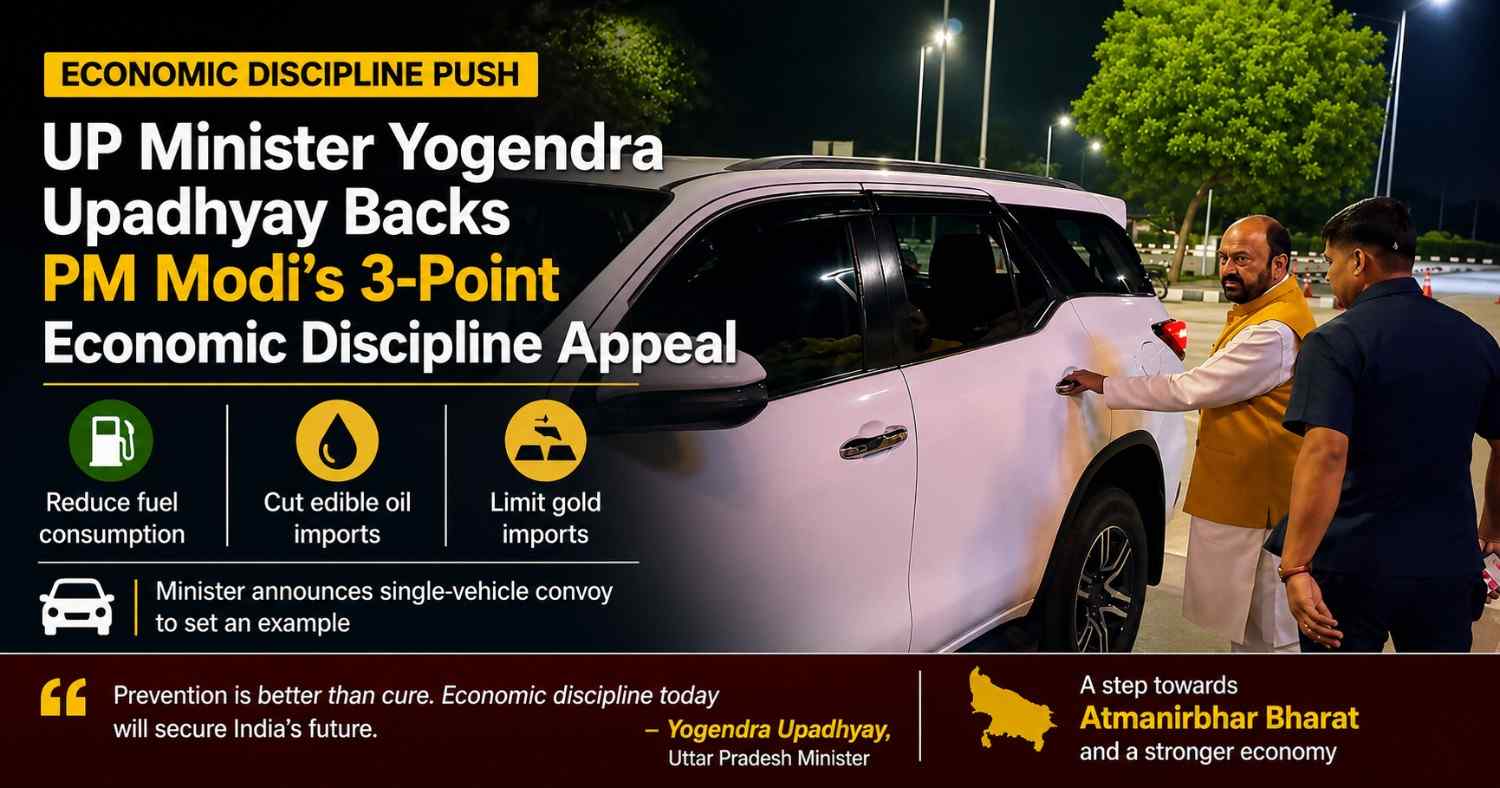
India’s growing emphasis on economic self-reliance and fiscal discipline received fresh political backing on Thursday after Yogendra Upadhyay publicly endorsed Prime Minister Narendra Modi’s appeal for responsible consumption and reduced dependence on foreign imports. The Uttar Pradesh minister also announced that he would reduce his official convoy to a single vehicle, describing the move as a symbolic but necessary step in the national interest.
Speaking in Lucknow, Upadhyay framed the issue not merely as a matter of administrative restraint but as part of a broader economic discipline campaign that he believes is increasingly important amid global uncertainty, volatile energy markets, and pressure on foreign exchange reserves.
The minister said unnecessary spending that leads to avoidable outflow of foreign currency should be discouraged, particularly in sectors where India remains heavily dependent on imports. He pointed to fuel consumption, edible oil imports, and excessive gold purchases as areas requiring greater public awareness and policy attention.
According to government and trade estimates, India imports a significant portion of its edible oil requirements, making the sector vulnerable to global supply disruptions and currency fluctuations. International developments such as the Russia-Ukraine conflict, disruptions in shipping routes, and geopolitical tensions involving Iran and the United States have repeatedly impacted commodity prices and freight costs over the past few years. These developments have increased pressure on importing nations, including India, where inflation management and trade balancing remain major policy priorities.
Upadhyay argued that reducing avoidable imports and encouraging domestic production align with India’s long-term economic strategy of self-reliance. The idea has been central to several recent government initiatives promoting local manufacturing, indigenous production, and domestic supply chains under broader economic programs linked to “Atmanirbhar Bharat.”
The minister’s remarks come at a time when India is navigating a complex global economic environment. Rising geopolitical tensions, uncertain crude oil prices, currency volatility, and concerns over global trade fragmentation have prompted policymakers to repeatedly stress prudent economic management. While India remains one of the world’s fastest-growing major economies, economists have also cautioned that sustained import dependency in critical sectors can expose the country to inflationary shocks and foreign exchange stress during periods of international instability.
In this backdrop, symbolic measures by political leaders are increasingly being projected as attempts to reinforce public messaging around economic discipline and resource conservation. Upadhyay said his decision to reduce his convoy was intended to demonstrate personal commitment rather than remain limited to public statements. He added that he would continue following the single-vehicle policy in the future.
Political observers note that austerity measures by public representatives often carry both administrative and symbolic significance. In India, political convoys and official travel arrangements have frequently been debated in public discourse, particularly when discussions around fuel conservation and government expenditure intensify. While reducing convoy size may have only a limited direct economic impact, such gestures are often aimed at shaping public perception and encouraging wider behavioural change.
The minister also appealed to citizens to adopt what he described as “economic discipline” in daily life. He stressed that strengthening foreign exchange reserves and reducing unnecessary import dependence are not solely government responsibilities but require public participation as well.
Economists have long argued that India’s appetite for imported gold and edible oils contributes significantly to the country’s import bill. Gold imports, in particular, tend to rise during festive and wedding seasons, placing pressure on the current account deficit when international prices are elevated. Similarly, edible oil imports remain a challenge despite multiple government efforts to boost domestic oilseed production.
Over the years, successive administrations have attempted to encourage self-sufficiency in sectors such as agriculture, electronics, defence manufacturing, renewable energy, and consumer goods. The broader objective has been to reduce vulnerability to external supply shocks while building domestic industrial capacity.
Upadhyay’s comments also reflect a larger political narrative increasingly visible in India’s governance discourse, where economic nationalism and domestic production are frequently linked to national security and long-term stability. The idea gained further traction during the COVID-19 pandemic, when global supply chain disruptions exposed dependence on overseas manufacturing networks.
Since then, policymakers have intensified efforts to promote local manufacturing ecosystems through production-linked incentive schemes, infrastructure expansion, and domestic industrial investments. The government has repeatedly highlighted reduced dependency in strategic sectors as both an economic and geopolitical necessity.
The Uttar Pradesh minister referred to the principle of “prevention is better than cure” while discussing economic preparedness. His remarks suggested that precautionary economic behaviour today could help reduce larger financial vulnerabilities in the future. Such messaging resonates with ongoing public campaigns promoting energy conservation, reduced wastage, and support for locally produced goods.
Analysts say public messaging around austerity and economic discipline often becomes more prominent during periods of geopolitical uncertainty because commodity-importing nations remain particularly sensitive to external shocks. India imports a large share of its crude oil requirements, making global oil market fluctuations a major concern for inflation management and fiscal planning.
The Russia-Ukraine war, now extending beyond its initial phase, has continued to disrupt global commodity markets, particularly energy and food supply chains. Meanwhile, tensions in West Asia have raised concerns over shipping security and oil supply routes. These developments have forced several countries, including India, to carefully monitor import costs and foreign exchange management.
Although India’s foreign exchange reserves remain among the largest globally, policymakers continue to emphasise caution due to the unpredictability of international markets. Maintaining macroeconomic stability while sustaining growth has become a balancing exercise involving inflation control, fiscal discipline, industrial expansion, and social welfare commitments.
Upadhyay credited the leadership of Yogi Adityanath and Prime Minister Modi for steering both Uttar Pradesh and the country toward what he described as stronger economic self-reliance. Uttar Pradesh, India’s most populous state, has increasingly positioned itself as a major investment destination in sectors ranging from manufacturing and infrastructure to logistics and renewable energy.
The state government has also promoted industrial corridors, expressway-linked economic zones, and investment summits as part of its broader development agenda. Political leaders frequently connect these initiatives with employment generation, domestic production growth, and reduced dependence on imports.
Public finance experts, however, note that achieving long-term self-reliance requires more than symbolic austerity measures. Sustainable outcomes depend on structural reforms, productivity improvements, technological innovation, competitive manufacturing ecosystems, and stronger agricultural output. Nevertheless, they acknowledge that public messaging from political leaders can influence behavioural trends, particularly regarding consumption patterns and conservation practices.
In recent years, discussions around economic discipline have expanded beyond government expenditure to include individual consumption choices. Campaigns encouraging local products, energy-efficient practices, and reduced wastage have increasingly become part of the broader public policy narrative.
Upadhyay’s statement appears aimed at reinforcing that messaging at a time when governments across the world are reassessing economic resilience in response to geopolitical instability and changing global trade dynamics. His remarks also underline how domestic political narratives around self-reliance continue to intersect with concerns over global economic uncertainty.
While the immediate economic effect of reducing a ministerial convoy may be limited in measurable terms, the political significance lies in the symbolism attached to public accountability, restraint, and alignment with broader national economic messaging. Whether such appeals translate into wider behavioural or policy shifts remains to be seen, but the emphasis on economic prudence is likely to remain a recurring theme as India navigates an increasingly uncertain global environment.
Key Insights
- The minister’s remarks reflect a broader policy emphasis on reducing India’s exposure to global supply-chain disruptions, particularly in sectors such as fuel, edible oils, and precious metals that significantly influence the country’s import bill and inflation trends.
- India’s continued dependence on imported edible oils and crude oil remains a structural economic challenge. Policymakers have increasingly linked domestic production growth with long-term economic resilience and foreign exchange stability.
- Symbolic austerity measures by public officials, such as reducing official convoys, often carry more political and behavioural significance than direct fiscal impact. Such gestures are commonly used to reinforce public messaging around resource conservation and responsible spending.
- The renewed focus on “economic discipline” comes amid persistent geopolitical instability, including the Russia-Ukraine conflict and tensions in West Asia, both of which continue to affect global energy prices, shipping costs, and commodity markets.
- The comments also align with the Centre’s larger “Atmanirbhar Bharat” strategy, which aims to strengthen domestic manufacturing capacity, reduce critical import dependence, and improve supply-chain security across sectors.
- Economists generally note that long-term self-reliance requires deeper structural reforms beyond symbolic measures, including improvements in agricultural productivity, industrial competitiveness, logistics infrastructure, and technology adoption.
- Rising gold imports continue to remain a concern for policymakers because they can widen the current account deficit during periods of high international prices and increased domestic demand, particularly during festive and wedding seasons.
- The discussion around economic restraint increasingly extends beyond government expenditure to citizen-level consumption behaviour, reflecting a wider policy narrative around sustainability, conservation, and support for domestically produced goods.
- Uttar Pradesh’s emphasis on industrial corridors, logistics infrastructure, and investment-led growth highlights how states are positioning themselves as contributors to India’s broader self-reliance and manufacturing ambitions.
- While India maintains substantial foreign exchange reserves, policymakers remain cautious due to ongoing volatility in global trade and commodity markets, making fiscal prudence and import management recurring themes in economic governance discussions.
Inputs and images : Hindusthan Samachar
Edited By E. Devanshi varma
Also Read: Assam Assembly Polls See 7 Major Highlights as Turnout Peaks, Counting Set for May 4
Follow us on Google News: Click Here