

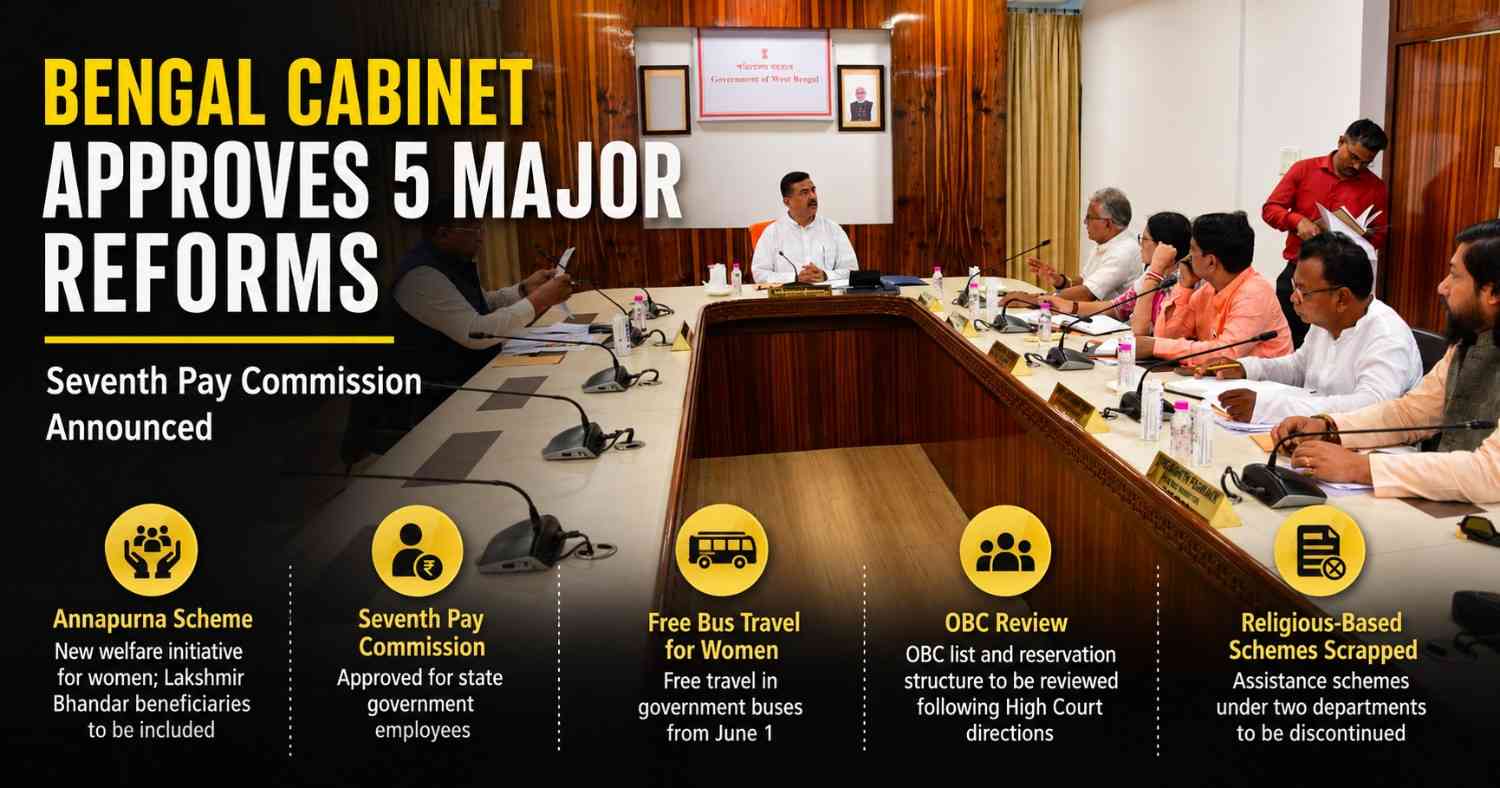
The newly formed West Bengal Cabinet on Monday announced a series of significant policy decisions covering women’s welfare, salaries of state government employees, public transport benefits and reservation policies, signalling the state government’s broader administrative and welfare priorities for the coming months.
The decisions were taken during the Cabinet’s second official meeting held at Nabanna under the chairmanship of Chief Minister Suvendu Adhikari. Following the meeting, minister Agnimitra Paul briefed the media on the outcomes, describing the measures as part of the government’s effort to strengthen welfare delivery and administrative restructuring across the state.
Among the most closely watched announcements was the approval of the ‘Annapurna Scheme’, a new welfare initiative under the Department of Women and Child Development and Social Welfare. According to the government, beneficiaries currently receiving assistance under the existing ‘Lakshmir Bhandar’ programme will automatically be shifted to the newly introduced ‘Annapurna Bhandar’ system without requiring fresh applications.
Officials said the financial support under the scheme would continue to be transferred directly into beneficiaries’ bank accounts, maintaining the direct benefit transfer model that has increasingly become central to welfare administration across India. The state government is also expected to launch a dedicated portal to facilitate new registrations under the programme in the near future.
The Annapurna initiative is likely to become one of the state government’s flagship welfare programmes aimed at women, particularly those from economically weaker households. Welfare schemes targeting women voters have played a major role in Bengal’s political and social policy landscape over the last several years, often influencing both electoral narratives and state budget priorities.
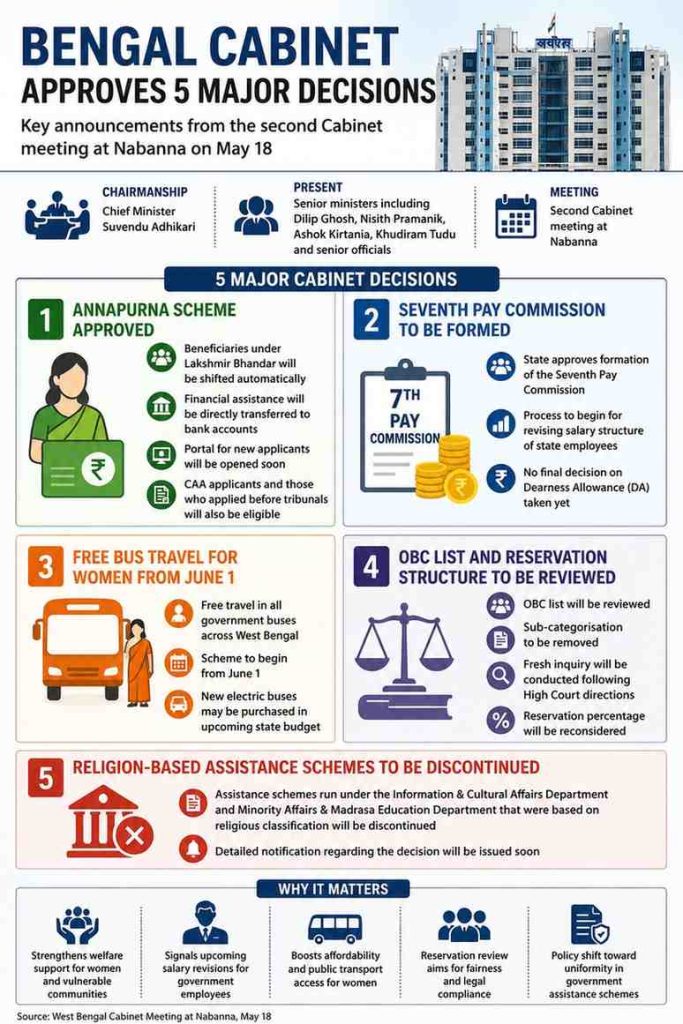
A notable aspect of the announcement was the government’s statement that individuals who had applied under the Citizenship Amendment Act (CAA) framework or before tribunals would also remain eligible for benefits under the scheme. The inclusion is expected to attract political and administrative attention given the continuing national debate surrounding citizenship documentation and welfare eligibility.
The Cabinet meeting also produced a major development for state government employees with the approval of the Seventh State Pay Commission. The formation of a new pay commission is expected to begin the process of revising salary structures and service-related financial benefits for lakhs of employees and pensioners across West Bengal.
However, the government stopped short of announcing any immediate decision on dearness allowance (DA), an issue that has remained politically sensitive and financially significant in the state. Government employees and workers’ organisations had been closely watching the Cabinet meeting amid expectations of clarity on pending DA-related demands.
The absence of an immediate announcement on DA may continue to keep discussions active among employee associations, especially as multiple states across India continue to face pressure over salary revisions and inflation-linked benefits. In West Bengal, the DA issue has repeatedly surfaced in legal and political debates in recent years, with employee groups seeking parity with central government rates.
Despite the lack of a final DA decision, the announcement of the Seventh Pay Commission indicates that the state government is preparing for a broader review of compensation structures, allowances and pension frameworks. Such commissions typically assess inflation trends, fiscal capacity and administrative requirements before submitting recommendations.
Another major public-facing decision announced by the Cabinet was the approval of free travel for women in all government-operated buses across West Bengal beginning June 1. The measure is expected to benefit daily commuters, particularly working women, students and low-income passengers who rely heavily on public transport.
The government, however, did not announce any immediate expansion in the number of state-run buses. Officials indicated that additional electric buses could be introduced later through allocations in the upcoming state budget, suggesting that transport infrastructure expansion may occur in phases.
Transport affordability has emerged as a major governance issue in several Indian states, particularly amid rising fuel prices and urban commuting costs. Welfare-oriented transport measures aimed at women have increasingly been adopted by state governments as part of broader gender-focused mobility policies. Similar initiatives in other states have often resulted in increased public transport usage among women while also raising questions regarding operational subsidies and long-term financial sustainability.
The Cabinet also addressed the politically significant issue of Other Backward Classes (OBC) categorisation and reservation policy. The state government announced that it would review the existing OBC list, remove sub-categorisation and reconsider the reservation percentage structure.
According to minister Agnimitra Paul, a fresh inquiry would be conducted in line with directives issued by the High Court. The findings of that inquiry are expected to shape the government’s eventual position on reservation categories and eligibility criteria.
The OBC reservation issue has become increasingly sensitive in West Bengal following legal scrutiny and debates over the process used for identifying beneficiary groups. Reservation frameworks often involve complex legal, constitutional and socio-economic considerations, particularly when questions arise over classification criteria and procedural transparency.
The proposed review may therefore have implications not only for beneficiaries but also for administrative processes linked to recruitment, education admissions and social welfare allocations.
In another significant policy shift, the Cabinet decided to discontinue assistance schemes operating under the Information and Cultural Affairs Department and the Minority Affairs and Madrasa Education Department that were reportedly based on religious classification.
While detailed operational guidelines have not yet been released, the government said a formal notification explaining the decision would be issued separately. The move could trigger political reactions and policy debates, especially given the sensitive nature of welfare targeting and minority-focused administrative programmes in the state.
Observers note that changes in welfare distribution mechanisms and eligibility frameworks often become major political talking points in West Bengal, where social welfare schemes have historically played an important role in governance strategy and electoral outreach.
The Cabinet meeting was attended by several senior ministers and officials, including Dilip Ghosh, Nisith Pramanik, Ashok Kirtania and Khudiram Tudu.
Political analysts believe the decisions collectively reflect an attempt by the new administration to simultaneously address welfare expansion, employee concerns, transport accessibility and reservation-related administrative restructuring early in its tenure. Several of the announced measures are also expected to carry financial implications for the state budget in the coming fiscal cycle.
The coming weeks are likely to bring greater clarity on how the Annapurna Scheme will be implemented, how the Seventh Pay Commission will be structured and how the state plans to navigate the legal and administrative complexities surrounding OBC reservations and discontinued departmental schemes.
For now, the announcements from Nabanna indicate that the Bengal government is preparing for an active policy phase with welfare delivery, administrative reform and politically significant social measures at the centre of its governance agenda.
Highlights
- West Bengal Cabinet approved the new Annapurna Scheme aimed at expanding direct financial assistance for women beneficiaries.
- The state government announced the formation of the Seventh State Pay Commission for government employees.
- Women will be allowed free travel on government buses across West Bengal from June 1.
- The Cabinet decided to review the state’s OBC list and reservation structure following High Court directions.
- Religious classification-based assistance schemes under two departments will be discontinued, with a detailed notification expected soon.
FAQs
What is the Annapurna Scheme approved by the West Bengal Cabinet?
The Annapurna Scheme is a welfare initiative approved under the Department of Women and Child Development and Social Welfare. It aims to provide direct financial assistance to eligible women beneficiaries through bank transfers.
What will happen to Lakshmir Bhandar beneficiaries?
Women currently receiving benefits under the Lakshmir Bhandar scheme will automatically be shifted to the Annapurna Bhandar system without needing to reapply.
Who will be eligible under the new scheme?
According to the state government, people who have applied under the Citizenship Amendment Act (CAA) process or before tribunals will also be eligible for benefits under the scheme.
What is the Seventh State Pay Commission?
The Seventh State Pay Commission is a government-appointed body that will review and recommend revisions to the salary structure, allowances and related financial benefits of West Bengal government employees.
Did the Cabinet announce any decision on Dearness Allowance (DA)?
No. While the Cabinet approved the formation of the Seventh Pay Commission, it did not announce a final decision regarding DA.
When will free bus travel for women begin in West Bengal?
The state government said free travel for women in government-operated buses will start from June 1.
Will the number of government buses increase?
No immediate expansion was announced. However, the government indicated that new electric buses may be added through future budget allocations.
Why is the OBC review important?
The review could affect reservation categories, eligibility criteria and administrative policies linked to recruitment, education and welfare programmes across the state.
What changes were announced regarding religion-based schemes?
The Cabinet decided to discontinue assistance schemes under certain departments that were reportedly based on religious classification. A detailed notification is expected later.
Why are these Cabinet decisions politically significant?
The announcements touch on major public-interest areas including welfare benefits, employee salaries, public transport and reservation policy, all of which have strong social and political implications in West Bengal.
Inputs and images : Hindusthan Samachar
Edited By E. Devanshi varma
Also Read: Assam Assembly Polls See 7 Major Highlights as Turnout Peaks, Counting Set for May 4
Follow us on Google News: Click Here