

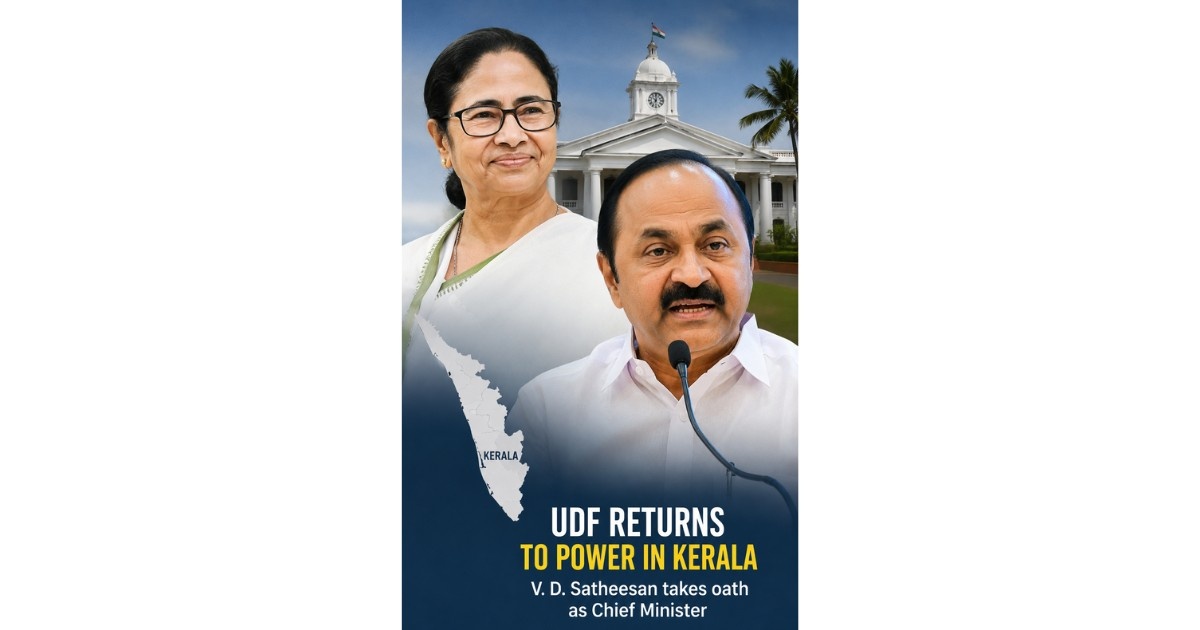
The return of the Congress-led United Democratic Front (UDF) to power in Kerala marks one of the most closely watched political developments in India this year, with leaders across the opposition spectrum viewing the outcome as a significant moment ahead of upcoming national political contests. The new government, headed by senior Congress leader V. D. Satheesan, formally assumed office on Monday during a swearing-in ceremony held in Thiruvananthapuram.
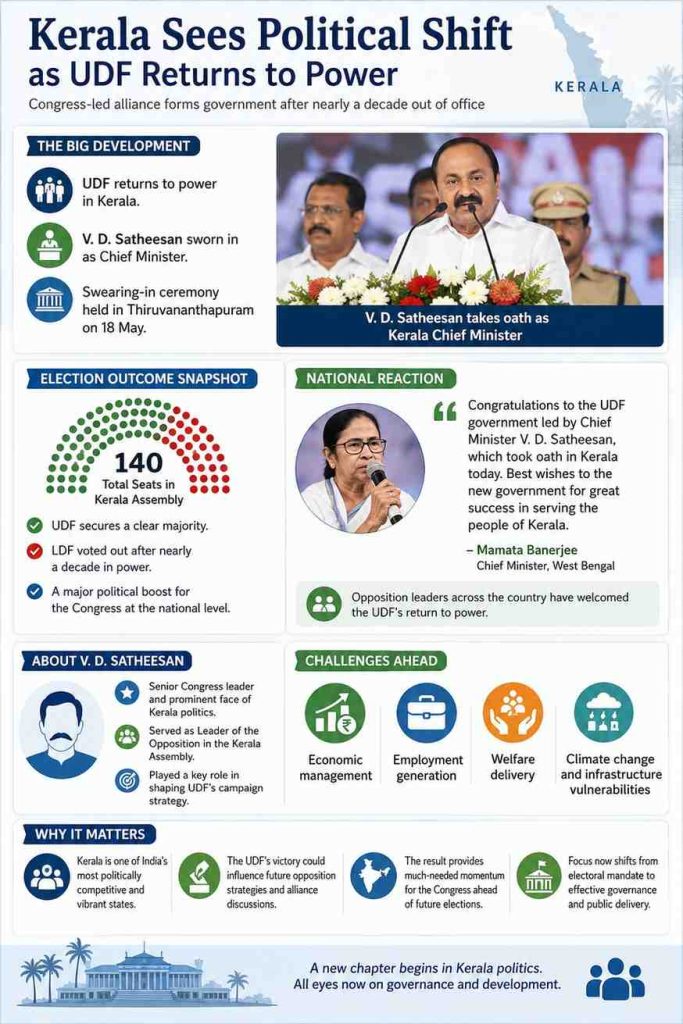
Among the first national leaders to react to the political transition was Mamata Banerjee, who congratulated the new Kerala government shortly after the oath-taking ceremony concluded. In a message shared on social media platform X, Banerjee extended her wishes to the new administration and expressed hope for its success in governance and public service.
The development is being viewed as politically significant not only for Kerala but also for the Congress party nationally, as the UDF’s victory ends nearly a decade of Left Democratic Front (LDF) rule in the southern state. Political analysts believe the result could reshape opposition dynamics ahead of future parliamentary and state-level elections.
UDF Returns After Years in Opposition
The Congress-led UDF alliance secured a comfortable majority in the 140-member Kerala Legislative Assembly, allowing it to form the government after years in opposition. The coalition’s victory came after a campaign that focused heavily on governance, employment, economic management, welfare delivery, and criticism of the outgoing administration’s handling of several state issues.
The election result is particularly notable because Kerala has historically alternated between the UDF and the LDF, creating one of India’s most competitive two-front political systems. However, the LDF’s previous return to power had broken the state’s long-standing pattern of electoral alternation, making the current UDF comeback politically more consequential.
For the Congress party, the Kerala victory provides rare momentum at a time when it has been attempting to rebuild organizational strength in several states. Political observers note that Kerala remains one of the few major states where the Congress retains a strong grassroots structure and a stable alliance network.
V. D. Satheesan Steps Into Leadership Role
V. D. Satheesan has long been regarded as one of the Congress party’s prominent faces in Kerala politics. Before becoming Chief Minister, he served as Leader of the Opposition in the Kerala Assembly and played a central role in shaping the party’s political strategy against the LDF government.
Known for his aggressive legislative interventions and organizational coordination, Satheesan emerged as a consensus leader within the UDF alliance during the election campaign. His elevation to the top post is being interpreted as part of the Congress party’s broader effort to project relatively younger regional leadership figures with stronger public outreach.
During the swearing-in ceremony, Satheesan pledged that the new government would prioritize welfare delivery, administrative transparency, economic revival, and employment generation. While the administration is yet to announce its full policy roadmap, expectations are already high among supporters and alliance partners regarding governance reforms and development initiatives.
The new cabinet is expected to balance experienced political leaders with younger representatives from different alliance constituents, reflecting the coalition-based nature of Kerala politics.
Mamata Banerjee’s Message Signals Wider Opposition Interest
Mamata Banerjee’s congratulatory message drew attention because it came amid continuing discussions about opposition coordination at the national level. Her statement, though brief and diplomatic, highlighted the broader significance attached to the UDF victory beyond Kerala’s state boundaries.
In her message on X, Banerjee congratulated the new government led by Satheesan and wished the administration success in serving the people of Kerala. Political analysts believe such reactions from non-Congress opposition leaders indicate the importance many regional parties are placing on Congress victories in states where the party remains electorally competitive.
Over the past few years, opposition politics in India has increasingly revolved around coalition-building and regional cooperation. Kerala’s election outcome may therefore influence conversations around future alliances, parliamentary strategies, and regional political equations.
Why the Kerala Result Matters Nationally
Kerala occupies a unique position in India’s political landscape. Despite its relatively smaller parliamentary representation compared to larger states, the state often plays an outsized role in ideological and coalition politics because of its politically aware electorate, strong party structures, and active public discourse.
The UDF’s victory is likely to be viewed as a morale booster for the Congress party at a time when it has faced mixed electoral performances across different regions. Winning a politically sophisticated state like Kerala allows the Congress leadership to project the result as evidence that the party can still successfully challenge entrenched governments under the right regional conditions.
Political experts also point out that Kerala’s elections frequently influence broader debates surrounding welfare politics, secular alliances, economic governance, and coalition management. The state’s electoral outcomes are therefore often closely studied by national parties seeking lessons for broader campaign strategies.
The Congress leadership is expected to use the Kerala victory to energize party workers in other states and strengthen its narrative ahead of future electoral contests.
Challenges Before the New Government
While the swearing-in ceremony marked a celebratory moment for the UDF, the new administration faces several immediate governance challenges. Kerala continues to deal with economic pressures, unemployment concerns, infrastructure demands, and climate-related vulnerabilities including recurring floods and coastal erosion.
The state’s financial condition has also remained a topic of political debate in recent years, with discussions around debt levels, welfare expenditure, and fiscal management frequently dominating political discourse. The new government will likely face pressure to deliver visible governance improvements quickly while balancing welfare commitments with economic realities.
Healthcare, tourism recovery, investment generation, and youth employment are also expected to emerge as key policy priorities for the incoming administration.
Political observers note that Kerala’s electorate has traditionally maintained high expectations from governments regardless of political affiliation, making administrative performance particularly important for long-term political sustainability.
Congress Looks to Build Momentum
The Kerala result may hold symbolic value for the Congress beyond immediate electoral arithmetic. In recent years, the party has attempted to rebuild its organizational structure and leadership credibility in multiple states after facing setbacks in several major elections.
A successful government in Kerala could provide the Congress with an example of stable regional governance that it can politically showcase in national campaigns. The party is also expected to emphasize the role of alliance unity, local leadership, and issue-based campaigning in securing the UDF victory.
The win could additionally strengthen internal confidence within the party’s southern units, especially as southern India continues to remain comparatively more favorable terrain for the Congress than several northern and western states.
At the same time, political analysts caution that translating a state-level victory into broader national gains remains a complex challenge in India’s highly diverse electoral environment.
A Significant Political Transition in Kerala
The transfer of power in Kerala once again underlines the state’s vibrant democratic culture and highly competitive political system. The peaceful transition from the LDF to the UDF reflects Kerala’s long-standing tradition of strong electoral participation and active political engagement among voters.
For the Congress-led alliance, the coming months will be crucial in determining whether the electoral mandate can be converted into effective governance and long-term political consolidation. Much of the attention will now shift from campaign promises to administrative delivery.
As the new government begins its term under V. D. Satheesan, national political parties, opposition leaders, and policy observers across India are expected to closely watch how the administration handles governance, coalition management, and economic challenges in one of the country’s most politically influential states.
Highlights
- Congress-led UDF has returned to power in Kerala after nearly a decade in opposition.
- V. D. Satheesan took oath as Kerala Chief Minister in Thiruvananthapuram.
- Mamata Banerjee congratulated the new Kerala government through a message posted on X.
- The UDF secured a majority in the 140-member Kerala Assembly, defeating the Left Democratic Front.
- Political observers see the Kerala result as an important morale boost for the Congress at the national level.
- The new government is expected to focus on governance, employment, welfare delivery, and economic management.
FAQ
Who is the new Chief Minister of Kerala?
V. D. Satheesan has taken oath as the new Chief Minister of Kerala following the UDF alliance’s victory in the Assembly elections.
What is the UDF?
The United Democratic Front (UDF) is a Congress-led political alliance in Kerala that includes several regional and community-based parties.
Why is the Kerala election result important nationally?
The result is being viewed as politically significant because it gives the Congress party momentum at a time when opposition parties are preparing for future national electoral contests.
How long was the UDF out of power in Kerala?
The UDF had been out of power for nearly a decade before returning to government through the latest Assembly election victory.
What did Mamata Banerjee say about the new Kerala government?
Mamata Banerjee congratulated the new UDF government and wished it success in serving the people of Kerala.
What are the main challenges before the new government?
The new administration is expected to address issues related to employment, economic management, infrastructure development, healthcare, and climate-related vulnerabilities.
What role did V. D. Satheesan play before becoming Chief Minister?
Before assuming office as Chief Minister, Satheesan served as Leader of the Opposition in the Kerala Assembly and was a prominent campaign face for the Congress-led alliance.
Why is Kerala politically significant?
Kerala is known for its politically active electorate, strong coalition politics, and influential role in national political discussions despite being a smaller state in terms of parliamentary seats.
Inputs and images : Hindusthan Samachar
Edited By E. Devanshi varma
Also Read: Assam Assembly Polls See 7 Major Highlights as Turnout Peaks, Counting Set for May 4
Follow us on Google News: Click Here