

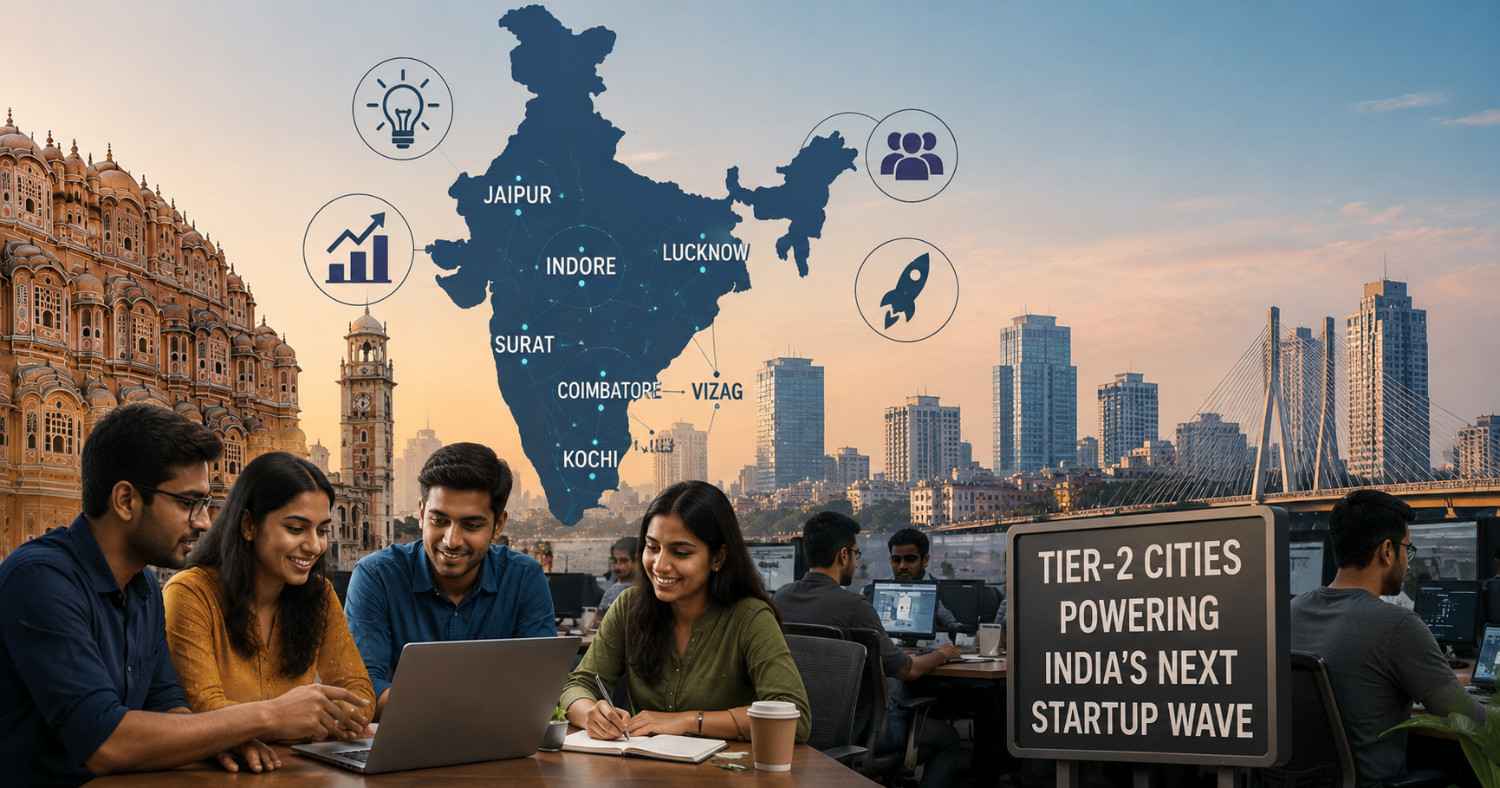
India’s startup landscape is undergoing a major geographical shift. For more than a decade, cities such as Bengaluru, Mumbai, Delhi-NCR, and Hyderabad dominated the country’s entrepreneurial ecosystem. But a growing number of founders, investors, technology professionals, and digital-first businesses are now emerging from tier-2 cities including Jaipur, Indore, Kochi, Coimbatore, Bhubaneswar, Surat, Lucknow, Chandigarh, and Vizag.
The rise of these smaller urban centres is changing how India builds companies, attracts investment, creates jobs, and develops innovation outside traditional metropolitan hubs. Industry observers say the trend is no longer experimental or temporary. Instead, it is becoming a structural transformation driven by digital access, lower operational costs, expanding talent pools, and changing consumer markets.
Over the last few years, startup founders from tier-2 cities have increasingly secured funding, built scalable digital businesses, and entered sectors ranging from fintech and agritech to logistics, healthcare, education technology, software services, and direct-to-consumer brands.
The shift has gained momentum especially after the pandemic accelerated remote work adoption and reduced the need for companies to remain concentrated in expensive metropolitan cities. As infrastructure improves and internet penetration deepens across India, entrepreneurs are finding that building a business outside traditional startup hubs is becoming more practical and financially sustainable.
Lower Costs Are Creating Competitive Advantages
One of the biggest reasons behind the rise of startups in tier-2 cities is cost efficiency. Operating a startup in cities such as Bengaluru or Mumbai often involves high office rents, expensive employee salaries, and increasing living costs. For early-stage startups working with limited funding, these expenses can significantly affect profitability and growth.
Tier-2 cities offer a different equation. Businesses can often operate at a fraction of the cost while maintaining similar levels of productivity. Affordable commercial spaces, lower employee attrition, and reduced infrastructure expenses are helping startups extend their financial runway.
Founders also point out that employees in smaller cities are increasingly willing to work with startups due to improved career opportunities and better quality of life. This allows companies to attract skilled professionals without facing the intense competition seen in larger metropolitan ecosystems.
Several startup founders have publicly stated that moving operations to smaller cities helped them focus more on product development and customer acquisition rather than managing high overhead costs.
Remote Work Changed the Geography of Entrepreneurship
The pandemic permanently altered workplace dynamics across India. Remote and hybrid work models enabled professionals to relocate from major metros back to their hometowns. Many technology workers who returned to smaller cities discovered they could continue building digital businesses without depending on physical proximity to traditional startup clusters.
This shift reduced the psychological and operational barriers associated with launching startups outside major cities. Entrepreneurs now rely heavily on cloud computing, remote collaboration tools, online hiring platforms, and digital payment systems that make location less important than before.
Investors have also become more open to backing companies based outside metropolitan regions, particularly when startups demonstrate scalable technology products and strong revenue potential.
Industry analysts believe this decentralisation of entrepreneurship may continue over the next decade as digital infrastructure improves further and businesses increasingly adopt distributed workforce models.
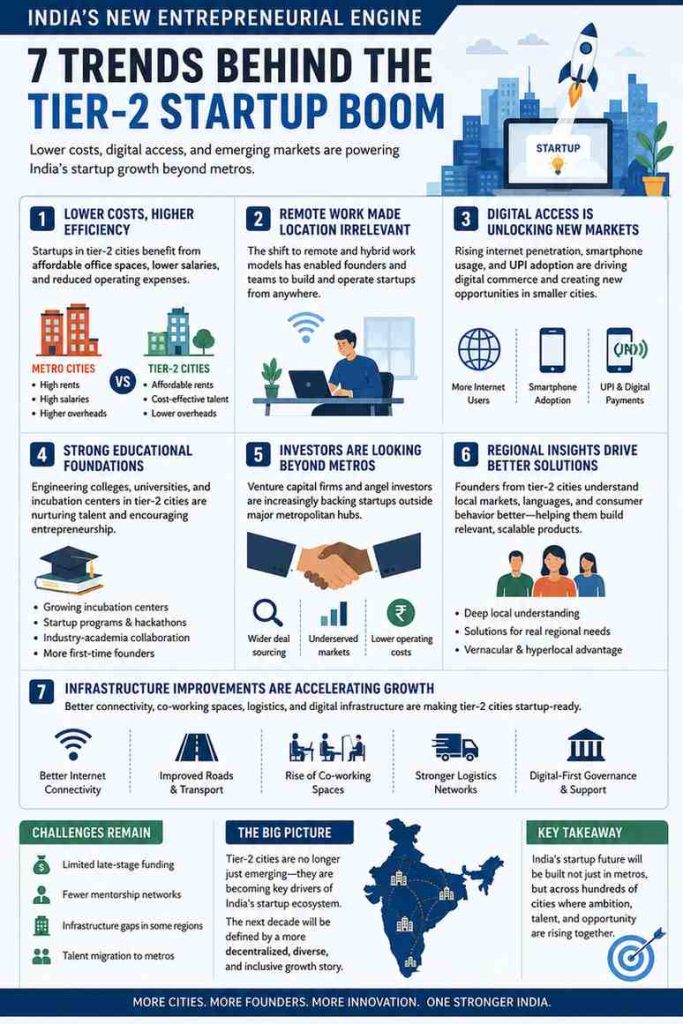
Internet Penetration Is Unlocking New Markets
India’s rapid expansion in internet access and smartphone usage has transformed consumer behaviour across smaller cities and towns. Millions of users from non-metro regions are now actively shopping online, consuming digital content, using fintech platforms, and adopting app-based services.
This has created enormous opportunities for startups that understand regional markets and local consumer behaviour better than companies operating solely from metropolitan centres.
Many emerging startups are building products specifically tailored to tier-2 and tier-3 consumers. These businesses often focus on regional language content, local commerce, hyperlocal logistics, affordable financial services, and digital education.
Unlike earlier startup waves that primarily targeted urban premium consumers, newer businesses are increasingly serving mass-market India. Investors view this segment as one of the country’s largest long-term growth opportunities.
The expansion of digital payments infrastructure through UPI has also accelerated startup activity by making online transactions easier and more accessible even in smaller cities.
Educational Institutions Are Fueling Entrepreneurial Talent
Another major factor driving the startup ecosystem in smaller cities is the growing role of universities, engineering colleges, and incubation centres. Educational institutions outside major metros are increasingly promoting entrepreneurship through startup programs, innovation labs, hackathons, and industry partnerships.
Cities like Coimbatore, Pune, Indore, and Bhubaneswar have seen growing startup activity partly because of strong educational ecosystems producing technically skilled graduates.
Many young entrepreneurs are now choosing to build startups immediately after graduation instead of relocating to metropolitan cities for corporate jobs. Access to online learning resources, startup mentorship networks, and digital funding opportunities has lowered entry barriers for first-time founders.
Government-backed startup initiatives and state-level innovation policies have also contributed to this trend. Several state governments are offering incubation support, grants, tax incentives, and startup-friendly policies aimed at encouraging regional entrepreneurship.
This ecosystem support is helping smaller cities build long-term innovation capacity instead of depending entirely on metropolitan startup hubs.
Investors Are Expanding Beyond Metro Markets
Venture capital firms and angel investors are increasingly scouting opportunities outside traditional startup centres. While funding still remains heavily concentrated in larger cities, investors are paying closer attention to emerging businesses from tier-2 regions due to rising market potential and lower valuation pressures.
Many investors believe startups from smaller cities often possess stronger understanding of underserved regional markets. Businesses solving local problems in logistics, agriculture, healthcare access, retail distribution, and education are attracting investor interest because these sectors address large-scale national challenges.
The success of several non-metro startups has further strengthened investor confidence. As more founders demonstrate scalability and operational efficiency, funding networks are gradually becoming more geographically diverse.
Industry experts note that digital pitching, virtual investor meetings, and online accelerator programs have also reduced location-based disadvantages for founders.
However, challenges still remain. Entrepreneurs from smaller cities often face limited access to mentorship, networking opportunities, and late-stage funding compared to startups in established ecosystems. Despite this, the funding gap appears to be narrowing gradually.
Regional Consumer Understanding Is Becoming Valuable
Startups from smaller cities often possess an advantage that larger urban companies may overlook — deep familiarity with regional consumers and local business environments.
India’s economic growth is increasingly driven by consumers outside metropolitan centres. Rising disposable incomes, expanding digital adoption, and improving infrastructure are creating new opportunities in smaller urban markets.
Founders from these regions typically understand local language preferences, purchasing behaviour, pricing sensitivity, and cultural nuances more effectively. This local understanding allows startups to design products that resonate strongly with regional audiences.
Several direct-to-consumer brands, agritech platforms, regional media startups, and vernacular technology companies have successfully scaled by targeting audiences beyond major metropolitan markets.
As India’s internet economy expands further into non-metro regions, this local market expertise may become even more commercially valuable.
Infrastructure Improvements Are Supporting Growth
Improved connectivity and infrastructure development are also contributing to the rise of startup ecosystems in smaller cities. Better highways, airports, co-working spaces, broadband access, and logistics networks are making business operations more feasible outside traditional metros.
The expansion of digital public infrastructure has further accelerated entrepreneurship. Online company registration systems, digital banking services, GST compliance platforms, and government-backed digital initiatives have simplified many aspects of running businesses.
Co-working operators and startup communities are increasingly establishing networks in emerging cities to support entrepreneurs with workspace, mentorship, and collaboration opportunities.
While infrastructure quality still varies significantly across regions, the overall business environment for startups outside metropolitan India has improved considerably compared to a decade ago.
Challenges Still Remain for Tier-2 Startup Ecosystems
Despite rapid growth, tier-2 startup ecosystems continue to face several structural limitations. Access to large-scale venture capital, experienced mentors, global investors, and specialised talent remains stronger in metropolitan cities.
Many startups eventually establish secondary offices in Bengaluru, Mumbai, or Delhi to improve investor access and business networking opportunities.
There are also concerns around uneven infrastructure quality, slower policy implementation in some states, and limited availability of advanced research ecosystems outside larger urban centres.
Industry experts argue that sustaining long-term startup growth in smaller cities will require continued investment in digital infrastructure, higher education quality, transportation connectivity, and local innovation ecosystems.
At the same time, analysts believe India’s entrepreneurial future is unlikely to remain concentrated in only a handful of metropolitan cities. The growing contribution of smaller urban centres suggests the country’s startup economy is entering a broader and more decentralised phase.
As digital adoption deepens and economic opportunities spread across regions, tier-2 cities may play an increasingly important role in shaping India’s next generation of technology companies, employment growth, and innovation-driven economic expansion.
Highlights
- Tier-2 cities across India are emerging as major startup hubs due to lower operational costs and improving digital infrastructure.
- Remote work adoption after the pandemic has reduced dependence on traditional startup centres like Bengaluru and Mumbai.
- Startups in smaller cities are increasingly targeting regional consumers through vernacular content, fintech, agritech, and local commerce platforms.
- Investors are gradually expanding funding activity beyond metropolitan markets as non-metro startups demonstrate scalability and market understanding.
- Educational institutions and state-backed startup initiatives are helping build entrepreneurial ecosystems in emerging cities.
- Improved internet access, UPI adoption, and smartphone penetration are accelerating digital business growth outside major metros.
- Challenges such as limited late-stage funding and mentorship remain, but the overall startup ecosystem is becoming more geographically diverse.
FAQ
What are tier-2 cities in India?
Tier-2 cities are smaller urban centres that are less populated and less commercially saturated than major metropolitan cities like Bengaluru, Mumbai, or Delhi. Examples include Jaipur, Indore, Kochi, Surat, Coimbatore, and Lucknow.
Why are startups moving to tier-2 cities?
Many startups are choosing tier-2 cities because operational costs are lower, employee retention is often better, and digital infrastructure has improved significantly in recent years.
How did remote work influence startup growth in smaller cities?
Remote and hybrid work models allowed professionals to relocate from metro cities to hometowns while continuing to work digitally. This reduced the need for startups to remain physically located in major tech hubs.
Which sectors are growing rapidly in tier-2 startup ecosystems?
Fintech, agritech, healthcare technology, logistics, edtech, direct-to-consumer brands, and regional-language digital platforms are among the fastest-growing sectors.
Are investors funding startups from smaller cities?
Yes. Venture capital firms and angel investors are increasingly exploring startups from non-metro regions, especially those solving regional or mass-market challenges.
What role do educational institutions play in this growth?
Universities and engineering colleges are supporting entrepreneurship through incubation centres, startup programs, mentorship initiatives, and innovation partnerships.
What challenges do tier-2 startups still face?
Common challenges include limited access to large investors, fewer networking opportunities, infrastructure gaps in some regions, and reduced availability of specialised talent.
Why are regional consumers becoming important for startups?
Consumers in smaller cities and towns represent one of India’s fastest-growing digital markets. Their increasing use of smartphones, digital payments, and online services creates significant business opportunities.
Edited By E. Devanshi varma
Also Read: Assam Assembly Polls See 7 Major Highlights as Turnout Peaks, Counting Set for May 4
Follow us on Google News: Click Here