

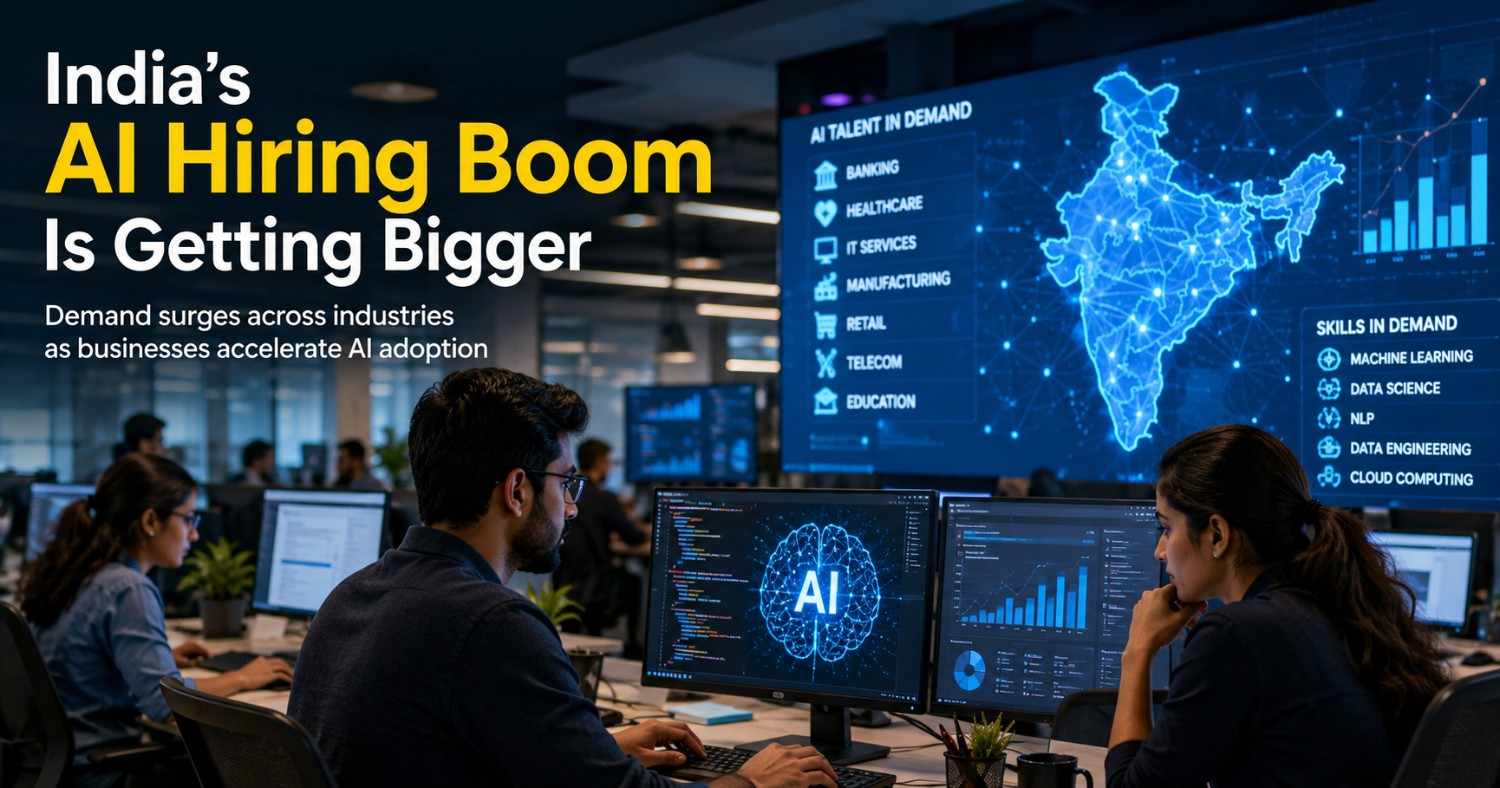
India’s artificial intelligence employment market is entering a new phase of growth as businesses across multiple sectors accelerate investments in automation, machine learning, data analytics, and generative AI technologies. What was once considered a specialized technology domain is increasingly becoming a mainstream business priority, driving a sharp rise in demand for skilled professionals capable of building, deploying, and managing AI-powered systems.
The country has emerged as one of the fastest-growing markets for artificial intelligence talent globally. Industry analysts, recruitment firms, and technology leaders point to a sustained increase in hiring activity as organizations seek to integrate AI into core business operations. From banking and healthcare to retail and manufacturing, companies are expanding their AI teams to remain competitive in a rapidly evolving digital economy.
The hiring momentum reflects a broader shift in how businesses view artificial intelligence. Rather than treating AI as an experimental technology, many organizations now consider it a strategic necessity capable of improving productivity, reducing operational costs, enhancing customer experiences, and supporting long-term growth.
AI Adoption Moves Beyond Technology Companies
For years, demand for AI specialists was concentrated among large technology firms and startups. However, the current hiring wave is being driven by a much broader range of industries.
Financial institutions are using AI-powered tools to strengthen fraud detection systems, automate customer service functions, improve risk assessment, and enhance personalized banking experiences. Healthcare organizations are exploring AI applications in diagnostics, patient care management, medical imaging, and drug discovery.
Retail companies are investing in AI to optimize inventory management, predict consumer behavior, personalize recommendations, and streamline supply chains. Manufacturing firms are increasingly deploying intelligent automation systems to improve efficiency and predictive maintenance capabilities.
This expansion into diverse industries has significantly widened the talent pool requirements, creating opportunities for professionals with varying levels of expertise and educational backgrounds.
Why Companies Are Hiring More AI Professionals
Several factors are contributing to the growing demand for AI talent across India.
The rapid development of generative AI platforms has encouraged organizations to explore new ways of automating content creation, customer interactions, coding assistance, and business processes. As enterprises experiment with these technologies, they require professionals who can customize AI models, ensure compliance, and integrate solutions into existing systems.
Digital transformation initiatives launched over the past several years are also creating new hiring needs. Organizations that invested heavily in cloud computing, big data infrastructure, and digital services are now seeking AI specialists to unlock greater value from those investments.
Competition is another major driver. Businesses that successfully implement AI solutions can often improve efficiency and customer satisfaction faster than rivals, making AI adoption a strategic business objective rather than a purely technical one.
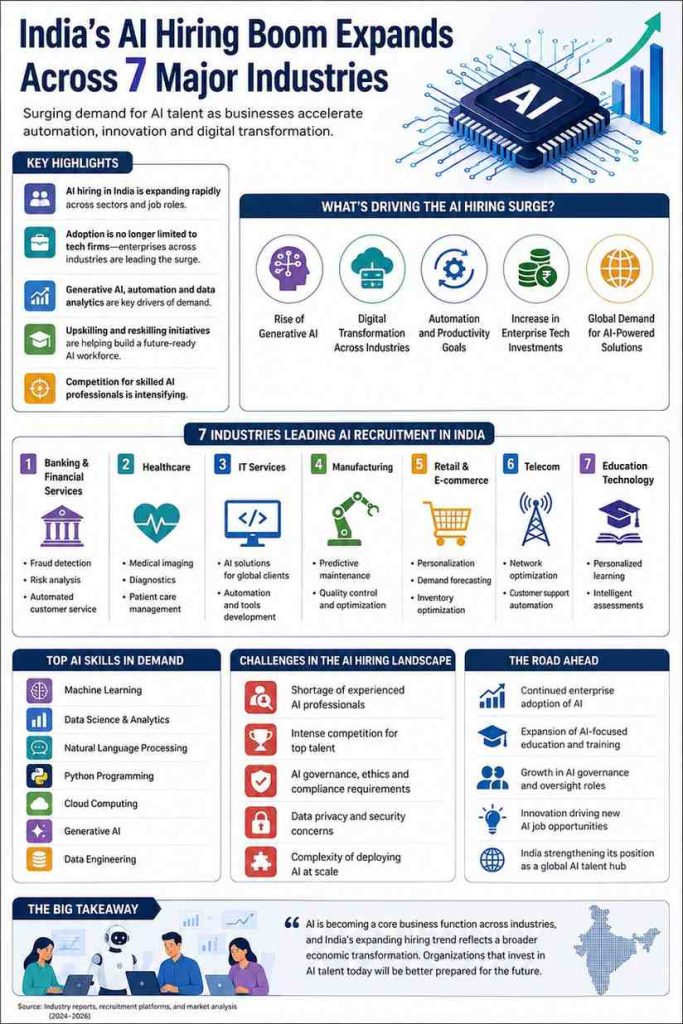
Seven Industries Driving India’s AI Hiring Expansion
Banking and Financial Services
The financial sector remains one of the largest employers of AI talent. Banks and financial institutions are increasingly using machine learning models to detect suspicious transactions, assess creditworthiness, and automate routine customer support functions.
AI-driven analytics are helping financial organizations process vast amounts of data more effectively while reducing risks associated with fraud and cybersecurity threats.
Healthcare
Healthcare providers and medical technology companies are expanding investments in artificial intelligence to support diagnostics, treatment planning, and operational efficiency.
AI-powered tools are assisting doctors in analyzing medical images, identifying patterns in patient data, and improving clinical decision-making. As adoption increases, demand for professionals skilled in healthcare AI solutions continues to grow.
Information Technology Services
India’s IT services sector remains a major contributor to AI employment growth. Global clients are increasingly requesting AI-enabled services, prompting technology companies to expand their workforce in machine learning, natural language processing, data science, and generative AI implementation.
Many IT firms are also establishing dedicated AI centers of excellence to accelerate innovation and client delivery capabilities.
Manufacturing
Manufacturers are deploying AI systems to optimize production processes, reduce downtime, and improve quality control. Predictive maintenance technologies powered by machine learning allow companies to identify equipment issues before costly failures occur.
As smart factory initiatives gain momentum, demand for AI engineers and industrial data specialists is expected to rise further.
Retail and E-commerce
Retailers are using AI to analyze purchasing patterns, forecast demand, and personalize shopping experiences. Recommendation engines, automated customer support systems, and intelligent inventory management platforms have become increasingly common.
The continued growth of digital commerce is creating additional opportunities for AI professionals who can help businesses improve operational efficiency and customer engagement.
Telecommunications
Telecom operators are leveraging AI to manage network performance, improve customer support, and identify service disruptions more quickly.
As telecom networks become increasingly complex, artificial intelligence is playing a larger role in maintaining reliability and supporting the rollout of advanced connectivity solutions.
Education Technology
The education sector has also emerged as a growing source of AI-related employment. Educational technology companies are developing personalized learning platforms, intelligent assessment tools, and virtual tutoring systems powered by artificial intelligence.
Growing interest in digital learning solutions is encouraging further investment in AI-driven educational technologies.
Skills Employers Are Looking For
The evolving AI landscape is changing employer expectations. While technical expertise remains critical, organizations increasingly value professionals who can connect AI capabilities with business objectives.
Skills in machine learning, deep learning, natural language processing, data engineering, cloud computing, and AI model deployment remain highly sought after. Familiarity with programming languages such as Python and frameworks used for AI development continues to be important.
At the same time, employers are placing greater emphasis on problem-solving abilities, communication skills, ethical AI understanding, and domain-specific knowledge.
Professionals who can explain complex AI concepts to business stakeholders often have a competitive advantage in the job market.
The Growing Importance of AI Upskilling
The hiring boom is encouraging educational institutions, online learning platforms, and corporate training programs to expand AI-focused courses.
Many organizations are investing in workforce reskilling initiatives to prepare employees for AI-driven workplaces. Rather than relying solely on external recruitment, businesses are increasingly training existing staff to work alongside emerging technologies.
This approach helps address talent shortages while enabling companies to retain experienced employees who already understand organizational processes and industry requirements.
Universities and technical institutes are also updating curricula to align with changing industry demands, introducing specialized programs focused on artificial intelligence, machine learning, and data science.
Challenges Amid Rapid Growth
Despite strong hiring activity, the industry faces several challenges.
One of the biggest concerns is the gap between demand and available talent. Many employers report difficulty finding candidates with practical experience in deploying AI systems at scale.
Competition for skilled professionals has also intensified, particularly in advanced areas such as generative AI, large language models, and AI infrastructure management.
Questions surrounding data privacy, responsible AI development, regulatory compliance, and algorithmic transparency are becoming increasingly important as adoption expands. Organizations are therefore seeking professionals who understand both technical implementation and governance requirements.
What the Future Could Look Like
Industry experts expect India’s AI employment market to remain strong over the coming years as artificial intelligence becomes embedded across a wider range of business functions.
Government initiatives supporting digital innovation, expanding startup ecosystems, increasing cloud adoption, and growing enterprise technology spending are likely to contribute to continued demand for AI expertise.
While automation may change certain job functions, many analysts believe AI will create new categories of employment focused on development, oversight, integration, governance, and human-AI collaboration.
For professionals entering the workforce, the current environment presents significant opportunities. For businesses, the challenge will be attracting, developing, and retaining talent capable of helping organizations navigate the next phase of the AI-driven economy.
As artificial intelligence transitions from an emerging technology to a foundational business capability, India’s expanding AI hiring boom reflects a broader transformation taking place across the country’s economy. The growing demand for skilled professionals suggests that AI talent will remain a critical component of business strategy, innovation, and competitiveness in the years ahead.
Highlights
- AI hiring in India is expanding rapidly as businesses accelerate investments in automation, machine learning, and generative AI technologies.
- Demand for AI talent is spreading beyond technology firms into banking, healthcare, manufacturing, retail, telecom, and education sectors.
- Companies are increasingly treating AI as a core business strategy rather than an experimental technology initiative.
- Skills in machine learning, data science, cloud computing, natural language processing, and AI deployment remain highly sought after.
- Organizations are investing in employee upskilling programs to address talent shortages and support AI adoption.
- Competition for experienced AI professionals continues to intensify as enterprises scale AI projects.
- Industry experts expect AI-related employment opportunities to remain strong as digital transformation efforts continue across India.
FAQ
1. Why is AI hiring increasing in India?
AI hiring is rising because companies across industries are adopting artificial intelligence to improve efficiency, automate processes, enhance customer experiences, and gain competitive advantages.
2. Which industries are hiring the most AI professionals?
Major hiring demand is coming from banking, healthcare, information technology services, manufacturing, retail, telecommunications, and education technology sectors.
3. What skills are most valuable for AI jobs?
Employers commonly seek expertise in machine learning, data science, Python programming, cloud computing, natural language processing, and AI model deployment.
4. How is generative AI affecting recruitment?
Generative AI has created demand for professionals who can develop, customize, manage, and integrate AI models into business operations.
5. Are AI jobs limited to technology companies?
No. AI-related roles are increasingly available across finance, healthcare, manufacturing, retail, education, and many other industries.
6. What challenges does India’s AI hiring market face?
A major challenge is the shortage of experienced professionals capable of implementing AI systems at enterprise scale.
7. Is AI expected to replace jobs completely?
While automation may change certain job functions, AI is also expected to create new roles related to development, oversight, governance, and human-AI collaboration.
8. How are companies addressing AI talent shortages?
Many organizations are investing in employee training, reskilling programs, partnerships with educational institutions, and specialized AI learning initiatives.
Edited By E. Devanshi varma
Also Read: IPL Honey-Trap Row Sparks 7 Big Questions Before Playoffs
Follow us on Google News: Click Here