


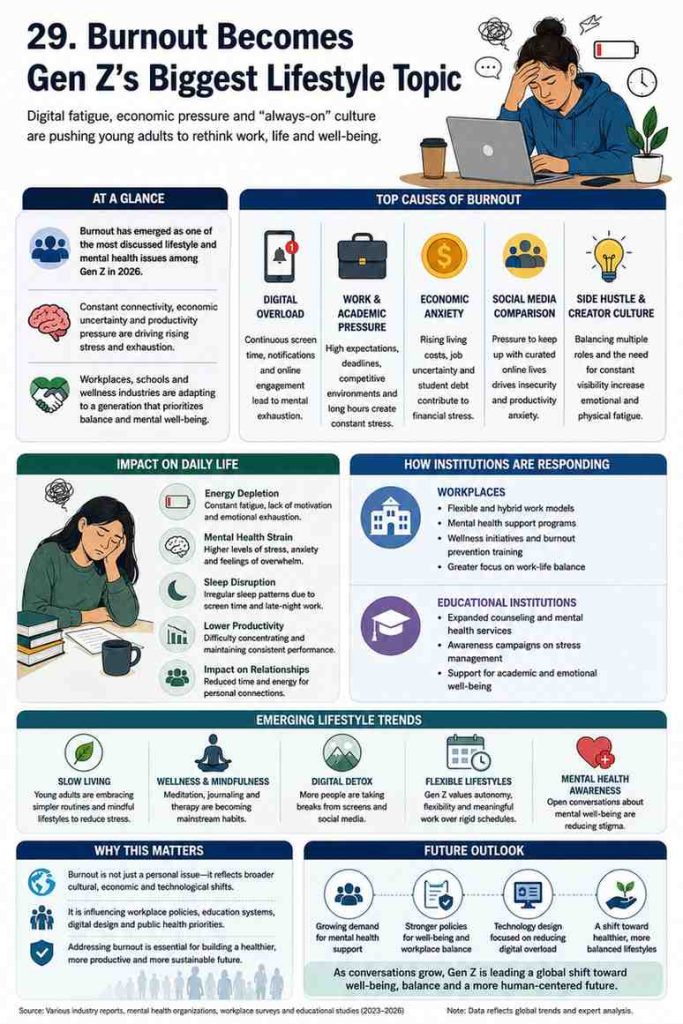
Burnout is no longer being viewed only as a workplace issue affecting corporate professionals or overworked executives. In 2026, the conversation has expanded far beyond office spaces, with Gen Z increasingly placing burnout at the center of discussions around mental health, digital culture, productivity, education, and modern lifestyle pressures.
Across social media platforms, podcasts, universities, and workplaces, younger adults are openly discussing emotional exhaustion, anxiety linked to constant online engagement, and the pressure to remain productive in both personal and professional life. Mental health experts, employers, and educators are also beginning to acknowledge that burnout among Gen Z reflects deeper structural and cultural shifts rather than isolated personal struggles.
The growing visibility of the issue has turned burnout into one of the most widely discussed lifestyle themes among young adults globally.
Why Burnout Is Resonating Strongly With Gen Z
Gen Z, broadly defined as people born between the late 1990s and early 2010s, entered adulthood during a period marked by economic uncertainty, rapid technological change, pandemic disruption, and rising social expectations. Many members of the generation experienced online learning during formative academic years, unstable job markets, and a highly competitive digital environment where personal identity is often tied to visibility and performance.
Unlike previous generations, Gen Z has grown up in a world where work, social interaction, entertainment, and self-expression are heavily connected to digital platforms. This continuous connectivity has created an environment where boundaries between rest and productivity are becoming increasingly blurred.
Mental health professionals say many younger adults now experience “always-on culture,” where responding quickly, staying updated, maintaining online presence, and pursuing side projects are treated almost as social expectations rather than optional activities.
As a result, burnout is increasingly being described not only as physical exhaustion but also as emotional and cognitive fatigue caused by constant stimulation and pressure.
Social Media’s Role in Lifestyle Exhaustion
Social media platforms have played a significant role in shaping burnout conversations. While these platforms provide spaces for awareness, support, and community discussions, they also contribute to comparison-driven stress and productivity anxiety.
Short-form content centered around “hustle culture,” career achievements, fitness routines, and self-improvement trends often creates unrealistic expectations about success and personal growth. Many young users report feeling pressure to optimize every aspect of their lives, including work performance, appearance, finances, relationships, and leisure time.
The rise of creator culture has further intensified this environment. Increasing numbers of young adults attempt to balance traditional jobs or education alongside content creation, freelance work, or personal branding efforts. For many, the pressure to remain visible online can become emotionally draining.
Experts note that burnout discussions on platforms such as TikTok, Instagram, and YouTube have become especially popular because many young people recognize similar experiences in others. Terms like “digital fatigue,” “productivity burnout,” and “quiet quitting” have become common parts of online lifestyle discussions.
Workplace Expectations Are Changing
The growing focus on burnout is also influencing workplace culture. Employers are increasingly facing demands from younger workers for healthier schedules, flexible work environments, mental health support, and stronger work-life boundaries.
Many Gen Z employees appear less willing to normalize long working hours or constant availability compared to older workplace traditions. Human resource analysts say this shift is changing how companies approach employee retention and productivity strategies.
Remote and hybrid work models introduced during the pandemic created flexibility for some workers but also made it harder for many people to disconnect from work responsibilities. Notifications, virtual meetings, and digital collaboration tools often extend professional engagement beyond regular working hours.
Companies in sectors such as technology, media, consulting, and startups are now investing more in wellness programs, mental health leave policies, and burnout prevention initiatives as younger employees prioritize emotional well-being alongside salary and career growth.
At the same time, critics argue that some organizations continue to frame burnout as an individual wellness problem instead of addressing broader structural issues such as excessive workloads, job insecurity, and unrealistic productivity expectations.
Education Pressure and Academic Burnout
Burnout discussions are also becoming increasingly common among students and young graduates. Competitive academic environments, pressure to secure internships, rising education costs, and uncertainty around future employment opportunities have added to stress levels among younger populations.
Many students report struggling to balance academic performance with networking, extracurricular activities, digital presence, and financial pressures. The expansion of online learning during recent years also increased screen exposure and reduced separation between personal and academic life.
Educational psychologists have observed rising conversations around concentration problems, emotional exhaustion, and reduced motivation among students navigating continuous digital engagement.
Universities in several countries have expanded counseling services and mental health awareness campaigns in response to growing concerns around student well-being. However, access to mental health support remains uneven in many regions, particularly for students from economically vulnerable backgrounds.
Burnout Is Influencing Consumer and Lifestyle Trends
The broader lifestyle economy is also adapting to changing attitudes around burnout and well-being. Industries connected to wellness, mindfulness, sleep improvement, fitness recovery, therapy apps, and digital detox experiences are seeing growing interest among younger consumers.
Travel trends have also shifted in response to burnout culture. Instead of fast-paced tourism, many younger travelers are increasingly seeking slower experiences focused on rest, nature, wellness retreats, and reduced digital engagement.
Meanwhile, lifestyle influencers and public figures are more openly discussing therapy, emotional health, and work-life balance compared to previous years, helping reduce stigma around mental exhaustion.
However, some experts caution that commercialization of burnout can sometimes oversimplify complex mental health issues. They argue that while wellness products and self-care routines may provide temporary relief, long-term solutions often require structural changes in workplaces, educational systems, and online environments.
Economic Anxiety Is Adding to Stress Levels
Financial uncertainty remains another major factor driving burnout conversations among Gen Z. Rising living costs, housing affordability concerns, student debt, and unstable employment opportunities have contributed to widespread anxiety among young adults in many countries.
Economic experts note that younger generations today are entering adulthood during a period of inflation pressures and rapidly changing labor markets shaped by automation and artificial intelligence.
Many Gen Z workers feel pressure to maintain multiple income streams or continuously upgrade skills to remain competitive. Side hustles, freelancing, and gig work have become increasingly common, but they can also contribute to unstable schedules and emotional exhaustion.
This economic backdrop has made burnout discussions more connected to broader conversations around sustainability, career expectations, and quality of life rather than simply workplace dissatisfaction.
Mental Health Awareness Is Becoming More Mainstream
One significant shift compared to previous generations is the openness with which Gen Z discusses emotional well-being. Mental health conversations that were once considered highly private are now more visible in mainstream culture.
Psychologists say this openness can have positive effects by encouraging people to seek support earlier and reducing stigma around therapy and emotional struggles. Online communities have also helped some young people feel less isolated in discussing stress, anxiety, and burnout experiences.
At the same time, experts warn that constant exposure to mental health content online may sometimes blur the line between awareness and self-diagnosis. They emphasize the importance of evidence-based mental health support and professional guidance where needed.
Governments, schools, and employers are increasingly recognizing mental health as a public policy issue rather than solely a personal matter. Discussions around digital well-being, workplace protections, and youth mental health funding are expected to continue growing in coming years.
How Burnout Conversations May Shape the Future
The rise of burnout as a major lifestyle topic reflects broader questions about how modern societies define productivity, success, and balance. Younger generations are increasingly challenging traditional expectations around constant work, hyperconnectivity, and achievement-driven lifestyles.
Researchers believe the conversation may influence future workplace policies, education systems, technology design, and even urban living patterns. Calls for shorter workweeks, healthier online environments, flexible employment models, and stronger mental health infrastructure are gaining more attention globally.
While burnout itself is not a new phenomenon, the scale and visibility of the discussion among Gen Z marks an important cultural shift. For many younger adults, burnout is no longer viewed as a temporary phase to push through silently but as a wider societal issue connected to how people live, work, communicate, and interact in a digitally driven world.
As conversations continue to evolve, experts say long-term solutions will likely require cooperation across employers, policymakers, educators, technology platforms, and public health systems. The growing visibility of burnout among Gen Z suggests that emotional well-being is becoming an increasingly central part of discussions about the future of modern life.
Highlights
- Burnout has emerged as one of Gen Z’s most discussed lifestyle and mental health concerns in 2026.
- Experts link rising burnout levels to digital fatigue, economic anxiety, and “always-on” online culture.
- Social media comparison and productivity-driven content are contributing to emotional exhaustion among young adults.
- Employers and universities are increasingly expanding mental health and wellness support initiatives.
- Gen Z workers are pushing for stronger work-life balance, flexible schedules, and healthier workplace boundaries.
- Wellness, digital detox, and slow-living trends are gaining popularity as younger consumers seek balance.
- Analysts say burnout conversations could influence future workplace policies and digital well-being standards.
FAQ
What is burnout among Gen Z?
Burnout among Gen Z refers to emotional, mental, and physical exhaustion linked to work pressure, academic stress, digital overload, and constant online engagement.
Why is burnout becoming a major lifestyle topic?
Burnout is gaining attention because many young adults are openly discussing stress, anxiety, exhaustion, and productivity pressure across social media and workplace environments.
How does social media contribute to burnout?
Social media can increase comparison, productivity anxiety, and pressure to maintain constant visibility or achievement, which may contribute to emotional fatigue.
Is burnout only related to jobs?
No. Burnout can also affect students, freelancers, content creators, and young adults balancing multiple responsibilities and digital demands.
Why is Gen Z discussing mental health more openly?
Compared to previous generations, Gen Z is generally more comfortable discussing emotional well-being, therapy, stress, and mental health challenges publicly.
How are workplaces responding to burnout concerns?
Many employers are introducing flexible work models, mental health support programs, wellness initiatives, and improved work-life balance policies.
What role does economic pressure play in burnout?
Rising living costs, job uncertainty, student debt, and competitive labor markets have increased stress and financial anxiety among younger adults.
Are wellness trends connected to burnout culture?
Yes. Growing interest in mindfulness, therapy apps, digital detoxes, and slower lifestyle choices reflects broader attempts to reduce stress and improve well-being.
Can burnout affect academic performance?
Yes. Students experiencing burnout may face concentration issues, reduced motivation, emotional exhaustion, and difficulty maintaining productivity.
Why does burnout matter beyond individual health?
Experts say burnout discussions are influencing larger conversations around workplace culture, digital habits, education systems, and public mental health policy.
Edited By E. Devanshi varma
Also Read: IPL Honey-Trap Row Sparks 7 Big Questions Before Playoffs
Follow us on Google News: Click Here