
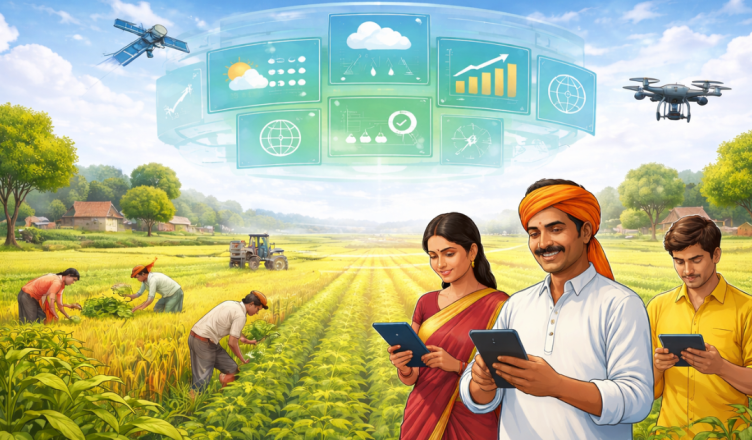
As Indian agriculture enters 2026, the focus of policy has decisively shifted from production alone to profitability, resilience, and farmer incomes. Against this backdrop, the Bharat-VISTAAR AI Platform has emerged as a flagship digital initiative designed to address one of the sector’s most persistent challenges: the gap between information, execution, and earnings at the farm level. Conceived as a nationwide, AI-driven agricultural intelligence system, Bharat-VISTAAR seeks to integrate data, advisory services, and market access into a single digital backbone tailored for India’s diverse farming landscape.
Unlike earlier agri-tech interventions that worked in silos, the platform aims to function as an ecosystem rather than an app. Its ambition is to combine artificial intelligence, satellite imagery, local weather data, soil health records, and real-time market signals to offer farmers actionable guidance that directly affects income outcomes.
Why Farmer Incomes Remain Under Pressure
Despite consistent gains in foodgrain output, farmer incomes in India have long been constrained by structural issues. Rising input costs, unpredictable weather patterns, fragmented landholdings, and volatile market prices have often eroded the benefits of higher production. Many farmers still make critical decisions on sowing, irrigation, and crop protection based on traditional knowledge or delayed information, leaving them vulnerable to losses.
Bharat-VISTAAR has been positioned as a corrective to this imbalance. By using AI to convert vast datasets into simple, timely recommendations, the platform aims to reduce avoidable risks while improving productivity and price realisation. The core idea is that better decisions, taken earlier, translate into higher net income rather than just higher yields.
How the Bharat-VISTAAR Platform Works
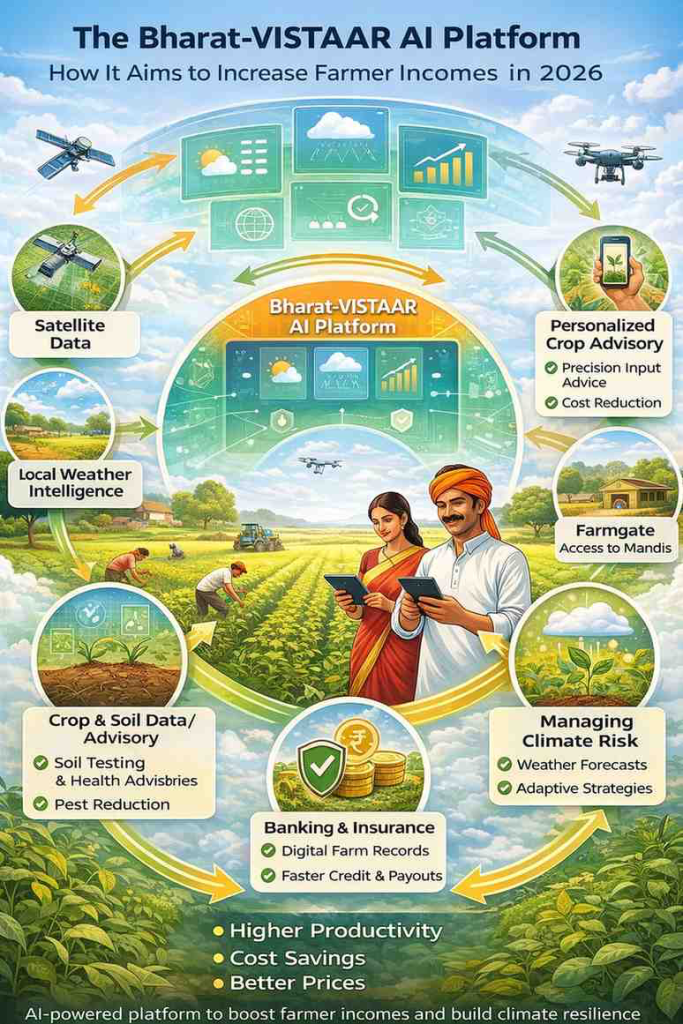
At the heart of Bharat-VISTAAR is an AI engine trained on region-specific agricultural data. The platform ingests satellite images to assess crop health, moisture stress, and pest vulnerability at the village and even plot level. This is combined with weather forecasts, soil profiles, and historical yield data to generate predictive insights.
For farmers, this intelligence is delivered through multilingual interfaces accessible via smartphones, assisted digital kiosks, and extension worker dashboards. Recommendations are contextual, meaning a paddy farmer in coastal Odisha receives advice that differs from that given to a cotton grower in Vidarbha. The emphasis is on clarity and practicality rather than technical complexity.
Personalised Crop Advisory and Cost Reduction
One of the most direct ways Bharat-VISTAAR aims to increase incomes is by reducing unnecessary expenditure. AI-based advisories on fertiliser application, irrigation scheduling, and pest management are designed to optimise input use. Instead of blanket recommendations, the platform suggests precise quantities and timings based on crop stage and local conditions.
This precision approach helps farmers avoid overuse of fertilisers and pesticides, which not only cuts costs but also improves soil health over time. In regions prone to erratic rainfall, irrigation advisories linked to short-term weather forecasts help conserve water and energy, further lowering cultivation expenses.
Managing Climate Risk Through Predictive Intelligence
Climate volatility has become one of the biggest income risks for Indian farmers. Unseasonal rains, heatwaves, and prolonged dry spells can wipe out months of effort within days. Bharat-VISTAAR’s predictive analytics are designed to act as an early warning system.
By analysing weather trends and crop sensitivity, the platform alerts farmers to potential risks and suggests mitigation strategies such as adjusting sowing dates, switching to short-duration varieties, or taking protective measures before extreme weather events. Over time, this ability to anticipate and adapt is expected to stabilise incomes by reducing catastrophic losses.
Linking Farmers to Better Market Outcomes
Production-side efficiency alone cannot guarantee higher incomes unless farmers also secure better prices. Bharat-VISTAAR addresses this through integrated market intelligence. The platform tracks mandi arrivals, price trends, and demand signals across regions, helping farmers decide when and where to sell.
In addition, the system supports aggregation by connecting farmer producer organisations with institutional buyers, processors, and exporters. By enabling collective negotiation and reducing dependence on intermediaries, the platform aims to improve price realisation, especially for small and marginal farmers who traditionally lack bargaining power.
Credit, Insurance, and Trust in Data
Access to timely and affordable credit remains uneven in rural India. Bharat-VISTAAR seeks to bridge this gap by creating verifiable digital farm records. Crop health data, sowing details, and yield estimates generated by the platform can be used to assess creditworthiness more accurately.
For insurers, AI-validated crop assessments reduce disputes and delays in claim settlement. Faster insurance payouts not only protect farmers from financial shocks but also encourage them to invest confidently in the next cropping cycle, creating a virtuous income loop.
Empowering Extension Services and Local Institutions
While technology is central to Bharat-VISTAAR, human intermediaries remain critical. The platform strengthens the role of extension officers, agri-entrepreneurs, and local cooperatives by equipping them with data-driven insights. Instead of generic advice, field-level workers can offer targeted guidance backed by real-time evidence.
This blended model of AI and human support is particularly important in regions with limited digital literacy. By embedding intelligence within existing institutional frameworks, the platform ensures wider adoption and trust among farmers.
Challenges and the Road Ahead
The success of Bharat-VISTAAR will depend on effective last-mile connectivity, data accuracy, and farmer confidence. Ensuring reliable internet access, safeguarding data privacy, and continuously updating AI models to reflect ground realities are ongoing challenges. There is also the task of aligning state-level schemes and local cropping practices with a national digital platform.
However, if these hurdles are addressed, Bharat-VISTAAR has the potential to mark a structural shift in how Indian agriculture functions. Rather than reacting to crises, farmers can move towards proactive, informed decision-making.
A Shift from Welfare to Wealth Creation
By 2026, Bharat-VISTAAR is expected to symbolise a broader transformation in agricultural policy, from welfare-driven support to technology-enabled wealth creation. Its promise lies not in replacing farmers’ knowledge, but in augmenting it with intelligence that was previously inaccessible or delayed.
If implemented at scale and with sensitivity to regional diversity, the platform could help convert India’s vast agricultural base into a more predictable, profitable, and future-ready sector. In doing so, Bharat-VISTAAR aims to redefine farmer incomes not as a function of subsidies, but as an outcome of smarter, data-led agriculture.
Also read :High-Speed Rail Corridors in India: Full List of Routes, Travel Times, and Connectivity Benefits
add newsestate.in as a preferred source on google – click here
Last Updated on: Thursday, February 5, 2026 10:20 am by News Estate Team | Published by: News Estate Team on Thursday, February 5, 2026 10:20 am | News Categories: Trending, India
About The Author
