

The sport has crossed a major international participation benchmark required for Paralympic consideration, with India emerging as one of the strongest contributors to para arm wrestling’s global growth.
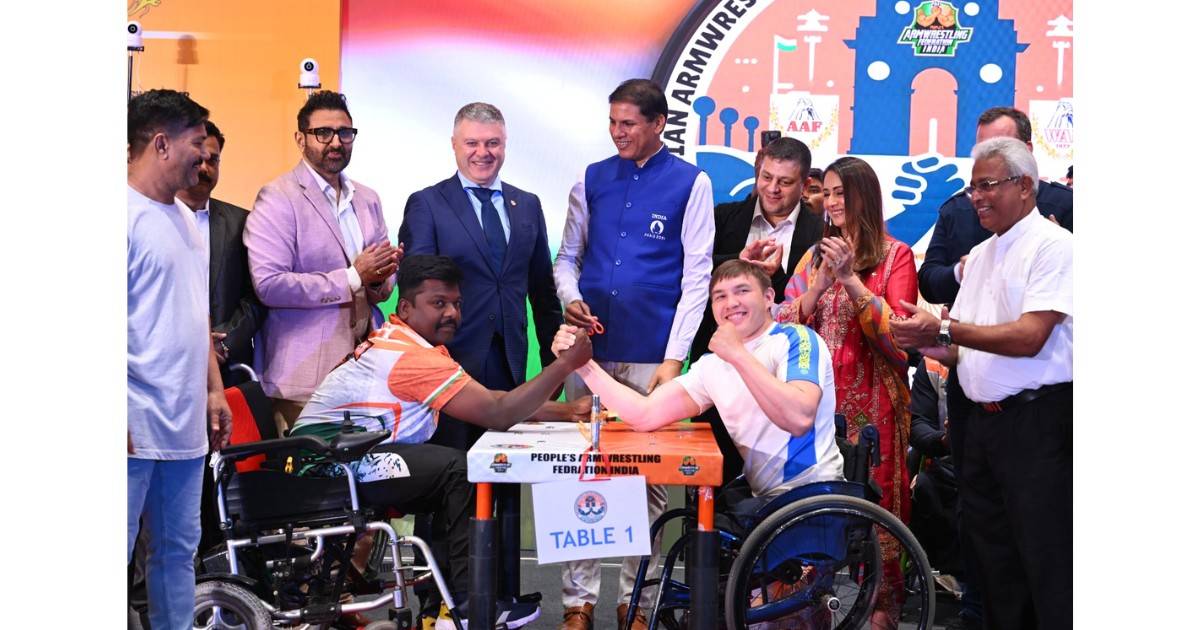
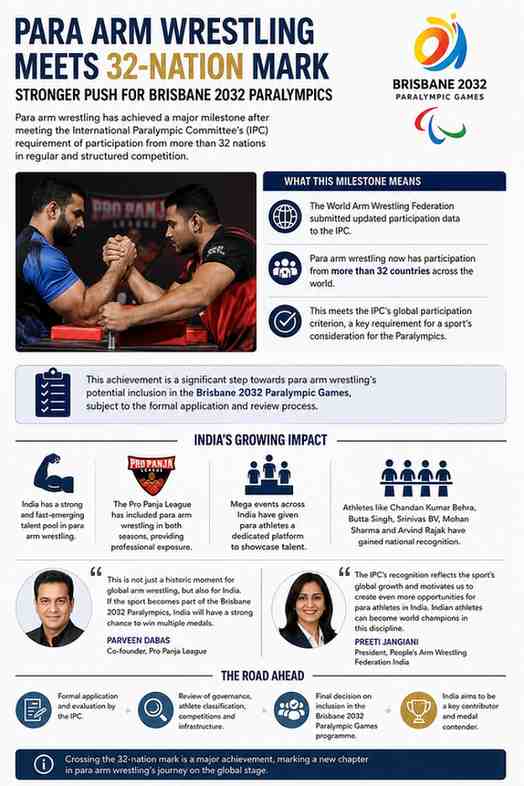
Para arm wrestling has taken a major step toward possible inclusion in the 2032 Paralympic Games in Brisbane after meeting the international participation criteria set by the International Paralympic Committee (IPC). The announcement was made on Monday by the People’s Arm Wrestling Federation India and the Pro Panja League, which described the development as a significant breakthrough for the sport worldwide.
According to the organisations, the IPC confirmed that para arm wrestling now has participation from more than 32 countries in regular and structured competition. The benchmark was achieved after the World Arm Wrestling Federation submitted updated participation data to the governing body.
The achievement does not automatically guarantee a place for para arm wrestling in the Brisbane 2032 Paralympic Games. However, crossing the minimum international participation threshold is considered one of the most important eligibility requirements in the Paralympic inclusion process. The sport must still undergo formal review, evaluation, and approval procedures before being officially added to the Paralympic programme.
Global Recognition Marks Turning Point for the Sport
The IPC generally requires sports seeking Paralympic inclusion to demonstrate broad international participation, competitive structure, governance standards, and athlete representation across multiple nations. By surpassing the 32-country benchmark, para arm wrestling has strengthened its case for recognition at the global level.
Sports administrators and athletes involved in the discipline see the development as a turning point after years of efforts to professionalise and expand the sport. Para arm wrestling has gradually built an organised competitive ecosystem through international federations, national bodies, and professional leagues.
In India, the momentum has accelerated in recent years due to increasing participation from athletes with disabilities and the emergence of structured tournaments. Organisers say the sport’s visibility has improved significantly because para categories are now being integrated into mainstream arm wrestling events rather than being treated as separate exhibitions.
The development is also important for India’s broader para-sports ecosystem. Over the past decade, Indian para-athletes have achieved notable success across multiple international competitions, including the Paralympics, Asian Para Games, and world championships. The possible addition of para arm wrestling to the Paralymic programme could open another medal avenue for the country.
India’s Expanding Role in Para Arm Wrestling
Officials associated with the sport say India has become one of the most active regions for para arm wrestling participation and talent development. The People’s Arm Wrestling Federation India and the Pro Panja League have organised several national competitions and public sporting events aimed at giving para athletes equal visibility.
Across both seasons of the Pro Panja League, para arm wrestling divisions were included alongside mainstream competitions. This approach helped create professional-level exposure for athletes competing in adaptive categories.
Several Indian para arm wrestlers have gained recognition through these tournaments, including Chandan Kumar Behra, Butta Singh, Srinivas BV, Mohan Sharma and Arvind Rajak. Their performances at national-level events have contributed to increasing public awareness of the sport.
Sports analysts note that visibility remains one of the biggest challenges for many para disciplines in India. Unlike cricket or Olympic athletics, emerging sports often struggle to secure sponsorships, television coverage, and long-term institutional support. Professional leagues and televised tournaments therefore play an important role in attracting audiences and encouraging participation.
The inclusion of para divisions in mainstream events is also viewed as an important shift in sporting culture. Instead of creating isolated competitions, organisers are increasingly attempting to build inclusive platforms where athletes with disabilities compete within the same professional sporting ecosystem.
Organisers Highlight Long-Term Efforts
Speaking about the milestone, Parveen Dabas said the achievement reflects years of effort by the international arm wrestling community and supporters in India.
He said the growth of para arm wrestling in India has been evident through participation in national tournaments and league events. According to him, organisers made a conscious effort from the beginning to ensure para athletes received equal opportunities and competitive platforms.
Dabas also expressed confidence that Indian athletes could emerge as strong medal contenders if the sport becomes part of the Paralympic Games in Brisbane.
Meanwhile, Preeti Jangiani said India has consistently demonstrated strong talent in para sports and that arm wrestling is beginning to follow a similar trajectory. She noted that participation from para athletes across different states has increased steadily over recent years.
Jangiani added that the IPC’s recognition of the participation benchmark reflects the sport’s expanding international presence and could encourage greater institutional support for athletes. She also stressed the importance of continued infrastructure development, coaching, and organised competitions in helping Indian competitors reach international standards.
Understanding the Paralympic Inclusion Process
The road to Paralympic inclusion is often lengthy and highly competitive. Sports seeking entry into the Paralympic Games must satisfy several technical and administrative requirements established by the IPC.
These generally include international governance structures, anti-doping compliance, gender representation, classification systems for athletes with disabilities, and regular competitions across multiple regions. Demonstrating widespread participation is especially important because the Paralympics aim to include sports with global reach rather than regional popularity.
Even after meeting participation requirements, sports are usually evaluated based on logistical feasibility, audience interest, competitive integrity, and alignment with Paralympic values.
For para arm wrestling, the latest milestone primarily confirms that the sport now meets one of the major global participation standards necessary for consideration.
Sports observers say the next phase could involve stronger international coordination, additional world-level tournaments, and continued lobbying efforts ahead of future Paralympic programme discussions.
Growing Popularity of Arm Wrestling in India
Arm wrestling has historically remained a niche sport in India despite having a dedicated grassroots following. However, the rise of professional sporting leagues and digital content has helped increase mainstream interest in recent years.
The launch of the Pro Panja League brought greater commercial attention to the sport through televised competitions, celebrity involvement, and regional representation. Organisers have also focused on presenting arm wrestling as a professionally managed combat-strength sport rather than a recreational activity.
Para arm wrestling has benefited from this growing ecosystem. Athletes who previously had limited opportunities to compete publicly are now gaining visibility through organised leagues and championship events.
Experts believe that recognition at the Paralympic level could significantly transform the sport’s future in India. Inclusion in the Paralympics often leads to increased funding, better training infrastructure, government support, and sponsorship opportunities.
It can also improve access to sports science, rehabilitation facilities, and athlete welfare programmes for competitors with disabilities.
Why the Development Matters for Athletes
For para athletes, international recognition of the sport represents more than just competitive expansion. It also validates years of advocacy for equal opportunities in professional sports.
Many adaptive sports athletes face barriers related to infrastructure, accessibility, funding, and public recognition. Formal inclusion pathways within international sporting bodies can help address some of these challenges by bringing greater institutional attention to athlete development.
The possible Paralympic pathway may also encourage more young athletes with disabilities to take up arm wrestling competitively. Increased visibility at national and international levels often inspires grassroots participation and improves public perception toward adaptive sports.
In India, where awareness of para sports has grown significantly after recent Paralympic successes, the timing of this development is particularly notable. Public and corporate interest in supporting para athletes has gradually expanded, especially after Indian athletes delivered strong performances at major international events in recent years.
Sports administrators believe para arm wrestling could benefit from this changing environment if sustained investment and policy support continue.
Challenges Still Remain Before Brisbane 2032
Despite the milestone, several steps remain before para arm wrestling can officially become part of the Brisbane 2032 Paralympics programme.
The sport will still need to navigate formal evaluation procedures and secure approval through IPC decision-making channels. Competition for inclusion is often intense, as only a limited number of sports can be accommodated within the Paralympic Games schedule.
Infrastructure readiness, international federation governance, athlete classification systems, and event management standards will likely remain under scrutiny during the review process.
At the same time, supporters of the sport believe the latest development gives para arm wrestling its strongest opportunity yet for Paralympic recognition.
With participation now extending across more than 32 nations and countries like India investing heavily in athlete development, the sport appears to be entering a new phase of international legitimacy.
For Indian athletes and organisers, the announcement is being viewed not only as a symbolic achievement but also as an indication that years of grassroots work and professional league-building may finally be translating into global recognition. If the Paralympic bid progresses successfully in the coming years, para arm wrestling could emerge as one of the newest additions to the international adaptive sports landscape ahead of Brisbane 2032.
Inputs and images : Hindusthan Samachar
Edited By E. Devanshi varma
Also Read: Assam Assembly Polls See 7 Major Highlights as Turnout Peaks, Counting Set for May 4
Follow us on Google News: Click Here