

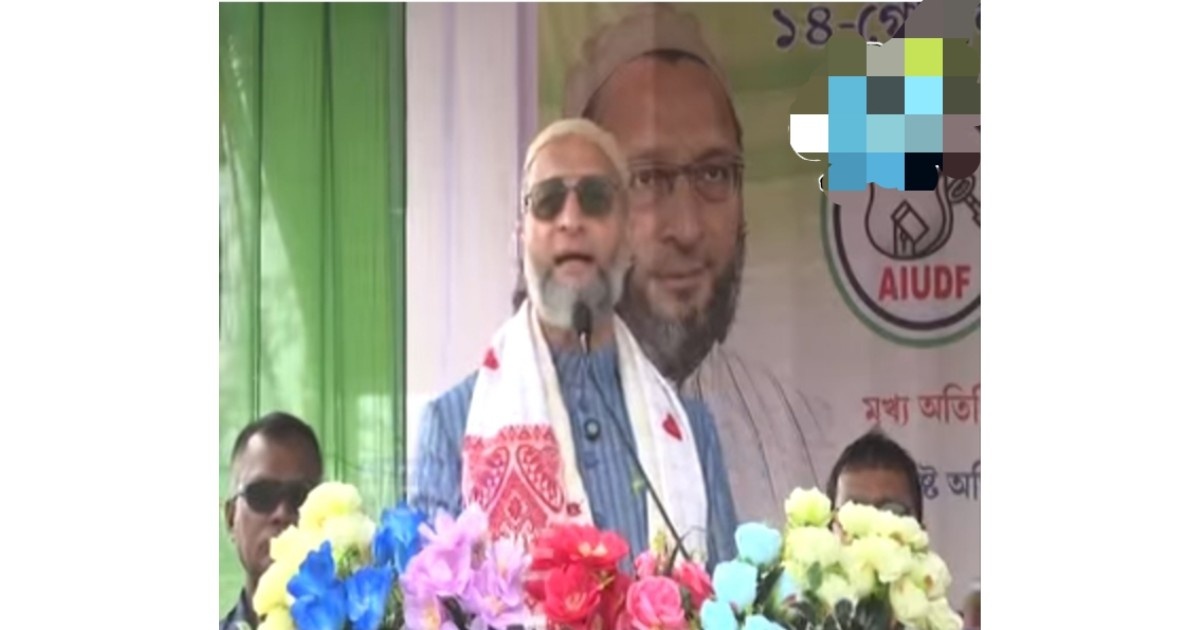
Guwahati, April 3: All India Majlis-e-Ittehadul Muslimeen (AIMIM) president Asaduddin Owaisi has stepped up his campaign efforts in Assam, urging members of the ‘Miya’ community to unite politically and support the All India United Democratic Front (AIUDF) in the upcoming elections. Speaking at multiple rallies across the state, Owaisi positioned the election as a critical moment for minority representation, while launching sharp criticism against both the Bharatiya Janata Party (BJP) and the Congress.
His remarks come amid an increasingly competitive political environment in Assam, where regional identity, land rights, and minority issues continue to influence electoral narratives.
Key Campaign Appeals
During his campaign speeches, Owaisi made a series of pointed appeals to voters, particularly targeting the ‘Miya’ community—a term commonly used to describe Bengali-origin Muslims in Assam.
First, he called for unity in voting patterns, urging the community to consolidate its support behind the AIUDF. According to him, a fragmented vote would weaken the community’s political influence and reduce its ability to safeguard its interests.
Second, he emphasized what he described as the need to defeat the BJP electorally. Owaisi framed the election as a referendum on the ruling party’s policies, particularly those affecting minority communities.
Third, he appealed to voters to use the ballot box as a means of protest. Referring to recent eviction drives in parts of Assam, he urged people to “respond through their vote,” suggesting that electoral participation is the most effective way to express dissent in a लोकतांत्रिक system.
Focus on Eviction Drives
A central theme of Owaisi’s campaign speech was criticism of eviction drives carried out under the BJP-led state government. These drives, often aimed at clearing alleged encroachments on government land, have sparked political debate and public concern.
Owaisi accused the government of disproportionately affecting economically weaker sections, particularly minorities. He argued that such actions have led to displacement and insecurity among vulnerable communities.
While the state government has maintained that these drives are necessary to reclaim public land and enforce legal norms, opposition leaders have frequently questioned their implementation and impact. Owaisi’s remarks reflect a broader opposition narrative that seeks to highlight humanitarian concerns associated with such measures.
Criticism of Congress
In addition to targeting the BJP, Owaisi also directed criticism at the Congress, accusing the party of failing to adequately represent or defend minority interests in Assam.
He claimed that the Congress did not take a strong stand during eviction operations and suggested that supporting the party would not yield tangible benefits for the ‘Miya’ community. This line of argument appears aimed at consolidating minority votes that might otherwise be divided between opposition parties.
The criticism also underscores the competitive dynamics within opposition politics, where regional and national parties often vie for overlapping voter bases.
Positioning AIUDF as a Key Player
Owaisi repeatedly highlighted the role of the AIUDF, presenting it as a party that consistently advocates for the rights and dignity of minority communities in Assam. Founded in 2005, the AIUDF has established itself as a regional political force with a significant support base among Bengali-origin Muslims.
By endorsing the AIUDF, Owaisi signaled a strategic alignment between AIMIM and regional players in certain states. While AIMIM has been expanding its footprint beyond its traditional base in Hyderabad, such collaborations indicate a broader effort to influence electoral outcomes in states with sizable minority populations.
Political Context in Assam
Assam’s political landscape has long been shaped by complex issues such as migration, identity, and land ownership. The ‘Miya’ community, in particular, has often been at the center of debates around citizenship and belonging.
Over the years, policies related to the National Register of Citizens (NRC) and land eviction drives have added layers of complexity to these discussions. Political parties have taken varied positions on these issues, often reflecting their ideological priorities and electoral strategies.
In this context, Owaisi’s campaign rhetoric seeks to tap into existing concerns while mobilizing a specific voter base. His emphasis on identity and representation aligns with AIMIM’s broader political messaging across different states.
Why This Matters
The significance of Owaisi’s campaign extends beyond immediate electoral outcomes. His involvement highlights the growing role of smaller and regional parties in shaping political discourse at the state level.
For the ‘Miya’ community, the election represents an opportunity to influence policy direction through democratic participation. Issues such as land rights, social security, and political representation are likely to remain central to voter concerns.
At the same time, the campaign also reflects the challenges faced by opposition parties in presenting a unified front. With multiple parties appealing to similar voter groups, the risk of vote splitting remains a key factor that could influence results.
Public Impact and Voter Considerations
For voters, especially those in minority communities, the current political climate presents both opportunities and dilemmas. On one hand, increased political attention can lead to greater visibility of community-specific issues. On the other hand, competing narratives may create confusion about which party is best positioned to address these concerns.
Owaisi’s call for consolidated voting is rooted in the idea that unity can translate into stronger political bargaining power. However, voter decisions will likely depend on a range of factors, including local candidates, past performance, and broader policy considerations.
Beyond the ‘Miya’ community, the election will also be closely watched for its implications on governance and social cohesion in Assam. The outcome could influence how future policies are framed and implemented, particularly in areas related to land use and minority welfare.
Looking Ahead
As campaigning intensifies ahead of the polling date, political parties are expected to further sharpen their messaging. Issues raised during this period are likely to shape public debate and voter priorities in the days leading up to the election.
Owaisi’s campaign in Assam adds another dimension to the electoral contest, bringing national attention to regional dynamics. Whether his appeals translate into electoral gains for the AIUDF remains to be seen, but they have already contributed to a more charged and competitive political environment.
The coming days will be crucial in determining how voters respond to these narratives and what direction Assam’s political landscape takes in the aftermath of the election.
Inputs and images : Hindusthan Samachar
Edited By E. Devanshi varma
Follow us on Google News: Click Here