

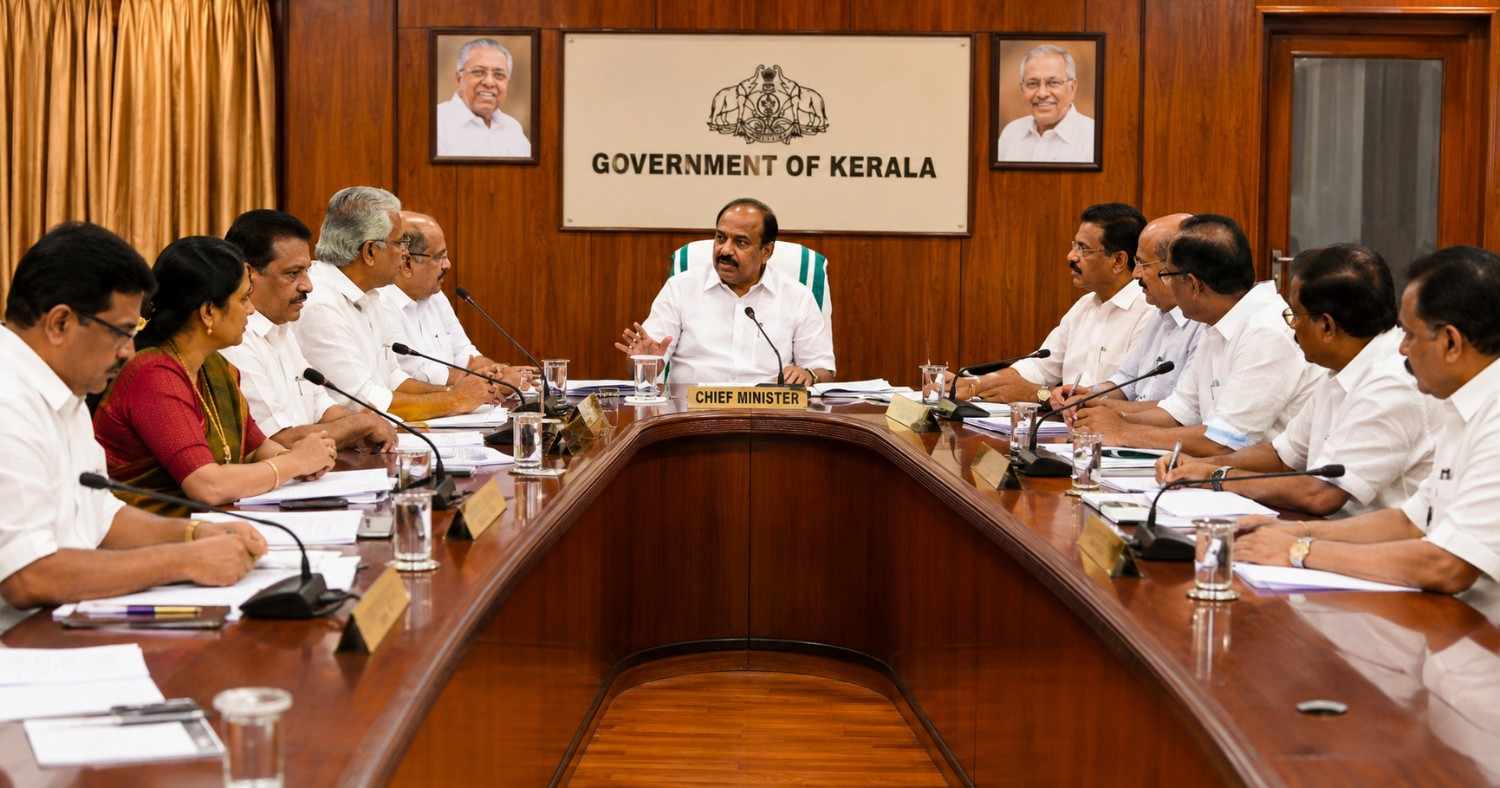
Thiruvananthapuram: Hours after taking oath as Kerala’s new Chief Minister, V. D. Satheesan chaired the first Cabinet meeting of the Congress-led United Democratic Front (UDF) government and announced a series of welfare-focused decisions aimed at signalling an immediate policy shift after returning to power in the state.
The newly formed administration approved free travel for women in Kerala State Road Transport Corporation (KSRTC) buses, enhanced welfare payments for frontline workers, plans for a dedicated department for senior citizens, and a probe into allegations linked to the Nava Kerala Yatra. The decisions were announced shortly after the swearing-in ceremony held at Central Stadium in Thiruvananthapuram, where Governor Rajendra Vishwanath Arlekar administered the oath of office to Satheesan and his 20-member Cabinet.
The announcements mark the first major governance decisions of the UDF government, which returned to power in Kerala after a decade in opposition. Political observers view the Cabinet’s initial moves as an effort to quickly implement welfare commitments highlighted during the election campaign while also attempting to reinforce the alliance’s pro-people image.
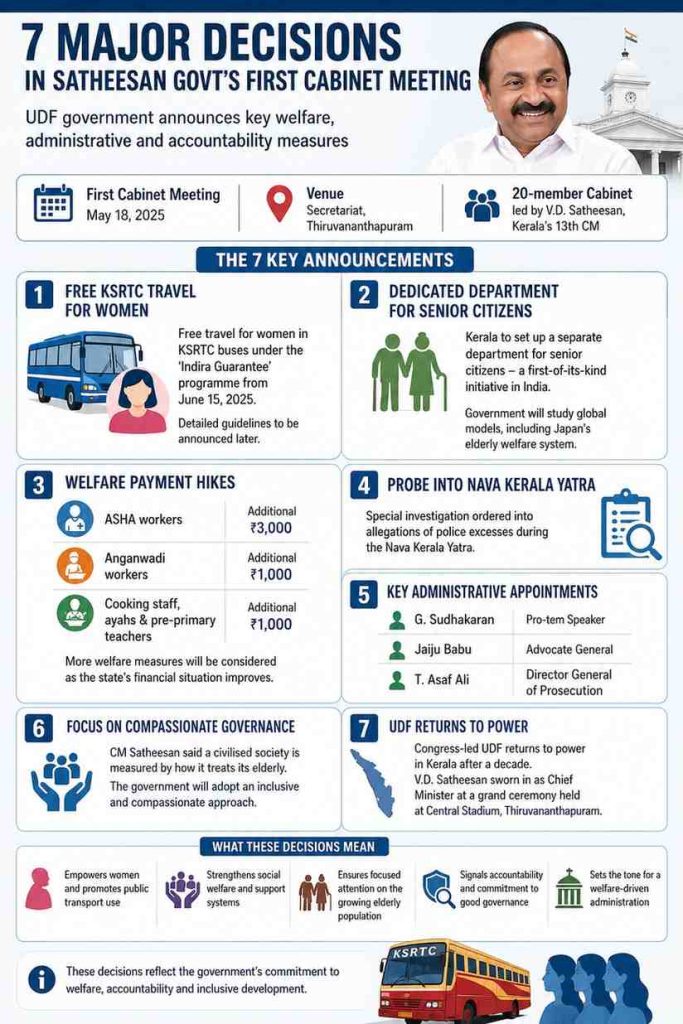
Free KSRTC Travel for Women from June 15
Among the Cabinet’s most closely watched decisions was the rollout of free travel for women in KSRTC buses under the “Indira Guarantee” programme. The scheme is scheduled to begin on June 15, though the government said detailed operational guidelines and eligibility rules would be announced separately.
The initiative is expected to benefit lakhs of women commuters across Kerala, particularly daily wage workers, students, domestic workers, and low-income households that rely heavily on public transport. Similar free bus travel schemes introduced in states such as Karnataka and Delhi have generated strong public response and significantly increased female ridership in government-run transport systems.
Kerala’s decision comes at a time when many states are experimenting with welfare-driven mobility schemes aimed at improving women’s workforce participation and easing household financial burdens. Analysts say the policy may also help increase public transport usage in urban areas while reducing dependence on private vehicles.
However, questions remain regarding the financial sustainability of the programme and the compensation model for KSRTC, which has been facing persistent financial stress for years. Opposition parties and transport experts are likely to closely watch how the state manages operational costs once the scheme becomes functional.
Dedicated Department for Senior Citizens
In another major policy announcement, the Kerala government said it would establish a separate department dedicated exclusively to senior citizens, describing it as a first-of-its-kind initiative in India.
Speaking after the Cabinet meeting, Satheesan said the government intends to study successful international welfare systems, particularly Japan’s elderly care model, before finalising the structure of the department.
Kerala has one of India’s highest ageing populations, driven by increased life expectancy, migration of younger workers, and changing family structures. According to demographic studies, the state is expected to witness a sharp rise in elderly citizens over the next decade, increasing pressure on healthcare systems, pension mechanisms, and social welfare networks.
The proposed department is expected to focus on issues including healthcare access, social security, mental health support, assisted living, pension coordination, and protection against neglect and abuse. Experts have long argued that Kerala requires a more integrated policy framework for elderly welfare due to the state’s rapidly evolving demographic profile.
Satheesan said the government viewed elderly welfare not merely as an administrative responsibility but as a broader social commitment. He added that the way a society treats its elderly population reflects its level of social progress and compassion.
Welfare Payment Hikes for Frontline Workers
The Cabinet also approved increases in welfare payments and honorariums for several categories of workers engaged in public welfare and community-level services.
ASHA workers will receive an additional ₹3,000, while Anganwadi workers will get a monthly increase of ₹1,000. Cooking staff, ayahs, and pre-primary teachers associated with welfare and nutrition programmes will also receive an increase of ₹1,000 in their monthly honorariums.
The move is likely to be welcomed by thousands of workers who have repeatedly raised concerns over low wages and delayed payments in recent years. ASHA workers, in particular, played a critical role during the COVID-19 pandemic and have frequently demanded better compensation and recognition for their healthcare responsibilities.
Anganwadi workers and helpers have also been central to Kerala’s child nutrition and early education systems. Labour organisations and welfare unions have long argued that the honorariums paid to these categories do not adequately reflect the workload and social responsibilities attached to their roles.
While announcing the hikes, the Chief Minister acknowledged the state’s financial limitations and said additional welfare measures would be considered gradually as Kerala’s fiscal position improves.
Administrative Appointments and Governance Decisions
The first Cabinet meeting also cleared several key administrative appointments. Veteran legislator G. Sudhakaran was appointed Pro-tem Speaker of the Kerala Assembly. Senior advocate Jaiju Babu was named Advocate General, while T. Asaf Ali was appointed Director General of Prosecution.
These appointments are considered significant as the government prepares for the upcoming Assembly session and begins implementing its administrative agenda.
The Cabinet further announced a special investigation into allegations of police excesses during the Nava Kerala Yatra, a politically sensitive issue that generated debate during the previous administration. The investigation is expected to examine complaints related to policing methods and alleged misuse of authority during the outreach programme.
Political analysts believe the decision signals the new government’s attempt to project accountability and differentiate itself from the previous Left Democratic Front (LDF) administration.
UDF Returns to Power After a Decade
The swearing-in of the Satheesan government marks a major political shift in Kerala, where power has historically alternated between the UDF and the LDF. The Congress-led alliance secured a decisive mandate in the recent Assembly elections, ending ten years of Left rule in the state.
Satheesan, who emerged as one of the UDF’s most prominent opposition leaders over recent years, built much of his campaign around governance reforms, welfare delivery, corruption allegations, and administrative accountability.
The new Cabinet includes a mix of experienced leaders and younger faces, reflecting the alliance’s attempt to balance political continuity with generational change. The government now faces the challenge of translating campaign promises into policy while managing fiscal constraints and administrative pressures.
Financial and Political Challenges Ahead
While the Cabinet’s early welfare announcements have generated political momentum, economists say Kerala’s financial condition could pose implementation challenges in the months ahead.
The state has been dealing with rising debt obligations, revenue constraints, and increasing welfare expenditure commitments. Funding large-scale subsidy programmes and social welfare expansions without worsening fiscal stress will likely remain one of the government’s biggest tests.
At the same time, the UDF government may seek to position welfare-driven governance as its central political strategy ahead of future local body and parliamentary elections. Early implementation of manifesto promises could play an important role in shaping public perception during the initial months of the administration.
The success of the free KSRTC travel initiative and the proposed senior citizens department may also influence how other states approach gender-focused mobility and elderly welfare policies in the future.
For now, the Satheesan government’s first Cabinet meeting has set the tone for an administration seeking to combine welfare expansion, administrative restructuring, and political messaging within its opening hours in office.
Highlights
- Kerala’s new UDF government announced free KSRTC bus travel for women from June 15 under the “Indira Guarantee” scheme.
- Chief Minister V.D. Satheesan said the state would create a dedicated department for senior citizens, describing it as a first-of-its-kind initiative in India.
- ASHA workers will receive an additional ₹3,000, while Anganwadi workers and several welfare staff categories will get monthly honorarium hikes.
- The Cabinet ordered a special investigation into allegations of police excesses during the Nava Kerala Yatra.
- Veteran leader G. Sudhakaran was appointed Pro-tem Speaker, while Jaiju Babu and T. Asaf Ali received key legal appointments.
- The Congress-led UDF returned to power in Kerala after a decade, with the new government moving quickly to implement election promises.
FAQ
What did the Kerala Cabinet announce in its first meeting?
The Cabinet approved several welfare measures, including free KSRTC travel for women, increased payments for welfare workers, a new department for senior citizens, and a probe into alleged police excesses during the Nava Kerala Yatra.
When will free KSRTC travel for women begin?
The Kerala government said the scheme will be implemented from June 15 under the “Indira Guarantee” programme.
Who will benefit from the KSRTC free travel scheme?
Women commuters using Kerala State Road Transport Corporation buses are expected to benefit, particularly daily passengers from low-income and working-class backgrounds.
Why is Kerala planning a separate department for senior citizens?
The government said Kerala’s ageing population requires focused policy attention on healthcare, welfare, pensions, and elderly support systems.
How much increase was announced for ASHA workers?
ASHA workers will receive an additional ₹3,000 as part of the new welfare package announced by the Cabinet.
What changes were announced for Anganwadi workers?
Anganwadi workers will receive a monthly increase of ₹1,000 in their honorariums.
What is the Nava Kerala Yatra investigation about?
The government has ordered a special investigation into allegations of police excesses linked to the Nava Kerala Yatra conducted during the previous administration.
Who is V.D. Satheesan?
V. D. Satheesan is the new Chief Minister of Kerala and a senior Congress leader who led the UDF alliance back to power after a decade.
Why are the first Cabinet decisions politically significant?
The announcements are being viewed as an effort by the new UDF government to quickly implement major election promises and establish its governance priorities early in its tenure.
Inputs and images : Hindusthan Samachar
Edited By E. Devanshi varma
Also Read: Assam Assembly Polls See 7 Major Highlights as Turnout Peaks, Counting Set for May 4
Follow us on Google News: Click Here