

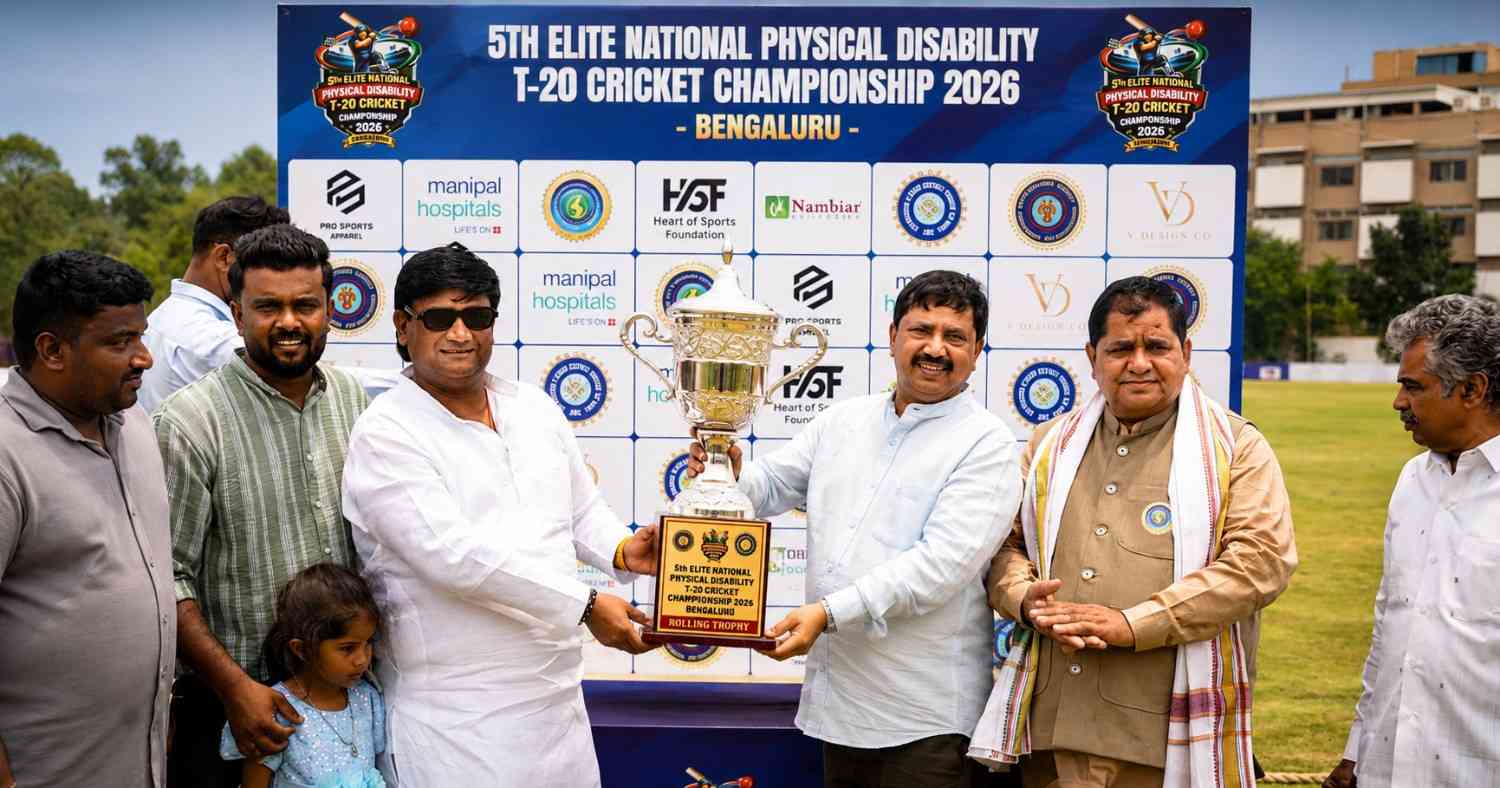
Bengaluru, May 18: The fifth edition of the National Physical Disability Elite Cricket Tournament began in Bengaluru on Sunday with an elaborate inaugural ceremony that brought together players, sports administrators, former cricketers, and supporters of differently-abled sports from across the country. Organized under the banner of the Karnataka State Disabled Cricket Association, the tournament marks another major step in India’s growing efforts to strengthen competitive opportunities for differently-abled athletes.
The event opened with cultural performances, ceremonial lamp lighting, and participation from senior officials associated with disability cricket administration in India. Representatives from the Physically Challenged Cricket Association of India (PCCAI), the Differently Abled Cricket Council of India (DCCI), and the Paralympic sports ecosystem attended the ceremony, emphasizing the increasing institutional focus on disability sports in the country.
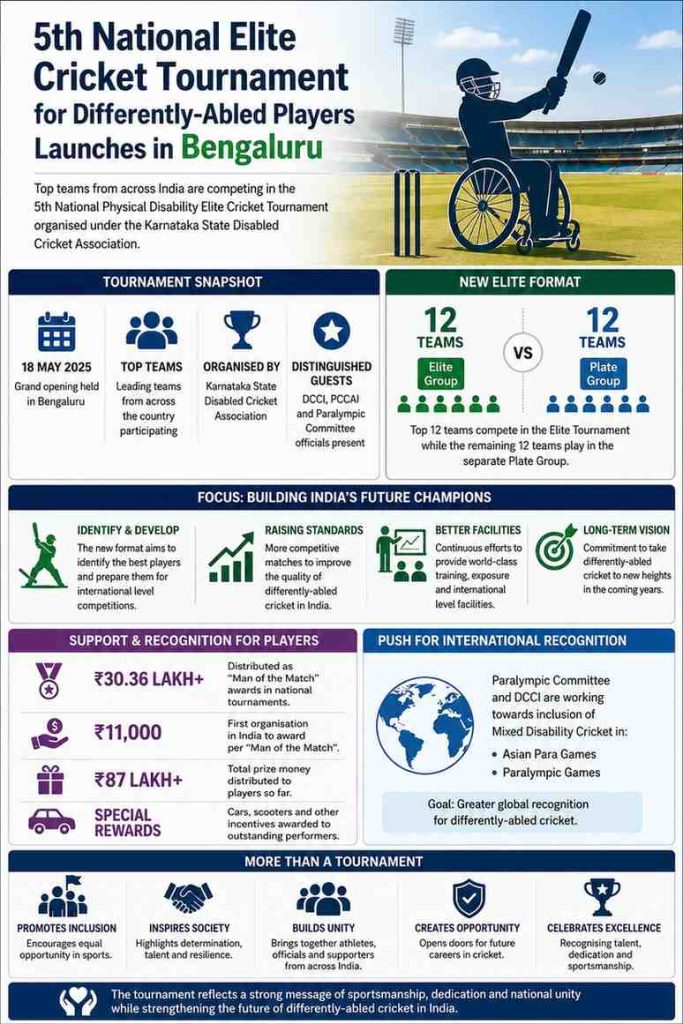
This year’s tournament carries added significance because organizers have restructured the competition format in an effort to improve the standard of national-level disability cricket. Unlike previous editions that featured 24 teams competing together, the latest edition introduces a separate elite structure involving the top 12 teams in the country. The remaining teams will participate in a separate Plate Group competition.
Officials said the revised structure is intended to create stronger competition among leading teams while helping selectors identify players capable of representing India in international tournaments in the future.
Speaking at the inauguration, DCCI General Secretary Ravikant Chauhan said the organization has consistently worked to create more competitive pathways for differently-abled cricketers. According to him, the new format is designed to elevate playing standards and provide talented athletes with greater exposure at the national level.
He noted that disability cricket in India has evolved significantly over the years, with better tournament management, growing public recognition, and improved support systems for athletes. He added that national tournaments are now increasingly focused not only on participation but also on long-term player development and international preparedness.
Officials associated with the event also highlighted the growing emphasis on professional facilities and financial support for players. Ravikant Chauhan stated that the organization has previously awarded vehicles, including cars and scooters, to outstanding performers in an effort to motivate athletes and recognize excellence in the sport.
According to tournament administrators, support systems for differently-abled players are gradually becoming more structured, especially in areas such as coaching, fitness preparation, travel arrangements, and competitive exposure. Organizers believe these initiatives are necessary if Indian disability cricket is to compete consistently at the global level.
The inauguration ceremony was attended by several prominent personalities, including PCCAI President Surendra Lohia, Paralympic Committee President Satyanarayana, Hemchandra, Santosh Gowda, and other officials associated with adaptive sports administration.
During his address, Surendra Lohia reflected on the long-term efforts made to expand opportunities for differently-abled cricketers across India. He said organizations connected to disability cricket have spent over a decade and a half working toward recognition, financial stability, and broader participation in the sport.
Lohia revealed that prize money worth more than ₹30 lakh has already been distributed through “Man of the Match” awards in national tournaments conducted under the association’s framework. He also said the organization was among the first in the country to introduce ₹11,000 awards for individual match winners in disability cricket competitions.
According to officials, overall player incentives distributed through tournaments and awards have crossed ₹87 lakh over the years. Organizers believe financial encouragement remains essential because many differently-abled athletes continue to face economic and social challenges while pursuing professional sport.
The tournament also drew attention to the larger conversation around inclusion and recognition of disability cricket within the international sporting system. Paralympic Committee President Satyanarayana said discussions and collaborative efforts are underway to push for the inclusion of mixed disability cricket in major multi-sport events such as the Asian Para Games and eventually the Paralympic Games.
Sports administrators involved in adaptive cricket believe international recognition could transform the future of the sport by attracting sponsorship, improving infrastructure, and creating professional career opportunities for players. Inclusion in global events would also help increase visibility for differently-abled athletes and strengthen public awareness around inclusive sports participation.
India has emerged as one of the most active countries in promoting disability cricket, particularly through domestic tournaments organized across states. Over the past decade, several regional associations have worked to build competitive structures for players with physical disabilities, hearing impairments, and intellectual disabilities. However, administrators say there is still a long way to go in terms of mainstream visibility, institutional funding, and integration with broader sports governance systems.
The Bengaluru tournament is expected to serve as an important scouting and development platform. Coaches and selectors will closely monitor performances during the competition, particularly among younger players aiming to break into the national setup. Officials say the elite tournament format is likely to increase the intensity of matches and help identify athletes capable of adapting to high-pressure situations.
The event also highlighted the role of community support and sponsorship in sustaining disability sports. Organizers thanked sponsors, volunteers, state associations, and supporters for contributing to the growth of the tournament over the years. They emphasized that long-term partnerships and institutional backing remain crucial for ensuring regular competitions and athlete welfare programs.
Former international players were felicitated during the opening ceremony in recognition of their contributions to the sport. The ceremony also promoted messages of sportsmanship, perseverance, and national unity, themes that have increasingly become central to disability sports initiatives in India.
Beyond competition, events like the National Physical Disability Elite Cricket Tournament carry broader social significance. Advocates of adaptive sports argue that greater visibility for differently-abled athletes helps challenge stereotypes surrounding disability and encourages wider participation in education, employment, and community life.
Sports experts have often pointed out that inclusive sporting events contribute not only to athlete development but also to public awareness and social integration. In recent years, India has seen rising interest in Paralympic and adaptive sports following the success of para-athletes at international competitions. Administrators believe that cricket — given its popularity in India — can become one of the strongest platforms for promoting inclusion if adequate support systems continue to expand.
The Bengaluru tournament is scheduled to feature matches between some of the country’s leading differently-abled cricket teams over the coming days. Organizers expressed confidence that the event would not only showcase high-quality cricket but also reinforce the message that sporting excellence is determined by skill, commitment, and opportunity rather than physical limitations.
As competition begins, players, coaches, and administrators alike will be hoping that the tournament further strengthens the momentum behind disability cricket in India and pushes the sport closer toward wider recognition at both national and international levels.
Highlights
- Bengaluru hosted the opening ceremony of the 5th National Physical Disability Elite Cricket Tournament with participation from top teams across India.
- Organizers introduced a new elite format featuring the country’s best 12 teams to improve competition standards and identify future international players.
- Officials from DCCI and PCCAI reiterated their commitment to strengthening infrastructure, training, and financial support for differently-abled cricketers.
- Prize incentives and player recognition initiatives have continued to expand, with lakhs of rupees already distributed through tournament awards.
- Paralympic sports administrators are working toward securing recognition for mixed disability cricket in future Asian Para Games and Paralympic events.
- The inauguration ceremony also highlighted themes of inclusivity, sportsmanship, and national unity through cultural performances and player felicitation.
FAQ
What is the National Physical Disability Elite Cricket Tournament?
The tournament is a national-level cricket competition for differently-abled players in India. It provides a competitive platform for athletes with physical disabilities to showcase their talent and compete at a high level.
Why is this year’s tournament considered significant?
This edition introduced a new elite format featuring the top 12 teams instead of the earlier broader structure involving 24 teams together. Organizers say the change is aimed at improving competitiveness and identifying stronger players for future international representation.
Where is the tournament being held?
The 5th National Physical Disability Elite Cricket Tournament is being held in Bengaluru.
Which organizations are associated with the event?
The tournament is being conducted under the Karnataka State Disabled Cricket Association with support from organizations including the Differently Abled Cricket Council of India (DCCI) and the Physically Challenged Cricket Association of India (PCCAI).
What role does DCCI play in disability cricket?
The DCCI works toward organizing tournaments, improving facilities, identifying talented players, and promoting differently-abled cricket at national and international levels.
How are players being financially supported?
Officials said prize money, performance awards, and incentives have been regularly distributed to encourage players. Awards such as cars, scooters, and cash prizes have previously been given to outstanding performers.
Is there a push for international recognition of disability cricket?
Yes. Sports administrators stated that efforts are underway to secure inclusion of mixed disability cricket in major events such as the Asian Para Games and eventually the Paralympic Games.
Why does disability cricket matter beyond sports?
Supporters believe disability cricket promotes inclusion, challenges social stereotypes, and creates opportunities for differently-abled athletes to gain recognition, confidence, and professional sporting exposure.
What is the purpose of the elite tournament structure?
The elite structure is intended to raise the standard of competition by bringing together the country’s strongest teams, helping selectors identify players capable of competing internationally.
How does the tournament contribute to Indian sports culture?
The event promotes inclusive participation in sports and reflects a growing effort within India’s sporting ecosystem to support adaptive athletics alongside mainstream competitions.
Inputs and images : Hindusthan Samachar
Edited By E. Devanshi varma
Also Read: Assam Assembly Polls See 7 Major Highlights as Turnout Peaks, Counting Set for May 4
Follow us on Google News: Click Here