


India’s artificial intelligence industry is moving at a pace that many analysts and technology executives did not anticipate even a few years ago. What began as a gradual push toward automation and data-driven systems has now transformed into one of the country’s fastest-growing technology movements, influencing sectors ranging from finance and healthcare to retail, education, logistics, and entertainment.
The rapid rise of generative AI tools, combined with India’s expanding internet ecosystem and strong digital infrastructure, has created conditions that are accelerating adoption across businesses of all sizes. Startups, multinational firms, educational institutions, and government agencies are increasingly investing in AI technologies to improve productivity, automate repetitive work, enhance customer engagement, and unlock new revenue opportunities.
Industry experts say the speed of India’s AI expansion is being driven by a combination of demographic advantages, growing digital literacy, and a large pool of engineering talent. Unlike previous technology waves that were concentrated mainly in metropolitan hubs, AI adoption is now spreading into smaller cities and regional business ecosystems as companies look for cost-efficient ways to scale operations.
A Rapidly Expanding Startup Ecosystem
India’s startup ecosystem has emerged as one of the central drivers of the country’s AI growth story. Over the past few years, a growing number of technology startups have focused specifically on artificial intelligence products, including generative AI platforms, automation software, cybersecurity tools, healthcare diagnostics, and enterprise productivity systems.
Venture capital interest in AI-focused businesses has also increased sharply. Investors are viewing AI as a long-term growth sector capable of reshaping industries in a manner similar to the rise of smartphones and cloud computing. Startups are increasingly positioning themselves not only as service providers but also as creators of proprietary AI models and specialized platforms designed for Indian markets.
Several Indian companies are building language-based AI systems tailored to regional languages, an area considered critical in a country with significant linguistic diversity. This localization effort is expected to play a major role in expanding AI accessibility beyond English-speaking users and metropolitan consumers.
The competition among startups has intensified as firms attempt to differentiate themselves through faster deployment, industry-specific solutions, and lower operational costs. Analysts say this environment is creating a highly dynamic innovation cycle within the Indian technology sector.
Big Tech Companies Are Increasing Investments
Global technology corporations are also deepening their AI investments in India. Major international firms have expanded engineering operations, cloud infrastructure projects, research partnerships, and AI training initiatives across the country.
India is increasingly being viewed as both a major consumer market and a strategic development hub for artificial intelligence technologies. The country’s large developer base allows companies to scale AI engineering capabilities while also testing products in a rapidly digitizing economy.
Cloud computing providers have announced new data centers and AI-focused infrastructure investments aimed at supporting enterprise demand. Businesses across banking, retail, manufacturing, and telecommunications are adopting AI-powered analytics and automation tools to improve efficiency and customer experiences.
Technology companies are additionally partnering with universities and educational institutions to strengthen AI-related skill development programs. Industry leaders believe workforce readiness will become one of the defining factors in determining how successfully India can capitalize on the AI opportunity.
Generative AI Is Reshaping Workplaces
One of the biggest shifts in India’s technology landscape has been the rapid rise of generative AI applications in everyday business operations. Companies are increasingly deploying AI systems for tasks such as customer support, document summarization, marketing content generation, software coding assistance, fraud detection, and workflow automation.
The impact is especially visible in sectors heavily dependent on large-scale operational processes. Financial services firms are using AI to detect unusual transaction patterns, while e-commerce companies are implementing AI-driven recommendation systems and inventory management tools.
In healthcare, AI-powered diagnostic support systems are helping medical professionals process imaging and patient data more efficiently. Educational technology platforms are also integrating AI tutoring systems and adaptive learning models to personalize digital learning experiences.
Corporate executives say AI adoption is no longer limited to experimental pilot projects. Many organizations are now incorporating AI directly into their long-term operational strategies in an attempt to reduce costs and remain competitive in increasingly digital markets.
At the same time, concerns over workforce disruption continue to grow. Automation of repetitive tasks may reshape employment patterns across industries, particularly in administrative and support roles. However, industry experts argue that AI could also create new categories of jobs related to data science, machine learning operations, cybersecurity, and AI governance.
India’s Digital Infrastructure Is Playing a Critical Role
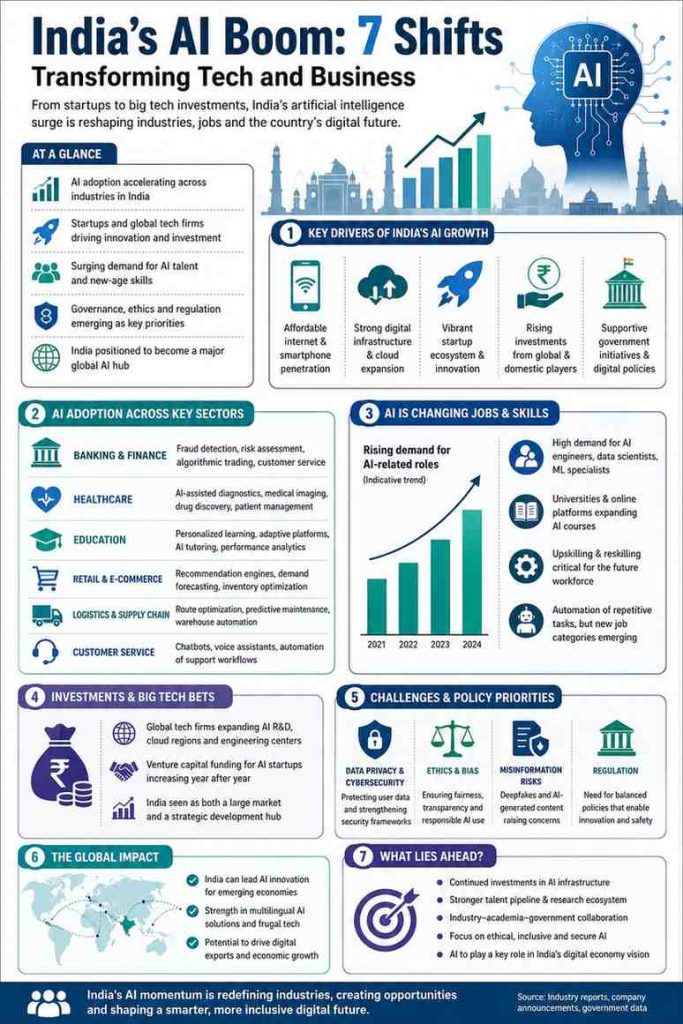
India’s existing digital ecosystem is widely considered one of the key reasons behind the country’s accelerating AI adoption. Over the past decade, initiatives related to digital payments, online identity verification, affordable mobile internet, and public digital infrastructure have dramatically expanded internet participation across the country.
This foundation has created a large volume of digital data and user engagement, both of which are important for training and deploying AI systems. Analysts note that India’s digital transformation over the last several years effectively prepared the environment for widespread AI experimentation and commercial implementation.
The availability of low-cost smartphones and mobile internet services has further expanded the reach of digital platforms into semi-urban and rural areas. Businesses increasingly view these emerging markets as opportunities for AI-driven services in areas such as agriculture, healthcare access, financial inclusion, and education.
Government-backed technology initiatives are also contributing to the ecosystem by encouraging digital innovation, startup development, and technology entrepreneurship. Policymakers have emphasized the importance of balancing innovation with responsible governance as AI technologies become more deeply integrated into society.
Demand for AI Talent Is Surging
The rapid growth of artificial intelligence has triggered a sharp increase in demand for skilled professionals. Companies are actively recruiting software engineers, data scientists, machine learning specialists, AI researchers, and cybersecurity experts as competition intensifies across the technology sector.
Educational institutions and online learning platforms have responded by expanding AI-focused certification programs, technical courses, and specialized training initiatives. Universities are increasingly partnering with technology companies to develop industry-oriented AI curriculums aimed at preparing students for changing workforce requirements.
Recruitment firms report that AI-related job postings have risen substantially compared with previous years, particularly in sectors such as fintech, cloud computing, enterprise software, and digital services.
However, industry observers warn that India may still face a significant talent gap if demand continues to grow faster than workforce training capacity. Experts argue that long-term success will depend not only on technological innovation but also on investments in education, research, and upskilling initiatives.
Concerns Around Regulation and Ethics Are Growing
As AI adoption accelerates, discussions around regulation, misinformation, privacy, and ethical governance are becoming increasingly important. Policymakers and industry leaders are debating how to create frameworks that encourage innovation while also protecting users and preventing misuse.
Concerns surrounding deepfakes, algorithmic bias, misinformation campaigns, and data security have intensified globally, and India is not immune to those challenges. Experts say balancing technological advancement with accountability will become one of the defining policy debates of the coming years.
Businesses are also facing pressure to improve transparency around AI-generated content and automated decision-making systems. Questions regarding copyright, data ownership, and responsible AI deployment are likely to become more prominent as adoption expands further.
Regulatory clarity may play a critical role in shaping investor confidence and long-term industry stability. Companies are closely monitoring how governments worldwide approach AI governance as they adapt compliance strategies for future regulations.
Why India’s AI Growth Matters Globally
India’s AI expansion is increasingly being viewed as more than just a domestic technology story. With one of the world’s largest internet user bases and a rapidly digitizing economy, the country has the potential to become a major global center for AI development, deployment, and innovation.
Technology analysts believe India could play an influential role in shaping affordable and scalable AI solutions for emerging markets. The country’s focus on multilingual systems, mobile-first platforms, and large-scale digital infrastructure may provide models that other developing economies can adapt.
The AI sector’s growth could also contribute significantly to India’s broader economic ambitions, particularly in areas such as manufacturing modernization, digital exports, financial technology, and innovation-driven entrepreneurship.
At the same time, the speed of expansion raises complex questions about workforce adaptation, policy readiness, infrastructure capacity, and ethical oversight. How India manages those challenges may ultimately determine whether its AI boom becomes a sustainable long-term transformation or a short-term technology surge driven primarily by global hype cycles.
For now, however, the momentum shows few signs of slowing. Across startups, corporations, educational institutions, and public-sector initiatives, artificial intelligence is rapidly becoming one of the defining forces shaping India’s next phase of digital and economic development.
Highlights
- India’s artificial intelligence sector is expanding rapidly across startups, enterprise technology, education, healthcare, and government-backed digital infrastructure.
- Increased investment from global technology firms and domestic startups is accelerating AI adoption in both urban and emerging markets.
- Affordable internet access, a large developer ecosystem, and digital public infrastructure are helping India become a major AI growth market.
- Companies are increasingly integrating generative AI into customer service, finance, logistics, healthcare, and content operations.
- Demand for AI-skilled professionals has surged as businesses compete to modernize operations and improve efficiency.
- Policymakers and industry leaders are also debating regulation, data privacy, misinformation risks, and ethical AI deployment.
- India’s AI momentum could significantly influence employment patterns, digital innovation, and the country’s long-term economic strategy.
FAQ
What is driving India’s rapid AI growth?
India’s AI growth is being driven by expanding internet access, strong digital infrastructure, rising startup activity, global technology investments, and increasing demand for automation across industries.
Which sectors in India are adopting AI the fastest?
Banking, healthcare, education, retail, logistics, e-commerce, and customer service sectors are among the fastest adopters of AI technologies.
Why are global technology companies investing heavily in India?
India offers a large developer workforce, a growing digital economy, and a massive consumer market, making it an important location for AI development and expansion.
How is generative AI being used by businesses?
Companies are using generative AI for customer support, content generation, coding assistance, analytics, workflow automation, and operational efficiency improvements.
Could AI affect employment in India?
AI may automate some repetitive tasks, but it is also expected to create demand for new roles in software engineering, machine learning, cybersecurity, and AI governance.
Why is India’s multilingual market important for AI?
India’s linguistic diversity creates demand for AI systems that can operate across regional languages, helping expand digital accessibility to broader populations.
What concerns are associated with rapid AI adoption?
Major concerns include misinformation, deepfakes, data privacy, cybersecurity risks, algorithmic bias, and the ethical use of AI-generated content.
How are educational institutions responding to AI demand?
Universities and online learning platforms are introducing AI-focused courses, certifications, and industry partnerships to prepare students for evolving workforce needs.
Could India become a global AI hub?
Many analysts believe India has the potential to become a major global AI hub due to its technology talent pool, startup ecosystem, and expanding digital economy.
Edited By E. Devanshi varma
Also Read: Assam Assembly Polls See 7 Major Highlights as Turnout Peaks, Counting Set for May 4
Follow us on Google News: Click Here