

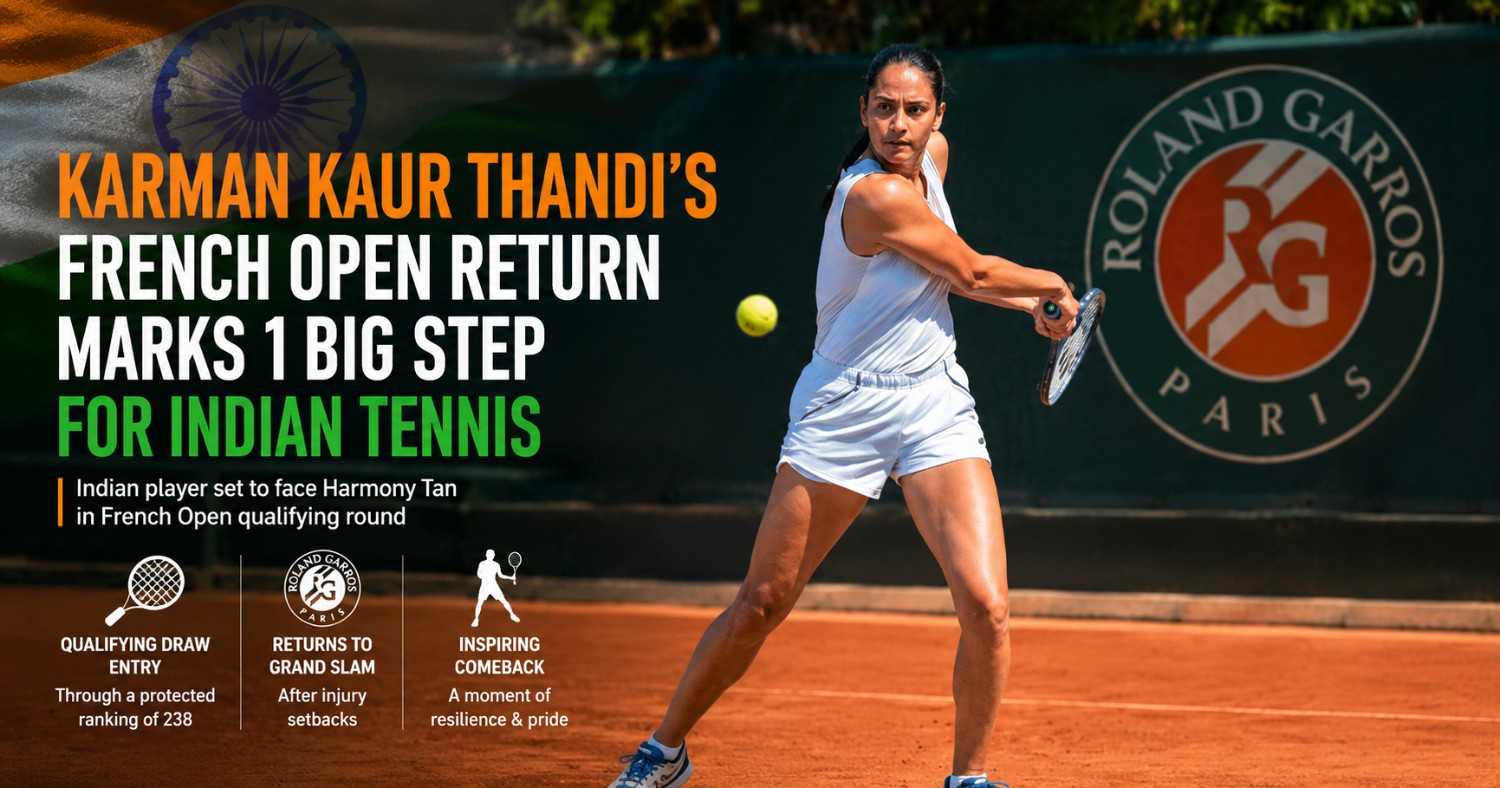
Indian tennis player Karman Kaur Thandi is set to return to Grand Slam competition after securing a place in the women’s singles qualifying draw at the French Open, marking an important moment not only in her own comeback journey but also for Indian tennis on the international stage.
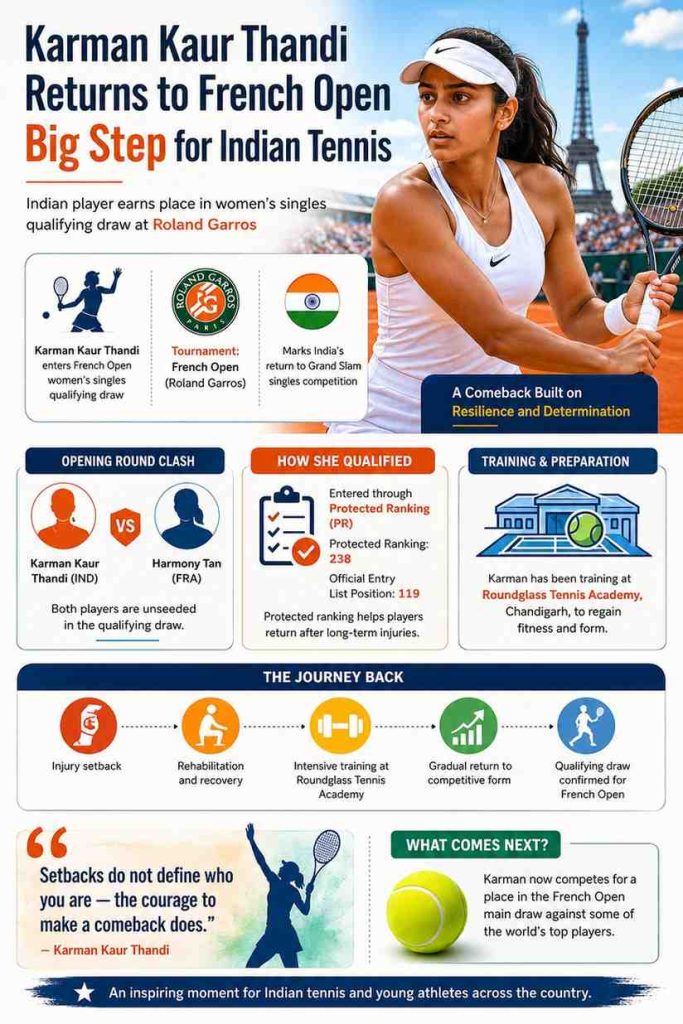
The Chandigarh-born player will face France’s Harmony Tan in the opening round of the qualifiers at French Open in Paris. Both players enter the qualifying competition unseeded, adding an element of unpredictability to the contest as they compete for a coveted place in the main draw at Roland Garros.
For Karman, however, the significance of the occasion extends far beyond a single qualifying match. Her presence in the draw represents the culmination of a long and demanding recovery process after injury setbacks interrupted her career momentum. It also signals India’s renewed representation in Grand Slam singles competition after a period of absence.
The 26-year-old earned her place in the qualifying field through a protected ranking of 238. The protected ranking system, used in professional tennis, allows players who have been sidelined for extended periods because of injury to enter tournaments based on their previous ranking position rather than their current ranking. This mechanism is considered critical in helping injured athletes resume competition without losing access to high-level events entirely.
Because of her protected ranking, Karman was positioned 119th on the official entry list for the qualifying competition. The development has been welcomed across Indian tennis circles, especially at a time when the country continues to search for greater consistency in singles tennis at the global level.
Indian tennis has historically enjoyed stronger visibility in doubles competitions, with players such as Leander Paes, Mahesh Bhupathi, and Sania Mirza achieving notable success on the international circuit. However, sustained representation in Grand Slam singles draws has remained relatively limited in recent years.
Karman’s return therefore carries broader symbolic importance. While qualifying rounds remain highly competitive and difficult to navigate, her participation itself reflects resilience and the gradual rebuilding of competitive depth in Indian women’s tennis.
Currently training at the Roundglass Tennis Academy in Chandigarh, Karman has spent months working on fitness recovery, conditioning, and match readiness. Coaches and support staff at the academy have closely monitored her return process as she attempted to regain both physical rhythm and competitive sharpness.
Athletes returning from long-term injuries often face challenges that go beyond physical rehabilitation. The transition back into elite competition requires rebuilding confidence, adapting to the intensity of professional matches, and managing the psychological pressure associated with returning to major tournaments.
Karman acknowledged the emotional significance of the moment after the release of the qualifying draw.
“Roland Garros, for me, is a reminder that setbacks do not define who you are — the courage to make a comeback does,” she said. “I am proud to represent India on one of the biggest stages in the world. Every player dreams of moments like these. I am stepping onto the courts at Roland Garros with purpose, gratitude, and confidence.”
Her comments reflected the difficult path many professional athletes face after injuries disrupt their careers. In modern tennis, where the tour schedule is physically demanding and rankings can fluctuate rapidly, extended injury breaks often place players at a competitive disadvantage. Protected rankings help create opportunities for return, but players must still perform under intense pressure once they re-enter competition.
Karman further described the comeback as one of the most meaningful phases of her career.
“Returning from injury and competing again at this level makes this journey even more special. It proves that perseverance and belief can take you back to where you truly belong,” she added.
The French Open qualifiers traditionally feature a mix of rising talents, experienced tour players, and returning competitors attempting to secure places in the main tournament draw. Matches in qualifying rounds are often fiercely contested because only a limited number of players advance into the main competition.
For Indian tennis followers, Karman’s participation provides renewed interest in singles competition at the Grand Slam level. India has periodically produced talented singles players, but maintaining consistent representation in major tournaments has remained a challenge due to factors including infrastructure gaps, limited exposure to international clay-court competition, injury management, and the financial demands of the professional circuit.
Clay courts, the surface used at Roland Garros, present a unique challenge for many players. The slower surface requires endurance, patience, tactical consistency, and strong movement. Indian players have historically had fewer opportunities to regularly train and compete on clay compared to athletes from Europe and parts of South America, where clay-court tennis is more deeply embedded in development systems.
Despite these challenges, Indian women’s tennis has continued to witness gradual progress through younger athletes and structured academy-based training programs. Sports academies in cities such as Chandigarh, Bengaluru, and Pune have increasingly focused on long-term athlete development, sports science support, and international exposure.
The Roundglass Tennis Academy described Karman’s return as an inspiring moment for Indian tennis and expressed confidence in her determination heading into the tournament. The academy has been involved in supporting player development pathways and creating high-performance training environments for emerging athletes.
Beyond the immediate tournament implications, Karman’s comeback story also resonates with younger athletes navigating setbacks in competitive sports. Injuries frequently test careers at every level of professional athletics, and successful returns often require prolonged discipline away from public attention.
Sports psychologists and performance experts regularly note that recovery periods can become mentally exhausting because athletes must balance uncertainty about future performance with the demands of rehabilitation. The ability to regain confidence after injury is often viewed as equally important as physical recovery itself.
Karman’s return to Roland Garros therefore represents more than a ranking-based entry into a qualifying event. It reflects persistence through rehabilitation, competitive resilience, and the willingness to restart at one of the sport’s most demanding stages.
Her opening-round opponent, Harmony Tan, also brings experience at the international level. The French player is expected to receive local support during the qualifiers, adding another layer of intensity to the contest. Tan has previously demonstrated the ability to compete effectively against higher-ranked opponents, making the match a significant early test for Karman’s comeback campaign.
The French Open remains one of the four Grand Slam tournaments in global tennis and is widely regarded as one of the sport’s most physically demanding events because of its clay-court conditions. Success at Roland Garros often requires exceptional endurance, strategic consistency, and mental resilience over extended rallies.
For Indian tennis administrators and supporters, moments such as these also underline the importance of long-term investment in athlete development. Building sustainable success in singles competition requires not only talent identification but also access to coaching, physiotherapy, nutrition support, international tournament exposure, and injury management systems.
As Indian sports increasingly expand beyond cricket into disciplines such as badminton, athletics, wrestling, and tennis, athletes like Karman Kaur Thandi continue to play an important role in inspiring participation and visibility for emerging players.
Whether or not she progresses deep into the qualifying rounds, her return to Grand Slam competition already marks a significant personal milestone and an encouraging moment for Indian tennis. At Roland Garros, the focus will now shift from recovery to performance as Karman attempts to translate months of rehabilitation and preparation into success on one of tennis’s biggest stages.
Highlights
- Karman Kaur Thandi has entered the French Open women’s singles qualifying draw through a protected ranking.
- She will face Harmony Tan in the opening round at Roland Garros.
- Karman’s return follows a lengthy injury recovery period and marks India’s renewed presence in Grand Slam singles competition.
- The Indian player has been training at the Roundglass Tennis Academy ahead of the tournament.
- The protected ranking system helped Karman regain access to elite-level competition after injury setbacks.
- Her comeback is being viewed as an encouraging moment for Indian women’s tennis and aspiring young athletes.
FAQ
What is the significance of Karman Kaur Thandi qualifying for the French Open draw?
Karman’s entry into the French Open qualifying rounds marks her return to Grand Slam competition after injury and also ends India’s absence from Grand Slam singles participation.
Who will Karman Kaur Thandi play in the first qualifying round?
She is scheduled to face French player Harmony Tan in the opening round of the qualifiers.
How did Karman secure entry into the qualifiers?
She entered the tournament through a protected ranking, which allows injured players to participate in tournaments using their previous ranking position.
What is a protected ranking in tennis?
A protected ranking is a system used by professional tennis tours to help players returning from long-term injuries regain access to tournaments without being severely affected by ranking drops during their absence.
Why is this comeback important for Indian tennis?
India has had limited representation in Grand Slam singles events in recent years. Karman’s return highlights renewed visibility for Indian women’s singles tennis on the international stage.
Where has Karman Kaur Thandi been training?
She has been training at the Roundglass Tennis Academy in Chandigarh.
Why is the French Open considered challenging?
The tournament is played on clay courts, which demand greater endurance, longer rallies, and strong movement compared to faster court surfaces.
What broader challenges do Indian singles players face internationally?
Indian players often face challenges related to limited clay-court exposure, injuries, international competition schedules, and the financial demands of the professional circuit.
Inputs and images : Hindusthan Samachar
Edited By E. Devanshi varma
Also Read: Assam Assembly Polls See 7 Major Highlights as Turnout Peaks, Counting Set for May 4
Follow us on Google News: Click Here