

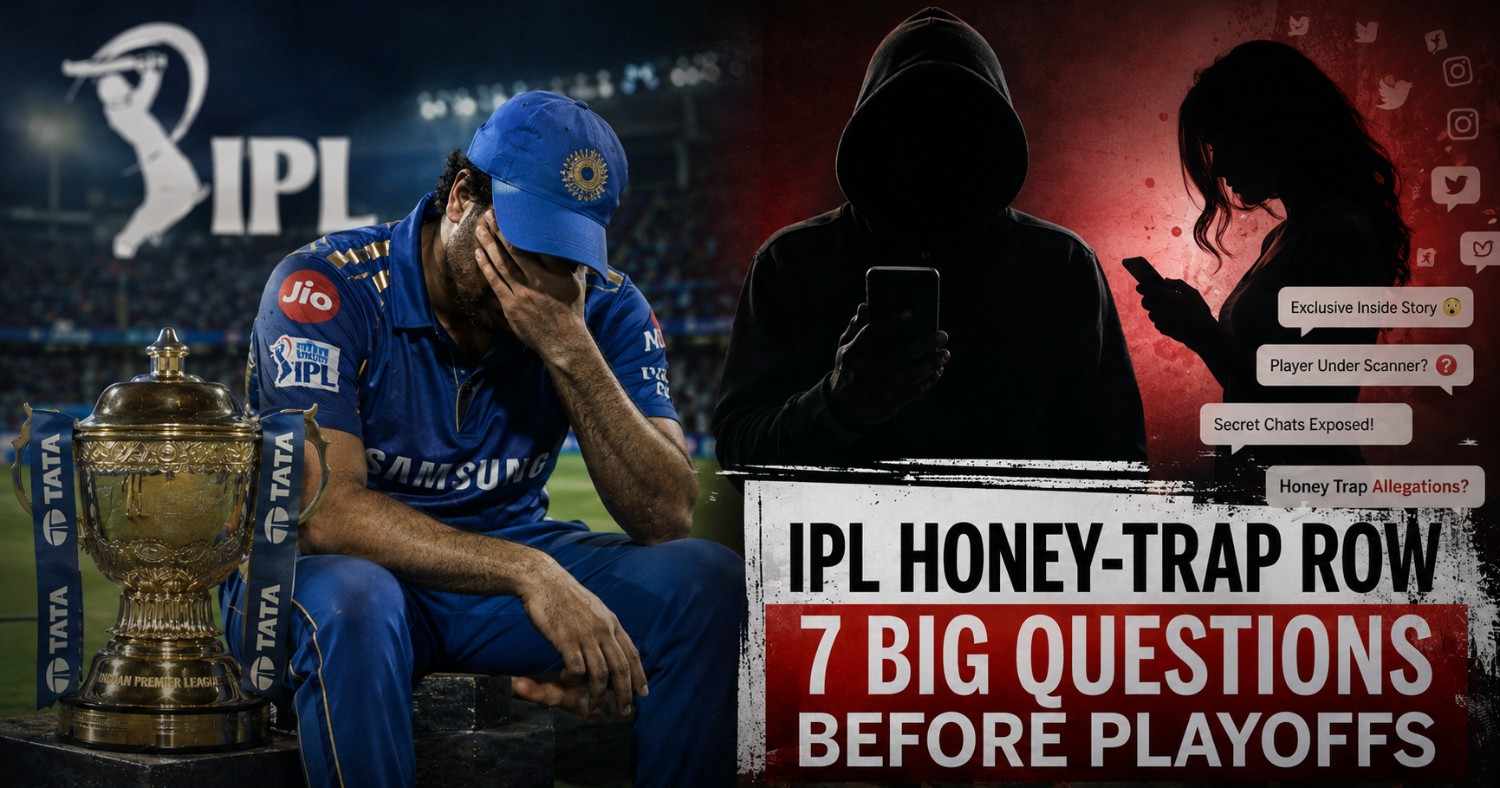
As the Indian Premier League enters its decisive playoff phase, discussions around team combinations, player fitness, and tactical battles are no longer dominating the cricket conversation alone. A parallel debate — popularly described online as the “IPL honey-trap controversy” — has rapidly gained traction across social media platforms, fan forums, and sports commentary spaces, creating an unusual distraction during one of the tournament’s most sensitive moments.
While no formal investigation or official allegation has been publicly confirmed by the league authorities, the growing online narrative has exposed the increasingly complicated intersection between celebrity culture, digital influence, player privacy, and the intense ecosystem surrounding modern franchise cricket.
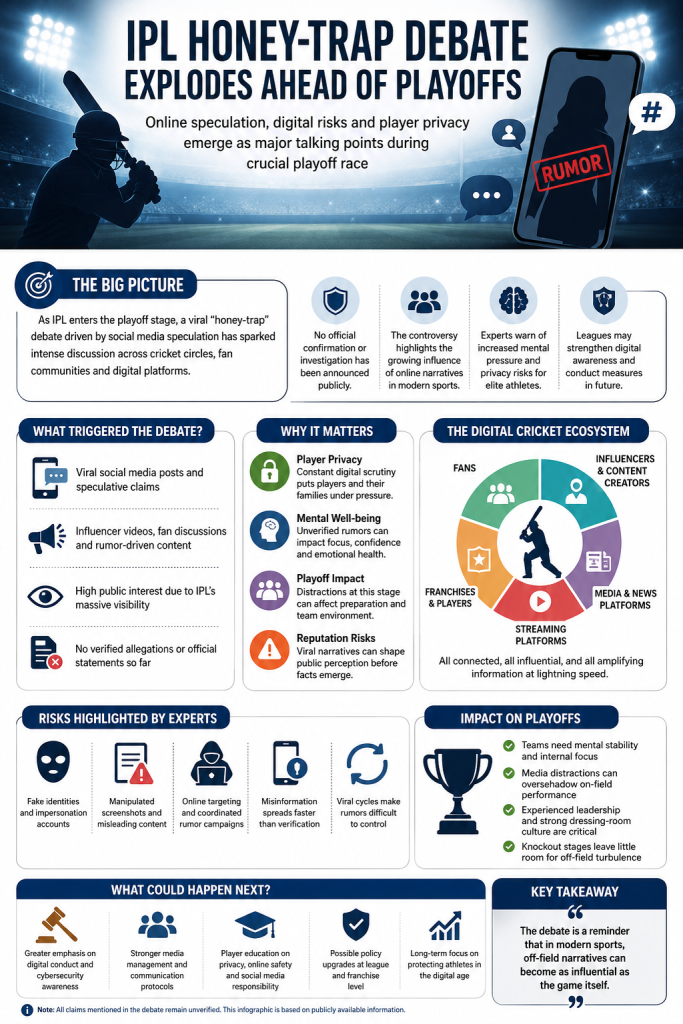
The controversy, amplified by speculative social media posts, anonymous online claims, and viral commentary videos, has triggered questions about player vulnerability, digital misinformation, reputational risks, and the broader pressures associated with high-profile sporting tournaments.
The timing of the debate has made it especially significant. With playoff qualification battles reaching their peak and public scrutiny intensifying around star players and franchises, even unverified narratives can influence public perception and dominate news cycles for days.
Social Media’s Expanding Influence on Sports Narratives
The IPL has always existed beyond cricket. Over the years, it has evolved into a massive entertainment ecosystem involving celebrities, influencers, advertisers, streaming platforms, betting concerns, fan armies, and online engagement communities.
In this environment, controversies — whether verified or speculative — often spread at extraordinary speed.
The recent “honey-trap” discussion appears to have emerged largely from viral online speculation rather than official disclosures. Yet the scale of attention highlights how digital platforms now shape sports narratives almost as powerfully as on-field performances.
Sports analysts note that players today operate under constant digital surveillance. Every public appearance, interaction, social media activity, or personal association can quickly become the subject of interpretation, misinformation, or coordinated online speculation.
This environment creates challenges not only for athletes but also for franchises attempting to maintain focus during critical tournament stages.
Why the Debate Has Gained Massive Attention
Several factors have contributed to the controversy becoming a major talking point ahead of the playoffs.
First, the IPL’s enormous visibility means any trending narrative connected to players or franchises can rapidly enter mainstream discussion. The tournament attracts millions of viewers daily, and online fan communities remain active around the clock.
Second, the term “honey-trap” itself carries sensational associations in public discourse. Historically, the phrase has been linked to manipulation, personal targeting, blackmail allegations, or covert influence operations. Even when used casually online, the phrase tends to generate immediate public curiosity and emotional reactions.
Third, the rise of short-form content platforms has intensified the spread of partially verified information. Viral clips, edited screenshots, speculative commentary, and rumor-driven discussions often circulate faster than factual clarification.
Media observers say this creates a difficult environment where reputational narratives can develop long before official verification becomes available.
Concerns Over Player Privacy and Mental Pressure
Former cricketers and sports psychologists have repeatedly highlighted the growing mental burden associated with elite-level franchise cricket.
Modern IPL players deal not only with competitive pressure but also with nonstop public attention, brand obligations, digital scrutiny, and social media commentary. The rise of speculative controversies further complicates that environment.
Even when allegations remain unverified, widespread online discussion can create reputational pressure and emotional stress for players and their families.
Mental conditioning experts associated with professional sports have increasingly emphasized the importance of digital discipline, media management, and emotional support systems for athletes participating in global tournaments.
Several franchises have already strengthened their internal media protocols over the past few years, especially after repeated incidents involving online trolling, fake news, impersonation accounts, and manipulated content targeting players.
The current debate may further encourage teams to tighten communication management during high-pressure tournament phases.
The Role of Influencer Culture Around Cricket
One major reason controversies escalate quickly today is the expanding overlap between sports and influencer culture.
The IPL is no longer limited to traditional sports coverage. Influencers, independent content creators, gossip pages, livestream commentators, and entertainment-focused accounts now contribute heavily to cricket discourse.
This ecosystem rewards engagement, virality, and speed — often ahead of verification.
As a result, rumors can gain millions of impressions within hours, particularly when they involve celebrity players or emotionally charged themes.
Media researchers say the challenge for audiences is distinguishing between verified reporting and engagement-driven speculation. The line between entertainment commentary and factual journalism has become increasingly blurred on digital platforms.
The current controversy reflects that larger transformation in sports media consumption.
Could the League Introduce Stronger Digital Conduct Measures?
Although the IPL already operates under strict anti-corruption and player conduct frameworks, the latest debate may renew conversations around digital risk management.
Sports governance experts believe leagues across the world are being forced to adapt to new forms of reputational and cyber-related vulnerabilities.
These include:
- fake identity interactions
- impersonation scams
- privacy breaches
- manipulated media content
- online targeting campaigns
- social engineering tactics
- misinformation networks
Professional sports organizations globally have started investing more heavily in cybersecurity awareness and digital literacy programs for athletes.
In India, where cricket commands unmatched emotional and commercial influence, such concerns are becoming increasingly important.
If online controversies continue affecting tournament narratives, franchises and league administrators may eventually consider more structured digital awareness programs for players and support staff.
Impact on Teams Ahead of Knockout Matches
The timing of any controversy matters significantly in elite sports.
The IPL playoffs represent the highest-pressure stage of the tournament, where strategic clarity, mental composure, and dressing-room stability become critical factors.
Even external distractions can affect preparation cycles, media interactions, and public focus.
Franchises typically attempt to shield players from unnecessary controversies during knockout stages. However, in the social media era, completely avoiding digital narratives has become nearly impossible.
Public attention surrounding off-field developments can sometimes overshadow tactical discussions, team performances, and player achievements.
Analysts believe teams with experienced leadership groups and stable dressing-room environments are generally better equipped to handle such distractions.
The ability to maintain internal focus despite external noise often becomes an underrated factor in tournament success.
A Larger Reflection of the Modern Sports Ecosystem
Beyond the immediate controversy, the episode reflects a broader transformation in global sports culture.
Modern athletes operate within a nonstop digital ecosystem where entertainment, celebrity culture, public relations, online fandom, and commercial branding intersect constantly.
Cricket tournaments are no longer just sporting competitions; they are media events shaped by algorithms, viral engagement, and public perception cycles.
This creates both opportunities and risks.
While digital platforms help leagues expand audiences and fan participation, they also increase the spread of misinformation, speculation, and reputational volatility.
For journalism organizations, the challenge remains balancing public interest with responsible reporting standards. For fans, the challenge is separating verified developments from rumor-driven narratives.
As the IPL playoffs approach, attention will ultimately return to performances on the field. Yet the latest debate serves as another reminder that in modern sports, off-field narratives can become almost as influential as the game itself.
Highlights
- IPL playoff discussions have been overshadowed by a rapidly spreading online “honey-trap” debate involving speculation around players and franchises.
- No official confirmation or formal investigation has been publicly announced by league authorities regarding the viral claims.
- The controversy highlights the growing influence of social media narratives in modern cricket ecosystems.
- Experts say elite athletes now face increasing pressure from nonstop digital scrutiny and online speculation.
- The episode has renewed conversations around player privacy, misinformation risks, and digital conduct awareness in sports.
- Analysts believe experienced teams may be better equipped to manage off-field distractions during high-pressure playoff matches.
FAQs
What is the IPL honey-trap debate?
The debate refers to viral online speculation and discussions circulating around players and the IPL ecosystem ahead of the playoffs. Much of the conversation has emerged through social media rather than official disclosures.
Has the IPL officially confirmed any allegations?
As of now, there has been no official public confirmation from IPL authorities regarding the claims circulating online.
Why has the controversy gained so much attention?
The IPL’s massive popularity, combined with social media amplification and celebrity-driven interest, has helped the discussion spread rapidly.
Could this affect playoff teams?
While direct impact is difficult to measure, off-field controversies can create distractions during crucial tournament phases where mental focus is important.
Why are social media rumors significant in sports today?
Modern sports audiences consume information rapidly through digital platforms, where speculation can trend before official verification is available.
Are sports leagues increasing digital awareness measures?
Many global sports organizations have expanded cybersecurity, media management, and digital literacy programs to protect athletes from online risks.
What challenges do players face beyond cricket?
Apart from performance pressure, players often deal with public scrutiny, trolling, misinformation, privacy concerns, and nonstop media attention.
Could the controversy lead to policy discussions?
Experts believe recurring digital controversies may encourage leagues and franchises to strengthen awareness programs related to online conduct and reputational risks.
Edited By E. Devanshi varma
Also Read: Assam Assembly Polls See 7 Major Highlights as Turnout Peaks, Counting Set for May 4
Follow us on Google News: Click Here